Navigating 2026 CMS Reimbursement for AI Diagnostics: A MedTech Guide

The New 2026 CMS Reimbursement Codes for AI-Powered Diagnostics: What MedTech Needs to Know Now
The convergence of artificial intelligence (AI) and medical diagnostics is reshaping the future of healthcare. AI-powered diagnostic tools promise to enhance accuracy, expedite diagnoses, and personalize treatment pathways, ultimately leading to improved patient outcomes. However, innovation in MedTech often outpaces regulatory and reimbursement frameworks. For companies developing these cutting-edge solutions, understanding the labyrinthine world of healthcare reimbursement, particularly from the Centers for Medicare & Medicaid Services (CMS), is not just important – it’s critical for market access and sustained growth.
The year 2026 is poised to be a pivotal moment for AI-powered diagnostics, with significant updates expected in CMS reimbursement codes. These changes will fundamentally alter how MedTech companies commercialize their AI innovations. This comprehensive guide delves into the anticipated 2026 CMS reimbursement landscape for AI diagnostic solutions, providing MedTech stakeholders with the essential knowledge to prepare, adapt, and thrive.
Why 2026 is a Crucial Year for AI Diagnostic Reimbursement
The healthcare reimbursement system, especially under CMS, is designed to evaluate and compensate for medical services and technologies that demonstrate clinical utility and cost-effectiveness. Historically, new and disruptive technologies, like AI, face challenges in fitting into existing coding structures. This often leads to delays in adoption and financial hurdles for innovators.
Recognizing the transformative potential of AI in healthcare, CMS has been actively exploring mechanisms to accommodate these advancements. The expected changes in 2026 are not merely incremental adjustments; they represent a concerted effort to create clearer pathways for AI diagnostic reimbursement. These updates are a direct response to the rapid development and deployment of AI in areas such as radiology, pathology, ophthalmology, and cardiology, where AI algorithms are proving invaluable in detecting subtle disease patterns, predicting risks, and assisting clinical decision-making.
For MedTech companies, the 2026 updates will dictate whether their AI diagnostic solutions can achieve broad market penetration and financial viability. Without appropriate reimbursement, even the most revolutionary technologies struggle to gain traction among healthcare providers who rely on predictable payment models. Therefore, a proactive understanding of these changes is paramount.
Understanding the Current Reimbursement Landscape for AI
Before diving into the specifics of 2026, it’s essential to grasp the current mechanisms for AI diagnostic reimbursement. Currently, AI-powered diagnostics often rely on existing CPT (Current Procedural Terminology) codes, which may not fully capture the unique value proposition or complexity of AI services. This can lead to under-reimbursement or a lack of specific codes, forcing companies to seek alternative, often less predictable, reimbursement avenues.
Existing CPT Codes and Their Limitations
Many AI diagnostic tools are currently billed under ‘unlisted procedure’ codes or codes for the underlying imaging or pathology service with an add-on modifier. While this provides a temporary solution, it presents several limitations:
- Lack of Specificity: Unlisted codes offer little specificity, making it difficult for payers to understand the exact service being rendered and its value.
- Reimbursement Uncertainty: Payment for unlisted codes can be inconsistent and often lower than what a dedicated code would provide.
- Administrative Burden: Providers face increased administrative burden in justifying the use of unlisted codes.
- Limited Data Collection: Without specific codes, CMS and other payers cannot effectively collect data on the utilization and outcomes of AI diagnostics, hindering future policy development.
Alternative Pathways: New Technology Add-on Payments (NTAP) and Transitional Pass-Through Payments (TPP)
Some innovative AI diagnostics have leveraged programs like NTAP for inpatient settings or TPP for outpatient settings. These mechanisms provide temporary additional payments for new technologies that meet specific criteria, such as being new, substantially improved, and demonstrating a substantial clinical improvement over existing technologies. While beneficial, these are temporary solutions and do not provide long-term reimbursement stability.
Anticipated Changes in 2026 CMS Reimbursement Codes for AI Diagnostics
The MedTech industry is eagerly awaiting the 2026 updates, which are expected to introduce more specific and appropriate reimbursement codes for AI diagnostic solutions. While the final details are yet to be fully revealed, several trends and proposals indicate the direction CMS is likely to take.
Emergence of New CPT Codes Specific to AI
The most significant expectation is the introduction of new CPT codes specifically designed for AI-powered diagnostic services. These codes could categorize AI applications based on their function (e.g., AI-assisted image analysis, AI-powered predictive analytics, AI-driven diagnostic interpretation) or the medical specialty they serve. Such codes would provide clarity, consistency, and a more accurate valuation of AI’s contribution to patient care.
MedTech companies should monitor the CPT Editorial Panel’s activities closely. The panel is responsible for maintaining the CPT code set and has been increasingly engaging with AI developers to understand their technologies and propose suitable coding solutions. Early engagement with these bodies can influence the development of codes that accurately reflect the value of your specific AI diagnostic solution.
Value-Based Reimbursement Models
CMS is continually moving towards value-based care models, where reimbursement is tied to patient outcomes and quality of care rather than just the volume of services. AI diagnostics are uniquely positioned to demonstrate value by improving diagnostic accuracy, reducing unnecessary procedures, and enabling earlier interventions. The 2026 framework might integrate AI diagnostics more explicitly into these value-based models, offering incentives for technologies that can prove their impact on clinical effectiveness and cost savings.
Companies should begin collecting robust real-world evidence (RWE) demonstrating the clinical and economic value of their AI solutions. This data will be crucial for negotiating favorable reimbursement rates under value-based agreements.
Bundled Payments and AI Integration
Another potential development is the inclusion of AI diagnostics within bundled payment models. In these models, a single payment covers all services related to a specific episode of care (e.g., a surgical procedure or a chronic disease management program). If AI diagnostics can demonstrate their ability to optimize care pathways within these bundles – for instance, by improving patient selection for procedures or preventing complications – they could become an integral, reimbursable component.
This approach would require MedTech companies to understand the entire care continuum and demonstrate how their AI solution contributes to the overall efficiency and effectiveness of the bundled service.
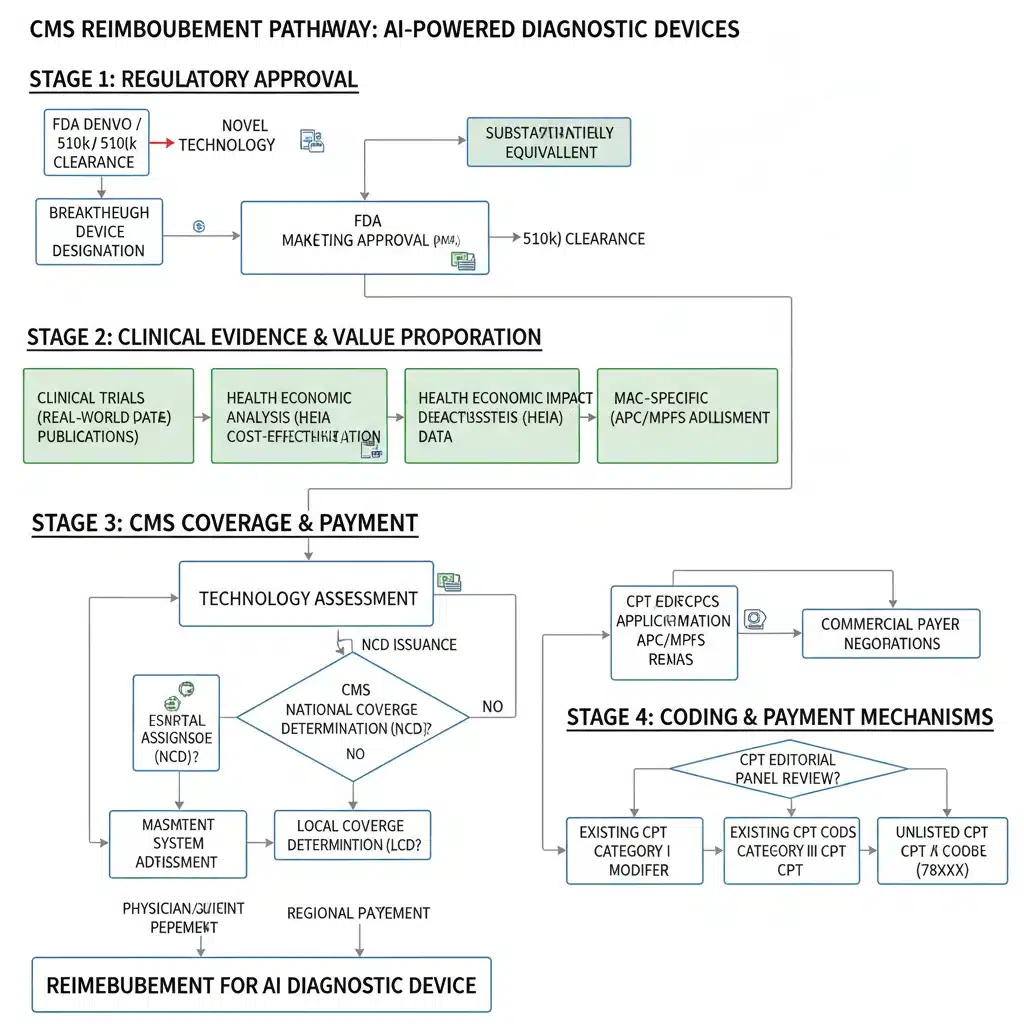
Key Strategies for MedTech Companies to Prepare for 2026
The impending changes demand a strategic and proactive approach from MedTech companies. Waiting until 2026 to react will put companies at a significant disadvantage. Here are key strategies to consider:
1. Engage Early with Regulatory and Reimbursement Bodies
Do not underestimate the power of early engagement. MedTech companies should actively participate in discussions with CMS, the CPT Editorial Panel, and other relevant regulatory bodies. Providing input on proposed coding structures and reimbursement policies can help shape a framework that is favorable to your technology. This includes submitting comments on proposed rules and participating in stakeholder meetings.
2. Build Robust Clinical and Economic Evidence
Reimbursement decisions are increasingly evidence-based. Companies must invest in generating high-quality clinical evidence demonstrating the efficacy, safety, and clinical utility of their AI diagnostic solutions. Beyond clinical outcomes, it is equally important to demonstrate economic value – how your AI solution reduces costs, improves efficiency, or prevents more expensive interventions. This includes:
- Randomized Controlled Trials (RCTs): The gold standard for clinical evidence.
- Real-World Evidence (RWE): Data gathered from routine clinical practice, showing how the AI performs in diverse patient populations and settings.
- Health Economics and Outcomes Research (HEOR): Studies that quantify the cost-effectiveness and budget impact of your AI diagnostic.
This evidence will be crucial not only for gaining regulatory approval but also for justifying appropriate reimbursement rates and demonstrating value to payers.
3. Understand the Nuances of Coding and Billing
Even with new codes, the intricacies of medical coding and billing remain complex. MedTech companies should work closely with coding experts and healthcare providers to understand how their AI diagnostic will be integrated into existing workflows and billing systems. This includes:
- CPT Code Application: Ensuring your technology aligns with the definitions and guidelines of new CPT codes.
- Modifier Usage: Understanding when and how to use modifiers to accurately describe the service rendered.
- Place of Service Codes: Knowing whether your AI diagnostic will be used in an inpatient, outpatient, or physician office setting, as this impacts reimbursement.
- Provider Education: Developing educational materials for healthcare providers on how to correctly code and bill for your AI solution.
4. Develop a Comprehensive Market Access Strategy
Reimbursement is a critical component of market access, but it’s not the only one. A holistic market access strategy also includes regulatory affairs (FDA approval), commercialization plans, and payer engagement. Companies should:
- Identify Key Stakeholders: Understand who the decision-makers are within CMS, private payers, and healthcare systems.
- Payer Engagement: Initiate early dialogue with private payers to understand their coverage policies and demonstrate the value of your AI diagnostic.
- Pricing Strategy: Develop a pricing strategy that reflects the value of your technology while remaining competitive and acceptable to payers.
- Distribution Channels: Determine the most effective channels for bringing your AI diagnostic to market, considering the reimbursement landscape.
5. Invest in Post-Market Surveillance and Data Collection
The journey doesn’t end with initial reimbursement. CMS and other payers are increasingly interested in the long-term performance and impact of new technologies. Companies should establish robust post-market surveillance programs to continuously collect data on their AI diagnostic’s real-world performance, patient outcomes, and economic impact. This data can be used to:
- Support future reimbursement adjustments: Demonstrate ongoing value to advocate for favorable payment rates.
- Address payer concerns: Proactively respond to questions about clinical utility and cost-effectiveness.
- Refine product development: Use real-world insights to improve your AI solution.
Challenges and Considerations
While the 2026 changes offer promising opportunities, MedTech companies must also be prepared for potential challenges.
Defining ‘AI-Powered Diagnostic’
One ongoing challenge is the precise definition of what constitutes an ‘AI-powered diagnostic’ for reimbursement purposes. Does it include AI-assisted tools that augment human interpretation, or only those that provide autonomous diagnoses? Clarity on this definition will be crucial for accurate coding and reimbursement.
Data Privacy and Security
AI diagnostics often rely on vast amounts of patient data. Ensuring the privacy and security of this data is paramount. Compliance with HIPAA and other data protection regulations will be a critical factor in gaining trust from providers and payers, and any breaches could impact reimbursement eligibility and market acceptance.
Scalability and Integration
For AI diagnostics to be widely adopted and reimbursed, they must be easily scalable and seamlessly integrated into existing healthcare IT infrastructure. Solutions that require extensive IT overhauls or complex workflows may face resistance, regardless of their clinical efficacy. MedTech companies should prioritize interoperability and user-friendliness in their product development.
Ethical Considerations and Bias
The ethical implications of AI in healthcare, including potential biases in algorithms, are under increasing scrutiny. Reimbursement policies may eventually incorporate considerations related to equitable access and the avoidance of algorithmic bias. Companies must proactively address these concerns in their development and validation processes.

The Future of AI Diagnostic Reimbursement Beyond 2026
The 2026 CMS reimbursement codes are not the final word but rather a significant step in an evolving landscape. The rapid pace of AI innovation means that reimbursement frameworks will need to be flexible and adaptable. MedTech companies should view these changes as an ongoing journey, continuously engaging with stakeholders and adapting their strategies.
Looking further ahead, we might see even more sophisticated reimbursement models that account for the dynamic and learning capabilities of AI. For instance, ‘performance-based’ or ‘subscription-based’ reimbursement models could emerge for AI diagnostics that continually improve their accuracy and utility over time. The emphasis will increasingly be on demonstrating sustained value and impact on population health.
The collaborative effort between MedTech innovators, healthcare providers, regulatory bodies, and payers will be essential to create a sustainable ecosystem where groundbreaking AI diagnostic technologies can flourish and deliver their full potential to patients.
Conclusion
The New 2026 CMS Reimbursement Codes for AI-Powered Diagnostics represent a critical inflection point for the MedTech industry. These anticipated changes offer both immense opportunities and significant challenges. By proactively engaging with regulatory bodies, building robust evidence, developing comprehensive market access strategies, and understanding the evolving reimbursement landscape, MedTech companies can position themselves for success.
The future of healthcare is undeniably intertwined with AI. Companies that can effectively navigate the complexities of AI diagnostic reimbursement will not only secure their own financial viability but also play a pivotal role in accelerating the adoption of transformative technologies that promise to revolutionize patient care worldwide. The time to prepare is now.