Unlock 2026 Medicare Savings: Up To $7,000 Annually in Benefits

Unlock 2026 Medicare Savings: Up To $7,000 Annually in Benefits
As we approach 2026, many Medicare beneficiaries are looking for ways to manage their healthcare costs more effectively. The good news is that the Medicare Savings Programs (MSPs) offer a powerful solution, potentially saving eligible individuals up to $7,000 annually on premiums, deductibles, and co-payments. Understanding these vital programs is crucial for maximizing your healthcare budget and ensuring access to the care you need. This comprehensive guide will delve into the intricacies of the medicare savings 2026 programs, outlining who qualifies, what benefits they offer, and how to navigate the application process.
Understanding Medicare Savings Programs (MSPs)
Medicare Savings Programs (MSPs) are state-administered programs designed to help low-income Medicare beneficiaries pay for some or all of their Medicare premiums, deductibles, co-insurance, and co-payments. These programs are often overlooked, yet they can provide substantial financial relief, making healthcare more affordable and accessible. The benefits of MSPs extend beyond just monetary savings; they can also automatically qualify you for Extra Help, a program that assists with prescription drug costs.
Why Are Medicare Savings Programs So Important for 2026?
Healthcare costs continue to rise, and for many seniors and individuals with disabilities on fixed incomes, these expenses can be a significant burden. The medicare savings 2026 programs are more critical than ever in helping beneficiaries maintain their health without compromising their financial stability. With potential savings reaching up to $7,000 per year, these programs can free up funds for other essential needs, improving the overall quality of life for millions.
Types of Medicare Savings Programs and Eligibility for 2026
There are four main types of Medicare Savings Programs, each with specific income and resource limits. These limits are updated annually, so it’s essential to check the most current figures for 2026. While the exact figures for 2026 are usually released closer to the end of the preceding year, we can provide estimates based on current trends and historical adjustments. It’s always best to verify with your state’s Medicaid office or Social Security Administration (SSA) for the most accurate and up-to-date information.
1. Qualified Medicare Beneficiary (QMB) Program
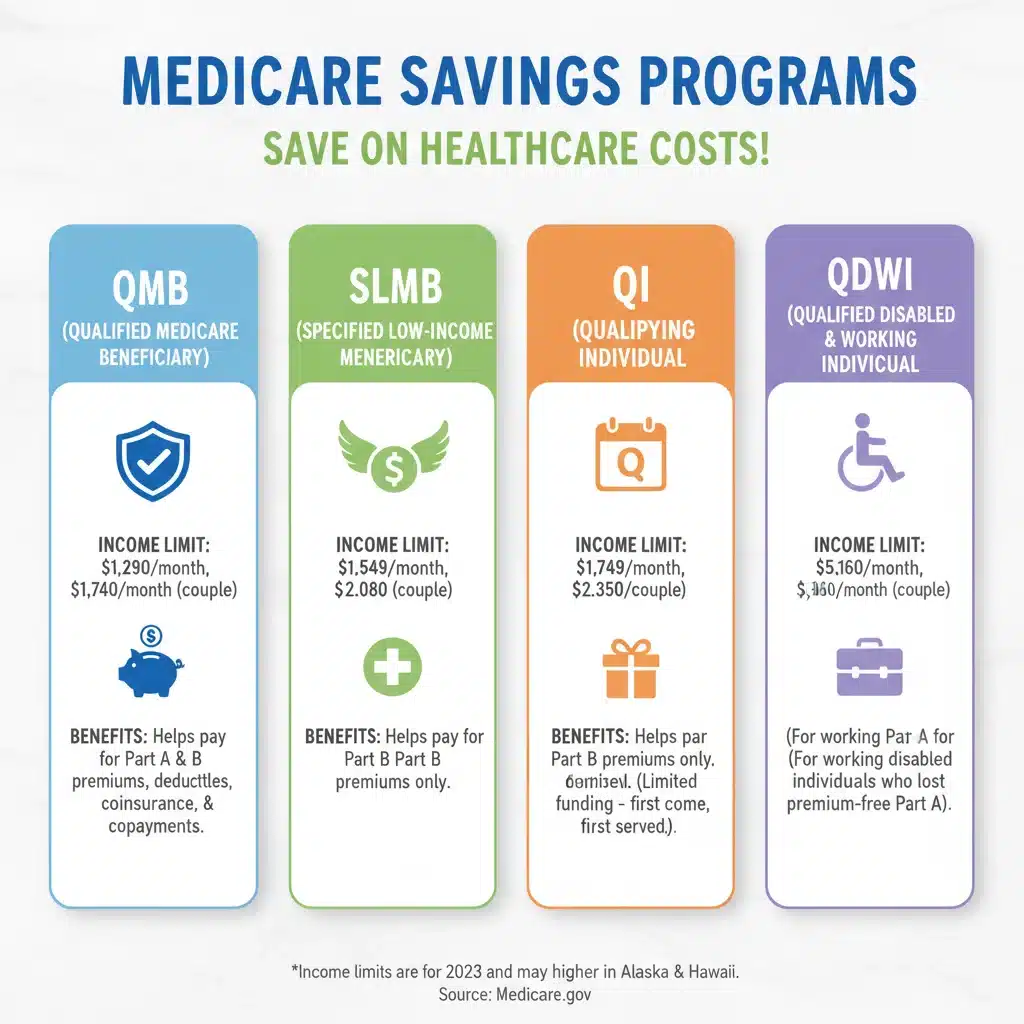
The QMB program is the most comprehensive of the MSPs. If you qualify for QMB, Medicare will cover your Medicare Part A and Part B premiums, deductibles, co-insurance, and co-payments. This means you will have virtually no out-of-pocket costs for Medicare-covered services. To be eligible for QMB in 2026, your monthly income and resources must be below certain thresholds. Typically, the income limit is around 100% of the Federal Poverty Level (FPL).
- Income Limit (Estimated for 2026): Approximately $1,280/month for individuals and $1,720/month for couples. (These are estimates and subject to change.)
- Resource Limit (Estimated for 2026): Approximately $9,430 for individuals and $14,130 for couples. (Resources include bank accounts, stocks, bonds, but generally exclude your home, one car, and burial plots.)
- Benefits: Pays for Part A and Part B premiums, deductibles, co-insurance, and co-payments.
2. Specified Low-Income Medicare Beneficiary (SLMB) Program
The SLMB program offers assistance with Medicare Part B premiums only. While it doesn’t cover deductibles or co-payments, saving on the Part B premium alone can amount to significant annual savings, especially as these premiums tend to increase each year. The income limits for SLMB are slightly higher than QMB.
- Income Limit (Estimated for 2026): Approximately 120% of the FPL, around $1,530/month for individuals and $2,060/month for couples.
- Resource Limit (Estimated for 2026): Same as QMB, approximately $9,430 for individuals and $14,130 for couples.
- Benefits: Pays for Medicare Part B premiums only.
3. Qualifying Individual (QI) Program
The QI program, like SLMB, helps pay for Medicare Part B premiums. However, its income limits are higher than SLMB. Funding for the QI program is limited and provided on a first-come, first-served basis, so it’s advisable to apply early if you believe you qualify. It’s also important to note that you cannot receive Medicaid benefits simultaneously with QI.
- Income Limit (Estimated for 2026): Approximately 135% of the FPL, around $1,720/month for individuals and $2,320/month for couples.
- Resource Limit (Estimated for 2026): Same as QMB and SLMB, approximately $9,430 for individuals and $14,130 for couples.
- Benefits: Pays for Medicare Part B premiums only.
4. Qualified Disabled and Working Individuals (QDWI) Program
The QDWI program is specifically designed for certain disabled individuals under 65 who have returned to work, lost their premium-free Medicare Part A due to earnings, but still have limited income and resources. This program helps pay for Medicare Part A premiums.
- Income Limit (Estimated for 2026): Approximately 200% of the FPL, around $2,550/month for individuals and $3,450/month for couples.
- Resource Limit (Estimated for 2026): Higher than other MSPs, approximately $4,000 for individuals and $6,000 for couples.
- Benefits: Pays for Medicare Part A premiums only.
Estimating Your Potential Savings with Medicare Savings 2026
The potential savings from participating in the medicare savings 2026 programs can be substantial. Let’s break down how these savings can add up:
- Medicare Part B Premium: In 2024, the standard Part B premium was $174.70 per month. Assuming a slight increase for 2026, this could be around $180-$190 per month. An MSP covering this premium would save you over $2,100 annually.
- Medicare Part A Premium: Most people don’t pay a Part A premium because they or their spouse paid Medicare taxes through employment for a sufficient period. However, if you do pay a Part A premium (e.g., if you have fewer than 30 quarters of Medicare-covered employment), it can be significant. In 2024, it was up to $505 per month. The QDWI program could save you over $6,000 annually if you pay this premium.
- Deductibles: In 2024, the Part A deductible was $1,632 per benefit period, and the Part B deductible was $240 per year. If you qualify for QMB, these could be covered, saving you potentially thousands more, especially if you have multiple hospital stays.
- Co-insurance and Co-payments: These vary widely based on the services you receive. For QMB beneficiaries, these out-of-pocket costs are eliminated for Medicare-covered services, which can easily add up to hundreds or even thousands of dollars over a year, especially for chronic conditions or frequent medical needs.
When you combine these potential savings – Part B premiums, deductibles, co-insurance, and co-payments – it’s easy to see how the total annual savings from medicare savings 2026 could indeed reach up to $7,000 or even more for some beneficiaries.
Automatic Enrollment in Extra Help
One of the most significant advantages of qualifying for any of the QMB, SLMB, or QI programs is the automatic enrollment in Extra Help. Extra Help is a federal program that helps pay for Medicare Part D (prescription drug plan) premiums, deductibles, and co-payments. This can result in additional savings of thousands of dollars per year on prescription medications, a crucial benefit for many seniors.
Without an MSP, applying for Extra Help involves a separate application and income/resource assessment. However, MSP beneficiaries are automatically deemed eligible, simplifying access to this critical assistance. This dual benefit underscores the importance of exploring your eligibility for medicare savings 2026.
How to Apply for Medicare Savings Programs for 2026
Applying for medicare savings 2026 is a straightforward process, though it requires gathering some documentation. The application is typically handled by your state’s Medicaid agency. Here’s a general guide to the application process:
Step 1: Gather Necessary Documents
Before you begin, collect the following information and documents:
- Proof of Identity: Driver’s license, state ID, or passport.
- Proof of Age: Birth certificate.
- Proof of U.S. Citizenship or Legal Residency: Birth certificate, naturalization certificate, or green card.
- Medicare Card: To verify your Medicare enrollment.
- Income Information: Social Security award letters, pension statements, pay stubs, tax returns, unemployment benefits, VA benefits, etc.
- Resource Information: Bank statements (checking, savings), investment statements (stocks, bonds, mutual funds), property deeds (excluding your primary residence).
- Proof of Living Expenses (sometimes required): Rent receipts, mortgage statements, utility bills.
Step 2: Contact Your State Medicaid Agency
The application for MSPs is processed through your state’s Medicaid office. You can usually find their contact information on your state’s official government website or by calling 1-800-MEDICARE (1-800-633-4227) and asking for your state’s Medicaid office contact details.
Step 3: Complete the Application Form
You may be able to apply online, by mail, or in person. The application form will ask for detailed information about your income, resources, and household. Be thorough and accurate to avoid delays.

Step 4: Submit Your Application and Supporting Documents
Submit the completed application along with all required supporting documents. Keep copies of everything you submit for your records.
Step 5: Follow Up
After submitting your application, it’s a good idea to follow up with your state Medicaid agency to ensure they received it and to check on its status. Processing times can vary by state.
Important Considerations for Medicare Savings 2026
Income and Resource Limits
It’s crucial to remember that income and resource limits are subject to change annually. Always refer to the most current guidelines published by the Centers for Medicare & Medicaid Services (CMS) or your state’s Medicaid agency for the medicare savings 2026 programs. While we provide estimates, the official figures will be the definitive guide.
Exempt Resources
When calculating resources, certain assets are typically not counted. These usually include your primary residence, one vehicle, household goods, personal effects, and burial funds up to a certain amount. Make sure you understand what counts and what doesn’t to accurately assess your eligibility.
Income Disregards
Some types of income may be disregarded when determining MSP eligibility. For instance, a portion of your earned income might not be counted. Additionally, some states have more generous income and resource limits than the federal minimums. It’s worth inquiring about any state-specific disregards or expanded eligibility criteria.
Appeals Process
If your application is denied and you believe you meet the eligibility criteria, you have the right to appeal the decision. The denial letter should provide instructions on how to initiate an appeal. Seeking assistance from a local State Health Insurance Assistance Program (SHIP) or legal aid service can be beneficial during this process.
Who Should Consider Applying for Medicare Savings Programs?
Anyone who is enrolled in Medicare Part A and/or Part B and has limited income and resources should explore the medicare savings 2026 programs. This includes:
- Seniors on fixed incomes.
- Individuals with disabilities.
- Those who have experienced a recent loss of income.
- People struggling to afford their Medicare premiums and out-of-pocket costs.
Even if you think your income might be slightly above the limits, it’s still worth applying or checking with your state Medicaid office due to potential income disregards and state-specific expanded criteria. The potential savings are too significant to ignore.
The Broader Impact of Medicare Savings Programs
Beyond the direct financial relief for individuals, MSPs play a vital role in public health. By reducing financial barriers to healthcare, these programs encourage beneficiaries to seek necessary medical attention, adhere to treatment plans, and access preventive care. This leads to better health outcomes, reduced hospitalizations, and a more sustainable healthcare system overall. The medicare savings 2026 initiatives are not just about saving money; they are about promoting health equity and well-being for vulnerable populations.
Staying Informed for 2026
As 2026 approaches, it’s crucial to stay informed about any changes to the MSPs. Here are reliable sources for updated information:
- Official Medicare Website: Medicare.gov is the official source for all Medicare-related information.
- Social Security Administration (SSA): The SSA handles certain aspects of Medicare and can provide information on MSPs.
- State Medicaid Agencies: Your state’s Medicaid office will have the most specific and up-to-date information regarding income and resource limits and the application process in your area.
- State Health Insurance Assistance Programs (SHIPs): SHIPs offer free, unbiased counseling and assistance to Medicare beneficiaries. They can help you understand your options and navigate the application process.
Common Misconceptions About Medicare Savings Programs
Many people hesitate to apply for MSPs due to common misconceptions. Let’s clarify a few:
- “It’s welfare.” MSPs are federal and state programs designed to ensure low-income Medicare beneficiaries can afford essential healthcare. They are a right for eligible individuals, not a handout.
- “The application is too complicated.” While it requires documentation, the process is manageable. Many resources, like SHIPs, are available to assist you.
- “I’ll lose my other benefits.” Qualifying for an MSP does not typically affect other benefits you may receive, such as Social Security. In fact, it often helps you qualify for additional assistance like Extra Help.
- “My income is too high.” Always check the current limits. With income disregards and state-specific rules, you might be eligible even if you think you’re not.
Conclusion: Don’t Miss Out on Medicare Savings 2026
The medicare savings 2026 programs represent a significant opportunity for eligible Medicare beneficiaries to reduce their healthcare costs by thousands of dollars annually. From covering Part B premiums to eliminating deductibles and co-payments, these programs provide a crucial financial safety net. By understanding the different types of MSPs, their eligibility requirements, and the application process, you can take proactive steps to secure your financial well-being and access the quality healthcare you deserve.
Don’t let the complexity deter you. Take the time to investigate your eligibility and apply. The potential savings of up to $7,000 per year, coupled with automatic enrollment in Extra Help for prescription drug costs, make exploring medicare savings 2026 a truly worthwhile endeavor. Reach out to your state’s Medicaid office or a SHIP counselor today to start your journey towards more affordable healthcare.