AI Regulations Healthcare 2026: MedTech Innovator’s Guide

Understanding the Latest AI Regulations in Healthcare: An Essential 2026 Educational Brief for MedTech Innovators
The landscape of healthcare is undergoing a profound transformation, driven by the rapid advancements in Artificial Intelligence (AI). From diagnostic tools to personalized treatment plans, AI promises to revolutionize patient care, enhance operational efficiency, and accelerate medical research. However, with great innovation comes the imperative for robust governance. As we step into 2026, understanding the intricate web of AI healthcare regulations is not merely a matter of compliance; it is a strategic necessity for MedTech innovators aiming to bring their groundbreaking solutions to market safely and effectively.
This comprehensive brief is designed to equip MedTech innovators, developers, and stakeholders with a deep understanding of the current and anticipated regulatory environment surrounding AI in healthcare. We will delve into the critical aspects of compliance, ethical considerations, and strategic approaches to navigate this evolving legal framework, ensuring your innovations not only meet technical excellence but also regulatory rigor.
The Evolving Landscape of AI Healthcare Regulations
The year 2026 marks a pivotal moment for AI healthcare regulations. Several key jurisdictions, including the United States, the European Union, and the United Kingdom, have been actively developing and refining their regulatory frameworks. These efforts are largely driven by the need to balance innovation with patient safety, data privacy, and ethical considerations. The dynamic nature of AI, characterized by its continuous learning capabilities and potential for bias, presents unique challenges for traditional regulatory models designed for static medical devices.
Innovators must recognize that the regulatory journey for AI-powered medical devices is fundamentally different from conventional hardware or software. It demands a holistic approach that integrates regulatory strategy from the earliest stages of product development. Ignoring or underestimating the complexity of these regulations can lead to significant delays, costly redesigns, or even market exclusion.
Key Regulatory Bodies and Their Approaches to AI
Understanding the mandates and approaches of the primary regulatory bodies is crucial for any MedTech innovator. Each jurisdiction brings its own nuances to the table, and a global strategy for AI products must account for these differences.
United States: FDA’s Evolving Guidance
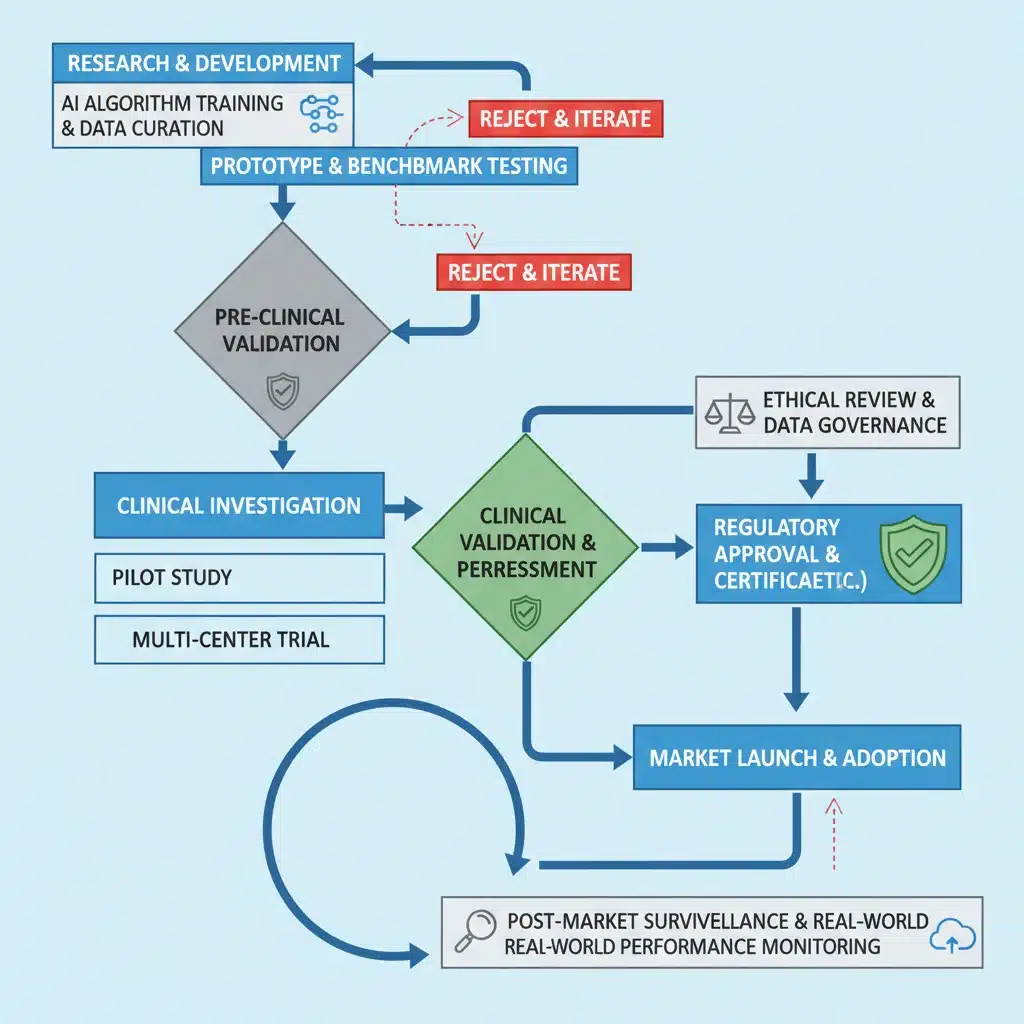
In the United States, the Food and Drug Administration (FDA) has been at the forefront of developing guidance for AI and Machine Learning (ML)-based medical devices. The FDA’s approach has focused on a ‘Total Product Lifecycle’ (TPLC) regulatory framework, emphasizing pre-market assurance and real-world performance monitoring. Key initiatives include:
- Software as a Medical Device (SaMD) Framework: Many AI algorithms fall under SaMD, requiring specific considerations for validation, risk management, and post-market surveillance.
- Predetermined Change Control Plan (PCCP): This allows for modifications to AI algorithms (e.g., performance updates, new data inputs) without requiring a new 510(k) clearance for every change, provided the changes are within the scope of the PCCP. This is particularly relevant for ‘locked’ algorithms and ‘adaptive’ or ‘continuously learning’ algorithms.
- Good Machine Learning Practice (GMLP) Principles: The FDA, in collaboration with international partners, has outlined GMLP principles that promote safe, effective, and high-quality AI/ML-enabled medical devices. These principles cover data management, model design, clinical validation, and performance monitoring.
- Real-World Performance (RWP) Monitoring: Continuous monitoring of AI device performance in real-world settings is increasingly emphasized to identify potential biases, drift, or performance degradation over time.
MedTech innovators must engage with the FDA early and often, leveraging pre-submission meetings to clarify regulatory pathways and expectations for their specific AI technologies. The emphasis on transparency, robust validation data, and a clear understanding of the algorithm’s intended use and limitations is paramount.
European Union: The AI Act and MDR/IVDR Synergy
The European Union’s regulatory landscape for AI in healthcare is shaped by two major legislative instruments: the Medical Device Regulation (MDR) and In Vitro Diagnostic Regulation (IVDR, and the groundbreaking AI Act. The AI Act, expected to be fully implemented by 2026, classifies AI systems based on their risk level, with healthcare AI predominantly falling into the ‘high-risk’ category.
- EU AI Act: High-risk AI systems in healthcare will be subject to stringent requirements, including robust risk management systems, high-quality data governance, extensive documentation, human oversight, transparency, accuracy, cybersecurity, and conformity assessments. This means a significant increase in the burden of proof for safety and effectiveness.
- MDR/IVDR: AI-powered medical devices and IVDs must also comply with the General Safety and Performance Requirements (GSPRs) of the MDR/IVDR. This includes clinical evaluation, post-market surveillance, and the involvement of Notified Bodies for conformity assessment. The interplay between the AI Act and MDR/IVDR is complex, requiring a harmonized approach to demonstrate compliance with both.
- Ethical Guidelines: The EU also places a strong emphasis on ethical AI, with guidelines focusing on human-centric AI, fairness, non-discrimination, and accountability.
Innovators targeting the EU market must be prepared for a dual-layered regulatory scrutiny. This necessitates a comprehensive strategy that addresses both medical device-specific requirements and the broader AI governance framework.
United Kingdom: Post-Brexit Regulatory Evolution
Following Brexit, the UK has been developing its own independent regulatory framework for medical devices, while also considering its approach to AI. While currently aligned with many aspects of the EU MDR, the UK’s Medicines and Healthcare products Regulatory Agency (MHRA) is forging its path, with a focus on agility and fostering innovation.
- UK Medical Devices Regulations: The new UK regulatory framework for medical devices is expected to be fully in force by 2026. Innovators will need to comply with these specific UK requirements, which may diverge from the EU MDR over time.
- AI Regulation Principles: The UK government has published principles for AI regulation, emphasizing safety, security, transparency, fairness, accountability, and contestability. While not yet a comprehensive legislative act like the EU AI Act, these principles will guide future regulatory development.
MedTech companies looking to enter the UK market must monitor these developments closely and be prepared to adapt their regulatory strategies to the evolving domestic landscape.
Critical Aspects of AI Healthcare Regulations for Innovators
Beyond understanding the jurisdictional differences, certain thematic areas are consistently emphasized across all regulatory frameworks for AI healthcare regulations. Innovators must pay particular attention to these critical aspects.
Data Governance and Quality
The adage “garbage in, garbage out” is particularly pertinent for AI. The quality, representativeness, and ethical sourcing of training data are fundamental to the performance and regulatory acceptance of AI models. Regulators are increasingly scrutinizing:
- Data Collection and Curation: How data is acquired, annotated, and prepared, ensuring it is free from biases and errors.
- Data Representativeness: Ensuring training datasets reflect the diversity of the target patient population to prevent algorithmic bias that could lead to health inequities.
- Data Privacy and Security: Compliance with regulations like GDPR, HIPAA, and other local data protection laws is non-negotiable. This includes robust anonymization, pseudonymization, and encryption techniques.
- Data Lineage and Documentation: Maintaining detailed records of data sources, transformations, and versions is crucial for auditability and transparency.
A robust data governance strategy is the bedrock of any compliant AI healthcare product.
Algorithm Transparency and Explainability (XAI)
The ‘black box’ nature of some AI algorithms, particularly deep learning models, poses significant challenges for regulatory oversight. Regulators are demanding greater transparency and explainability (XAI) to ensure that clinicians can understand how an AI arrived at a particular recommendation or diagnosis.
- Interpretability vs. Explainability: While not all algorithms need to be fully interpretable, being able to explain their outputs in a meaningful way to users (clinicians, patients) is becoming a regulatory expectation.
- Documentation of Model Design: Detailed documentation of model architecture, training parameters, feature selection, and decision logic is essential.
- Risk Management of Unintended Consequences: Identifying and mitigating risks associated with erroneous or biased AI outputs, and having clear protocols for human intervention when necessary.
Innovators should integrate XAI techniques into their development process from the outset, rather than attempting to retrofit them later.
Clinical Validation and Performance Monitoring
Rigorous clinical validation is paramount to demonstrate the safety and effectiveness of AI-powered medical devices. This extends beyond traditional clinical trials to include continuous monitoring.
- Prospective Clinical Studies: Designing studies that specifically evaluate the AI’s performance in real-world clinical settings, often comparing it against established standards of care.
- Performance Metrics: Defining appropriate and clinically relevant performance metrics (e.g., sensitivity, specificity, F1-score, AUC) and demonstrating that the AI meets predefined thresholds.
- Post-Market Surveillance (PMS): Establishing robust PMS systems to continuously monitor the AI’s performance, detect any degradation or drift, identify new biases, and ensure ongoing safety and effectiveness. This often involves real-world data collection and analysis.
- Version Control and Change Management: Managing updates and changes to AI models in a controlled manner, with clear documentation and re-validation as required by regulatory bodies.
Cybersecurity and Robustness
AI systems, especially those processing sensitive health data, are prime targets for cyberattacks. Robust cybersecurity measures are a non-negotiable component of AI healthcare regulations.
- Threat Modeling: Proactively identifying potential vulnerabilities and attack vectors throughout the AI system’s lifecycle.
- Data Protection: Implementing strong encryption, access controls, and secure data storage practices.
- Model Integrity: Protecting the AI model itself from adversarial attacks, data poisoning, or unauthorized modifications that could compromise its performance or safety.
- Resilience and Recovery: Developing plans for incident response, business continuity, and rapid recovery in the event of a cybersecurity breach.
A comprehensive cybersecurity strategy must be integrated into the design and deployment of all AI healthcare solutions.
Ethical Considerations in AI Healthcare
Beyond legal compliance, ethical considerations form a crucial pillar of public trust and regulatory acceptance for AI in healthcare. Regulators and society at large are increasingly demanding that AI systems uphold core ethical principles.
Fairness and Equity
AI algorithms trained on biased datasets can perpetuate and even amplify existing health disparities. Ensuring fairness and equity means:
- Bias Detection and Mitigation: Actively identifying and addressing biases in training data and algorithmic outputs across different demographic groups.
- Inclusive Design: Designing AI systems that are accessible and effective for all patient populations, regardless of age, gender, race, or socioeconomic status.
- Impact Assessments: Conducting ethical impact assessments to foresee and mitigate potential negative consequences on vulnerable populations.
Accountability and Responsibility
When an AI system makes an erroneous decision with adverse patient outcomes, determining accountability can be complex. Regulatory frameworks are working towards clarifying:
- Human Oversight: Ensuring that human professionals retain ultimate responsibility and control over critical decisions, with AI acting as a supportive tool.
- Clear Liability Frameworks: Establishing who is responsible—the developer, the manufacturer, the healthcare provider—in case of AI-related harm.
- Traceability and Auditability: Maintaining detailed logs of AI decisions and system parameters to facilitate post-incident analysis.
Patient Autonomy and Informed Consent
The use of AI in diagnosis and treatment raises questions about patient autonomy and the need for comprehensive informed consent.
- Transparency with Patients: Clearly communicating when AI is being used in their care, what its capabilities and limitations are, and how it might influence decisions.
- Right to Explanation: Patients should have the right to understand how an AI system arrived at a particular recommendation concerning their health.
- Data Usage Consent: Explicit consent for the use of patient data in AI training and deployment, going beyond general privacy policies.
Strategic Approaches for MedTech Innovators
Navigating the complex world of AI healthcare regulations requires a proactive and strategic approach. Here are key strategies for MedTech innovators to ensure compliance and accelerate market access:
Early Integration of Regulatory Strategy
Regulatory considerations should not be an afterthought. Integrating regulatory experts and strategies from the initial concept phase of an AI product can save significant time and resources down the line. This includes:
- Defining Intended Use: Clearly articulating the intended use of the AI system, as this dictates its classification and the applicable regulatory pathway.
- Risk Assessment: Conducting thorough risk assessments early to identify potential safety, performance, and ethical risks.
- Pre-Submission Engagements: Engaging with regulatory bodies (e.g., FDA, Notified Bodies) early to gain clarity on specific requirements for novel AI technologies.
Robust Quality Management Systems (QMS)
A comprehensive QMS, compliant with standards like ISO 13485, is fundamental for all medical devices, including AI-powered ones. For AI, the QMS needs to be adapted to cover:
- Software Development Lifecycle (SDLC): Integrating AI-specific development practices into the SDLC, including data management, model training, validation, and version control.
- Risk Management for AI: Developing specific risk management procedures for AI-related risks, such as algorithmic bias, drift, and cybersecurity vulnerabilities.
- Documentation: Maintaining meticulous documentation of all stages of AI development, validation, and post-market activities.
Interdisciplinary Team Building
Developing and regulating AI in healthcare is not solely the domain of engineers or clinicians. It requires a diverse team with expertise in:
- AI/ML Engineering: For model development and optimization.
- Clinical Medicine: For defining clinical needs, validating performance, and ensuring clinical relevance.
- Regulatory Affairs: For navigating complex legal frameworks.
- Data Science/Privacy: For data governance, bias detection, and privacy compliance.
- Ethics and Law: For addressing ethical considerations and legal implications.
Collaboration across these disciplines is essential for holistic product development and regulatory success.

Proactive Engagement with Standards and Best Practices
While formal regulations are crucial, adherence to emerging standards and best practices can provide a competitive edge and demonstrate a commitment to responsible AI development. This includes:
- AI-Specific Standards: Monitoring and adopting emerging standards for AI in healthcare, such as those being developed by ISO, IEEE, and other bodies.
- Industry Best Practices: Learning from early adopters and industry leaders in AI development and regulatory compliance.
- Pilot Programs: Participating in regulatory pilot programs or sandboxes where available, to gain early feedback and shape future regulations.
The Future of AI Healthcare Regulations: 2026 and Beyond
The regulatory landscape for AI healthcare regulations is not static; it is a continuously evolving domain. As AI technologies become more sophisticated and integrated into clinical workflows, regulators will likely refine existing frameworks and introduce new ones. Key trends to anticipate include:
- Increased Focus on Real-World Evidence (RWE): Greater reliance on RWE for post-market surveillance and demonstrating ongoing safety and effectiveness, especially for adaptive AI systems.
- Harmonization Efforts: Continued international collaboration to harmonize regulatory standards and facilitate global market access for AI-powered medical devices.
- Specific Guidance for Generative AI: As generative AI models (e.g., large language models) become more prevalent in healthcare, expect specific guidance addressing their unique risks, such as hallucination, misinformation, and intellectual property.
- Emphasis on AI Ethics and Governance: Stronger enforcement of ethical principles, with potential for legal repercussions for non-compliance with fairness, transparency, and accountability requirements.
- Certification and Auditing for AI: Development of specialized certification schemes and auditing processes specifically tailored for AI systems, going beyond traditional medical device audits.
MedTech innovators must remain agile and adaptable, continuously monitoring regulatory updates and adjusting their strategies accordingly. Building a culture of continuous learning and regulatory intelligence within organizations will be paramount for sustained success.
Conclusion
The advent of AI in healthcare presents an unprecedented opportunity to transform medicine and improve patient outcomes. However, realizing this potential hinges on navigating the complex and rapidly evolving world of AI healthcare regulations. For MedTech innovators, 2026 is a critical year, demanding a sophisticated understanding of regulatory requirements, ethical considerations, and strategic compliance approaches across major global markets.
By prioritizing robust data governance, embracing explainability, conducting rigorous clinical validation, implementing strong cybersecurity, and upholding ethical principles, innovators can build trust, ensure patient safety, and successfully bring their life-changing AI solutions to the healthcare ecosystem. The future of healthcare AI is bright, but its responsible development and deployment will be the key to unlocking its full promise.
Stay informed, stay compliant, and innovate responsibly. Your commitment to understanding and adhering to these regulations will not only pave the way for your success but also contribute to a safer, more equitable, and more advanced healthcare future for all.