Negotiate Employer Benefits 2026: Boost Total Compensation by 10%

In today’s competitive job market, securing a robust compensation package goes far beyond just your base salary. Employer-sponsored benefits are an increasingly vital component of your total remuneration, often accounting for a significant percentage of your overall value to a company. As we look ahead to 2026, understanding how to effectively negotiate employer benefits can be the key to boosting your total compensation by an extra 10% or more. This comprehensive guide will equip you with the knowledge, strategies, and confidence to navigate these crucial conversations.
The landscape of employee benefits is constantly evolving. What was once considered a standard offering a decade ago might now be a premium perk, and new benefits emerge as companies strive to attract and retain top talent. For 2026, we anticipate a continued emphasis on holistic well-being, flexibility, and personalized offerings. This makes the art of negotiation not just about asking for more, but about strategically aligning your needs with the employer’s value proposition.
Understanding the True Value of Your Total Compensation
Before you can effectively negotiate employer benefits, you must first understand what constitutes your total compensation. Many employees mistakenly focus solely on their base salary, overlooking the substantial financial and personal value embedded in their benefits package. Total compensation includes:
- Base Salary: Your fixed earnings.
- Bonuses and Commissions: Performance-based variable pay.
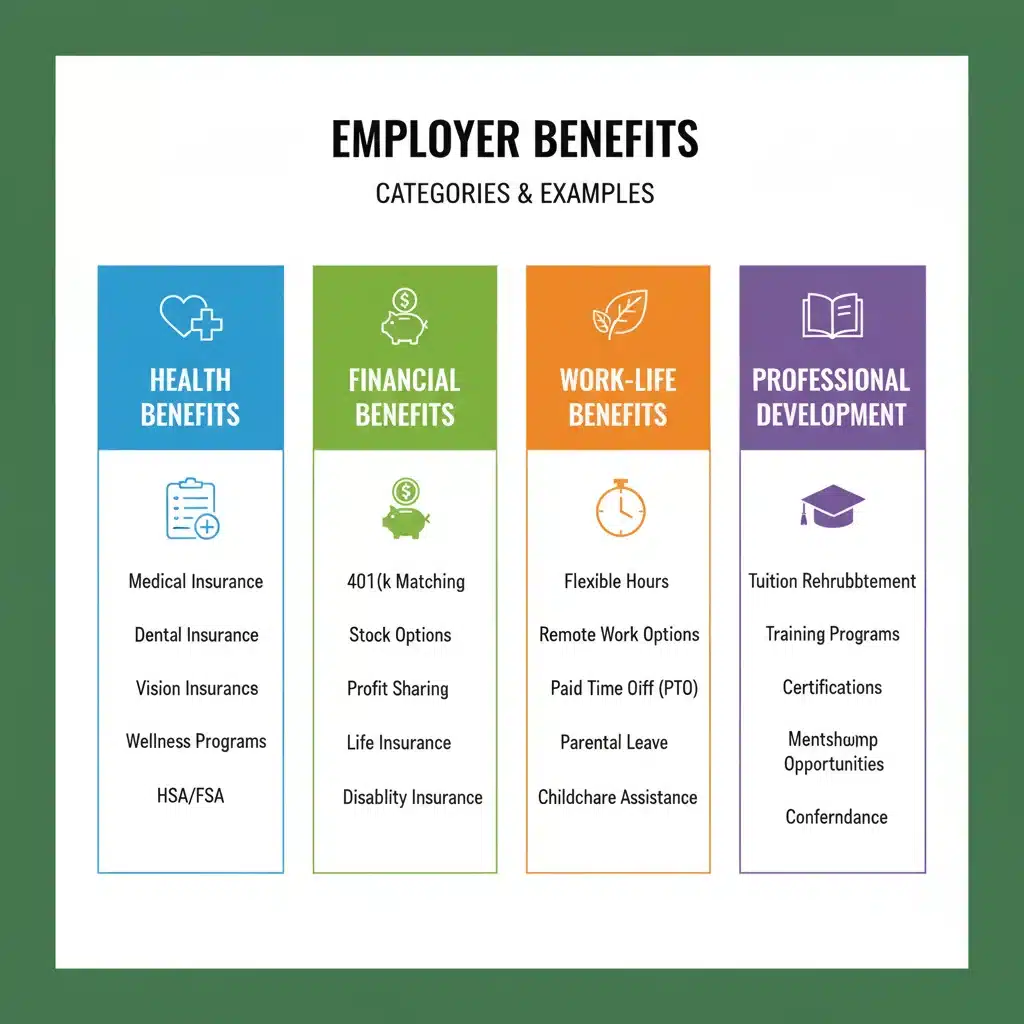
- Health Benefits: Medical, dental, vision insurance, and wellness programs.
- Retirement Plans: 401(k), 403(b), pension plans, and employer matching contributions.
- Paid Time Off (PTO): Vacation days, sick leave, holidays, and personal days.
- Life and Disability Insurance: Employer-provided coverage.
- Professional Development: Tuition reimbursement, training programs, certifications, and conference attendance.
- Work-Life Balance Perks: Flexible work arrangements (remote, hybrid), childcare assistance, gym memberships, mental health support.
- Stock Options/Equity: Ownership stakes in the company.
- Other Perks: Commuter benefits, employee discounts, company car, relocation assistance.
By quantifying the value of each of these components, you can present a much stronger case for increasing your overall package. For instance, a 5% increase in your 401(k) match might be worth more to you long-term than a small bump in base salary, especially when considering tax implications and compound interest.
Why Companies Offer Diverse Benefits
Companies don’t just offer benefits out of generosity; they do so for strategic reasons. Understanding these motivations can give you an edge when you negotiate employer benefits:
- Attraction and Retention: A strong benefits package helps attract top talent and reduces turnover.
- Employee Well-being and Productivity: Healthy, happy employees are more productive. Benefits like mental health support, and flexible work arrangements contribute directly to this.
- Competitive Advantage: In a tight labor market, superior benefits can differentiate an employer from competitors.
- Tax Advantages: Many employer-sponsored benefits offer tax advantages for both the employer and the employee.
- Legal Compliance: Certain benefits, like workers’ compensation, are legally mandated.
When you approach a negotiation, frame your requests in terms of how they align with these company objectives. For example, advocating for professional development benefits can be presented as an investment in your skills, which directly benefits the company’s future success.
Research is Your Superpower: Laying the Groundwork for 2026
Effective negotiation is built on solid research. Before you even think about entering a discussion, you need to be armed with data. Here’s how to prepare for 2026:
1. Understand Industry Standards and Trends
What are other companies in your industry and geographic location offering? Look for reports on compensation and benefits trends for 2026. Websites like Glassdoor, LinkedIn, Salary.com, and industry-specific surveys can provide valuable insights. Pay attention to emerging benefits like enhanced mental health coverage, increased parental leave, and expanded remote work policies.
2. Benchmark Your Current Package
How does your current benefits package stack up against these industry standards? Identify areas where your current offerings might be lacking or where there’s room for improvement. This will help you prioritize what to negotiate employer benefits for.
3. Quantify the Value of Your Contributions
Document your achievements, successes, and the value you bring to the company. How have you saved money, generated revenue, improved processes, or contributed to team goals? Specific examples and metrics are far more powerful than vague statements. This demonstrates why you deserve more.
4. Know Your Personal Needs and Priorities
What benefits are most important to you at this stage of your life and career? Are you planning a family and need better parental leave? Are you looking to advance your skills and require tuition assistance? Do you prioritize work-life balance and seek more flexible hours or remote work options? Prioritize your top 2-3 benefits to focus on during negotiation.
5. Research the Company’s Financial Health and Culture
Is the company performing well financially? A company in a strong financial position might be more willing to negotiate. Also, consider the company culture. Is it one that values employee well-being and invests in its people? This can influence the type of benefits they are open to discussing.
Strategic Approaches to Negotiating Employer Benefits
Once you’ve done your homework, it’s time to craft your negotiation strategy. Remember, the goal is to create a win-win situation where both you and the employer feel satisfied.
1. Timing is Everything
The best times to negotiate employer benefits are:
- During a Job Offer: This is often the most opportune moment, as the company is eager to onboard you.
- During Your Annual Performance Review: If you’ve demonstrated significant value over the past year, this is a natural time to discuss adjustments to your compensation package.
- After a Major Accomplishment: If you’ve just completed a significant project or achieved a major milestone, leverage that success.
2. Frame Your Request as a Discussion, Not a Demand
Adopt a collaborative tone. Instead of saying, "I demand X benefit," try, "I’d like to discuss how we can enhance my total compensation package to better align with my contributions and market value, particularly regarding Y benefit."
3. Be Specific About What You Want
Don’t be vague. Instead of asking for "better benefits," specify, "I’d like to explore the possibility of increasing my 401(k) match to 6%" or "I’m seeking additional professional development funds for the AI certification program."
4. Justify Your Requests with Data and Value
This is where your research on market rates and your documented achievements come into play. "Based on industry benchmarks for my role and my consistent achievement of [specific accomplishments], I believe an increase in my PTO to 4 weeks would be appropriate." Or, "Investing in this certification will allow me to [specific benefit to company], thereby increasing my value to the team."
5. Be Prepared to Prioritize and Compromise
You might not get everything you ask for. Know what your non-negotiables are and what you’re willing to compromise on. If they can’t offer more vacation time, perhaps they can offer a higher contribution to your health savings account or a more flexible work schedule.
6. Consider the ‘Why’ Behind Their Offers (or Lack Thereof)
If an employer pushes back, try to understand their reasoning. Is it budget constraints, company policy, or simply a lack of understanding of your needs? This insight can help you reframe your request or explore alternative solutions.
7. Get It in Writing
Once you’ve successfully negotiated, ensure all agreed-upon benefits are clearly documented in your offer letter or an addendum to your employment contract. This protects both parties.
Key Benefits to Focus On for 2026 Negotiations
While your personal priorities will guide your specific requests, here are some high-value benefits that are likely to be strong negotiation points in 2026:
1. Enhanced Health and Wellness Programs
- Comprehensive Medical Coverage: Beyond basic plans, look for options with lower deductibles, better out-of-network coverage, and specialized care.
- Mental Health Support: This is a growing priority. Inquire about robust EAPs (Employee Assistance Programs), access to therapy, and mental health days.
- Wellness Stipends: Funds for gym memberships, fitness classes, or health apps.
- HSAs/FSAs with Employer Contributions: These accounts offer tax advantages and can significantly offset healthcare costs.
2. Robust Retirement Contributions
- Higher 401(k)/403(b) Match: Even a small increase in employer match can have a huge impact over time due to compounding.
- Vesting Schedules: Understand how quickly you gain full ownership of employer contributions. Shorter vesting periods are more favorable.
3. Flexible Work Arrangements
- Remote or Hybrid Work Options: If not already offered, this can be a powerful negotiation point for work-life balance and reduced commuting costs.
- Flexible Hours: The ability to adjust your start and end times to better suit personal commitments.
- Compressed Workweeks: Working full-time hours in fewer days (e.g., four 10-hour days).
4. Professional Development and Education
- Tuition Reimbursement: For degrees, certifications, or workshops relevant to your role and career growth.
- Conference Attendance: Funding for industry conferences, including travel and accommodation.
- Mentorship Programs: While not a direct financial benefit, a strong mentorship program can be invaluable for career progression.
5. Generous Paid Time Off (PTO)
- Increased Vacation Days: More time to recharge, travel, and spend with family.
- Paid Parental Leave: For new parents, this is a critical benefit.
- Sabbaticals: For long-term employees, a paid sabbatical can be a significant perk.
6. Equity and Stock Options
If you’re in a startup or high-growth company, negotiating for more stock options or equity can lead to substantial long-term wealth creation. Understand the vesting schedule and potential value.

Common Pitfalls to Avoid When Negotiating Benefits
Even with thorough preparation, some common mistakes can derail your efforts to negotiate employer benefits:
- Not Researching: Going into a negotiation without knowing market rates or company policies is a recipe for failure.
- Being Unrealistic: While it’s good to aim high, asking for benefits far outside industry norms or the company’s capacity can make you seem out of touch.
- Focusing Only on Salary: Neglecting the value of benefits means leaving money and perks on the table.
- Being Demanding or Aggressive: A confrontational approach is rarely effective. Maintain a professional, collaborative, and respectful tone.
- Not Quantifying Your Value: If you can’t articulate why you deserve more, it’s hard for an employer to justify giving it to you.
- Not Getting it in Writing: Verbal agreements can lead to misunderstandings or unfulfilled promises.
- Failing to Follow Up: If there’s a delay, a polite follow-up can show your continued interest and professionalism.
- Accepting the First Offer Without Countering: Always assume there’s room for negotiation, even if it’s just a small adjustment.
The Art of the Counter-Offer: Boosting Your Package by 10%
The goal of boosting your total compensation by an extra 10% requires a strategic approach to the counter-offer. Here’s how to execute it:
1. Express Enthusiasm, Then Counter
When presented with an initial offer, express your appreciation and excitement for the opportunity. Then, politely state that you’d like to discuss the overall compensation package further. For example: "Thank you so much for this exciting offer! I’m very enthusiastic about the role and the team. I’d like to take a day or two to review everything and then discuss a few components of the total compensation package."
2. Focus on Total Compensation, Not Just Salary
When you present your counter-offer, frame it around the entire package. "Considering my experience, the market value for this role, and the significant contributions I’m confident I can make, I was hoping for a total compensation package closer to X. This would include a base salary of Y, along with enhanced benefits such as Z (e.g., an additional week of PTO and a higher 401(k) match)."
3. Be Specific with Your ‘10% Boost’ Target
If your current offer is, for example, $100,000 in base salary and $20,000 in benefits (total $120,000), aiming for a 10% increase means targeting $132,000. You can achieve this through various combinations: a higher base, more valuable benefits, or a mix. Calculate the monetary value of the benefits you’re requesting. For instance, an extra week of PTO for a $100k salary is worth roughly $2,000. A 1% increase in a 401(k) match on a $100k salary is $1,000. Add these up to show how you reach your 10% target.
4. Use External Offers (Carefully)
If you have another job offer that’s more competitive, you can use it as leverage. However, do so respectfully and be prepared to take the other offer if your current negotiation doesn’t meet your needs. "I’ve also received another offer that includes [specific benefit, e.g., a more generous professional development budget]. While I’m very keen on this role, I’m hoping we can bridge the gap in that area to make this offer truly compelling."
5. Practice Your Pitch
Rehearse what you’ll say, especially if you’re nervous. Practice articulating your value and your requests clearly and confidently. Enlist a friend or mentor to role-play with you.
The Evolving Landscape of Benefits in 2026
As we move into 2026, several trends are shaping the benefits landscape, offering new opportunities to negotiate employer benefits:
- Personalized Benefits Packages: Some companies are moving towards ‘cafeteria-style’ plans, allowing employees to choose benefits that best suit their individual needs. If your company offers this, maximize your choices. If not, you might suggest it as an innovative idea.
- Focus on Financial Wellness: Beyond retirement plans, look for benefits like financial planning assistance, student loan repayment support, or emergency savings programs.
- Expanded Caregiving Support: With an aging population and dual-income households, benefits such as elder care support, enhanced childcare subsidies, and more flexible parental leave are becoming more prevalent.
- Sustainability and Social Impact: Younger generations are increasingly valuing employers who align with their ethical values. Benefits related to sustainable commuting, volunteer time off, or matching charitable donations can be attractive.
- Technology Integration: Expect more benefits to be managed and accessed through intuitive apps and platforms, making it easier to utilize your perks.
Staying abreast of these trends will not only help you identify valuable benefits but also demonstrate your forward-thinking approach during negotiations.
Conclusion: Empowering Your Compensation Journey
Negotiating employer-sponsored benefits is a critical skill that directly impacts your financial well-being and job satisfaction. By understanding your total compensation, conducting thorough research, and employing strategic negotiation tactics, you can confidently advocate for a package that truly reflects your value and meets your needs.
As we navigate 2026, the opportunity to boost your total compensation by an extra 10% through shrewd benefits negotiation is well within reach. Remember, every benefit has a monetary value, and by mastering the art of the ask, you’re not just getting ‘perks’ – you’re securing a more comprehensive, valuable, and personally tailored compensation package that empowers your career and life goals. Start preparing today, and step into your next negotiation with confidence and clarity.