
Navigating UDI Compliance 2026: A Definitive Roadmap for Medical Device Manufacturers
The landscape of medical device regulation is constantly evolving, with a clear global push towards enhanced traceability and patient safety. For medical device manufacturers, the year 2026 marks a significant milestone: the full implementation and enforcement of Unique Device Identification (UDI) regulations across various jurisdictions. Achieving UDI compliance 2026 is not merely a regulatory hurdle but a strategic imperative that will redefine how devices are tracked, managed, and monitored throughout their lifecycle. This comprehensive guide is designed to equip you with the knowledge and strategies necessary to navigate these complex requirements successfully.
Understanding the Imperative of UDI Compliance 2026
The Unique Device Identification (UDI) system is a global standard for uniquely identifying medical devices. Its primary goal is to enhance patient safety by improving the ability to track devices, facilitate recalls, and combat counterfeiting. While the UDI framework has been progressively rolled out by regulatory bodies like the FDA in the United States and the European Union under the Medical Device Regulation (EU MDR), the year 2026 represents a critical juncture for many manufacturers. By this time, virtually all medical devices, regardless of their risk class, are expected to be fully compliant with UDI requirements, including direct marking for certain reusable devices.
The implications of failing to meet UDI compliance 2026 are significant, ranging from market access restrictions and costly product recalls to substantial fines and reputational damage. Therefore, a proactive and well-structured approach is paramount. This isn’t just about slapping a barcode on a product; it involves a fundamental overhaul of data management, labeling processes, supply chain visibility, and post-market surveillance.
The Global Landscape of UDI Regulations
While the principles of UDI are globally harmonized, the specific implementation details can vary by region. Key regulatory bodies include:
- U.S. Food and Drug Administration (FDA): The FDA was a pioneer in UDI implementation, with phased deadlines beginning in 2014. By 2026, all Class I and unclassified devices, including those typically exempt from direct marking, will need to fully comply, extending to direct marking requirements for reusable devices.
- European Union Medical Device Regulation (EU MDR): The EU MDR introduced its own robust UDI system, with deadlines that have also been phased. The EUDAMED database, a central component of the EU UDI system, is crucial for data submission and public access. Manufacturers marketing devices in the EU must ensure their UDI data is accurately uploaded and maintained.
- Other Jurisdictions: Countries like Canada, Australia, Japan, and China are also developing or have implemented their own UDI frameworks, often aligning with international standards but with unique local requirements. Manufacturers with global markets must navigate this complex web of regulations.
Understanding the nuances of each market’s UDI requirements is critical for global manufacturers aiming for seamless UDI compliance 2026. This often necessitates a centralized strategy that can adapt to local specificities while maintaining overall consistency.
Key Components of UDI Compliance 2026
Achieving UDI compliance involves several interconnected components, each requiring careful planning and execution.
1. UDI Assignment and Issuance
Every medical device must be assigned a UDI, which consists of two main parts:
- Device Identifier (DI): A static portion that identifies the specific version or model of a device and the labeler.
- Production Identifier (PI): A dynamic portion that identifies variable characteristics such as the lot or batch number, serial number, manufacturing date, and expiration date.
Manufacturers must obtain their DIs from an accredited issuing agency (e.g., GS1, HIBCC, ICCBBA). The process involves registering as a labeler and then systematically assigning unique DIs to each device model. The PI must be generated dynamically for each production unit or batch. Accurate and consistent UDI assignment is the foundation of successful UDI compliance 2026.
2. UDI Labeling and Direct Marking
Once assigned, the UDI must be placed on the device label and packaging in both human-readable plain text and machine-readable format (e.g., barcode, RFID). The specific format and placement requirements vary by regulation and device type. For reusable devices, direct marking on the device itself is often mandated, allowing the UDI to persist through multiple reprocessing cycles. This presents significant technical challenges, requiring manufacturers to invest in suitable marking technologies like laser etching or chemical etching that can withstand sterilization processes without compromising device integrity or UDI readability.
For UDI compliance 2026, particular attention must be paid to the expanded scope of direct marking requirements, especially for lower-risk devices that may not have previously required it. This could necessitate changes to manufacturing processes and equipment.
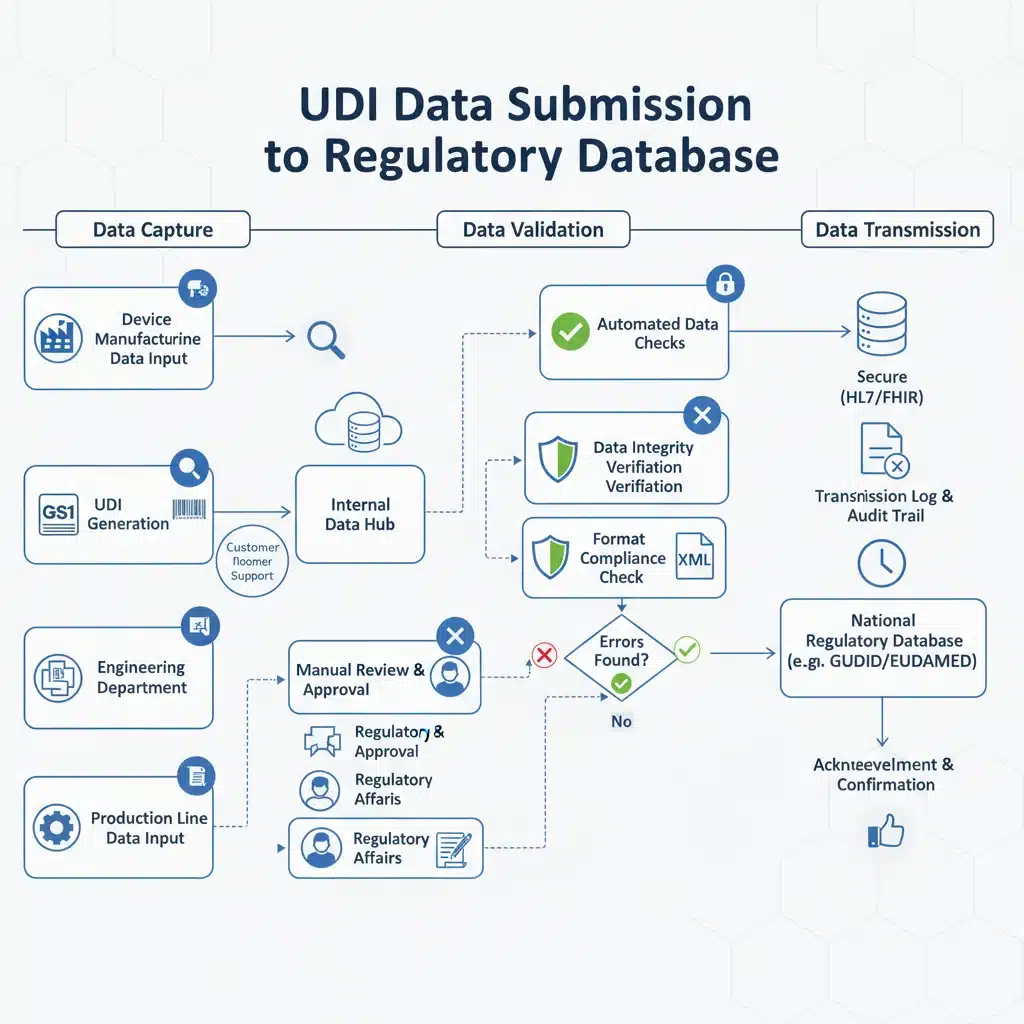
3. UDI Data Submission to Regulatory Databases
A crucial aspect of UDI compliance is the submission of device information, including the DI and associated product attributes, to a central regulatory database. In the U.S., this is the Global Unique Device Identification Database (GUDID) managed by the FDA. In the EU, it is the European Databank on Medical Devices (EUDAMED). These databases serve as public repositories of key device information, enabling regulators, healthcare providers, and patients to access critical data.
Data submission is not a one-time event. Manufacturers must ensure that their UDI data is accurate, complete, and kept up-to-date. Any changes to a device’s characteristics (e.g., new model, change in packaging, updated sterilization method) that affect its DI must be promptly reflected in the respective database. This continuous data management is a significant operational burden but essential for maintaining UDI compliance 2026.
4. Internal Process Integration and Data Management
Achieving UDI compliance extends far beyond external regulatory submissions. It requires a robust internal infrastructure to manage UDI data throughout the entire product lifecycle. This includes:
- Product Lifecycle Management (PLM) Systems: Integrating UDI data generation and management into existing PLM systems ensures that UDI information is consistently linked to product design, manufacturing, and post-market activities.
- Enterprise Resource Planning (ERP) Systems: ERP systems need to be updated to handle UDI data for inventory management, shipping, and sales.
- Quality Management Systems (QMS): UDI data is critical for enhancing traceability in quality control, complaint handling, and recall management processes.
- Labeling and Packaging Systems: These systems must be capable of generating UDI-compliant labels and packaging consistently and accurately.
The goal is to create a ‘single source of truth’ for UDI data, minimizing discrepancies and ensuring data integrity across all internal and external systems. This level of integration is foundational for sustainable UDI compliance 2026.
Strategic Planning for UDI Compliance 2026
Given the complexity and scope of UDI regulations, a well-defined strategic plan is indispensable. Here’s a roadmap for manufacturers:
Phase 1: Assessment and Gap Analysis (Current State)
- Inventory All Medical Devices: Create a comprehensive list of all products, categorizing them by risk class, intended market (U.S., EU, etc.), and current UDI status.
- Review Current Labeling and Packaging: Assess existing labeling and packaging for UDI readiness. Identify which devices already have UDI-compliant labels and which require significant changes.
- Evaluate Direct Marking Capabilities: For reusable devices, determine if current manufacturing processes can accommodate direct marking requirements. Identify technologies, equipment, and validation needs.
- Analyze Data Management Systems: Examine existing PLM, ERP, and QMS systems to understand their current capabilities for generating, storing, and transmitting UDI data. Identify gaps in data fields, integration, and automation.
- Identify Regulatory Gaps: Compare current practices against the specific requirements of the FDA, EU MDR, and other relevant regulatory bodies for UDI compliance 2026.
Phase 2: Planning and Strategy Development (Future State)
- Develop a UDI Project Plan: Outline clear objectives, timelines, resource allocation, and key performance indicators (KPIs). Assign roles and responsibilities to a dedicated UDI compliance team.
- Select Issuing Agency and UDI Strategy: Choose an accredited issuing agency and define your strategy for DI assignment across your product portfolio.
- Technology Evaluation and Investment: Research and select appropriate labeling software, direct marking equipment, and data management solutions. Consider cloud-based solutions for scalability and accessibility.
- Data Model Design: Design a robust UDI data model that accommodates all required attributes for each regulatory database (GUDID, EUDAMED, etc.).
- Budget Allocation: Secure adequate budget for technology, personnel, training, and potential external consulting services.
Phase 3: Implementation and Execution
- System Integration: Implement and integrate new UDI-capable software and hardware with existing PLM, ERP, and QMS systems. Automate data flow wherever possible.
- Data Migration and Validation: Migrate existing product data into the new UDI data model. Rigorously validate data accuracy and completeness.
- Labeling and Direct Marking Rollout: Update labeling and packaging designs. Implement direct marking processes, including validation of marking quality and durability.
- Data Submission Protocol: Establish clear protocols and workflows for submitting and updating UDI data to regulatory databases. Implement automated submission tools where available.
- Employee Training: Conduct comprehensive training for all relevant personnel, including R&D, manufacturing, quality assurance, regulatory affairs, IT, and sales.
Phase 4: Monitoring, Maintenance, and Continuous Improvement
- Ongoing Data Management: Establish processes for continuous monitoring and updating of UDI data in internal systems and regulatory databases.
- Audit and Review: Regularly audit UDI processes and data for compliance. Conduct internal assessments and be prepared for external regulatory inspections.
- Post-Market Surveillance Integration: Leverage UDI data to enhance post-market surveillance activities, including tracking adverse events, facilitating recalls, and identifying trends.
- Stay Updated on Regulations: Continuously monitor regulatory updates and changes in UDI requirements globally to ensure ongoing UDI compliance 2026 and beyond.
Challenges and Best Practices for UDI Compliance 2026
While the benefits of UDI are clear, manufacturers often face significant challenges in achieving and maintaining compliance. Anticipating these challenges and adopting best practices can streamline the process.
Common Challenges:
- Data Volume and Complexity: Managing vast amounts of detailed UDI data across numerous product lines and global markets.
- System Integration: Integrating new UDI solutions with legacy IT systems can be complex and costly.
- Direct Marking Technicalities: Ensuring direct marks are durable, readable, and do not compromise device functionality or biocompatibility.
- Regulatory Divergence: Harmonizing processes to meet slightly different requirements across multiple regulatory jurisdictions.
- Resource Constraints: Allocating sufficient financial and human resources for a large-scale UDI implementation project.
- Maintaining Data Quality: Ensuring the accuracy and consistency of UDI data over time, especially with product variations and updates.
Best Practices for Success:
- Start Early: Procrastination is the biggest enemy. Begin your assessment and planning immediately, especially with the 2026 deadline looming for many remaining devices.
- Cross-Functional Team: Assemble a dedicated team comprising representatives from regulatory affairs, quality assurance, R&D, manufacturing, IT, supply chain, and legal. UDI compliance is not just an IT or regulatory issue; it impacts every facet of the business.
- Leverage Automation: Invest in automated solutions for UDI data generation, labeling, and submission to minimize manual errors and improve efficiency.
- Standardize Data: Adopt a standardized approach to data capture and management across all product lines and regions.
- Phased Implementation: Break down the UDI compliance project into manageable phases, focusing on high-priority devices or markets first.
- Vendor Collaboration: Work closely with suppliers of UDI-related technologies (labeling systems, direct marking equipment, UDI software) to ensure seamless integration and support.
- Robust Validation: Thoroughly validate all UDI-related processes, systems, and data to ensure accuracy and compliance before going live.
- Continuous Monitoring and Training: Treat UDI compliance as an ongoing operational process, not a one-time project. Regular training and audits are essential.
- Embrace a Data-Centric Approach: View UDI not just as a compliance burden but as an opportunity to gain deeper insights into your products, supply chain, and post-market performance.

The Benefits Beyond Compliance
While the immediate focus on UDI compliance 2026 is often driven by regulatory mandates, the long-term benefits extend far beyond avoiding penalties. A robust UDI system can:
- Enhance Patient Safety: Improved traceability allows for faster and more targeted recalls, reducing patient exposure to faulty devices. It also aids in identifying counterfeit devices.
- Streamline Supply Chain Management: Better visibility into device location and status throughout the supply chain, from manufacturing to point of care. This can optimize inventory, reduce waste, and improve logistics.
- Improve Post-Market Surveillance: UDI data facilitates more effective tracking of device performance, adverse events, and real-world outcomes, leading to better product design and patient care.
- Increase Operational Efficiency: Automated UDI processes can reduce manual effort, minimize errors, and improve data accuracy across various departments.
- Facilitate Reimbursement: In some healthcare systems, UDI may become a requirement for reimbursement, making compliant devices more marketable.
- Support Global Market Access: Adherence to UDI standards is increasingly a prerequisite for market entry in major economies, offering a competitive advantage.
By viewing UDI implementation as a strategic investment rather than just a cost, manufacturers can unlock significant value and position themselves for future growth in a highly regulated industry.
Conclusion: Securing Your Future with UDI Compliance 2026
The year 2026 is rapidly approaching, and for many medical device manufacturers, it represents the culmination of a decade-long journey towards full UDI implementation. The demands of UDI compliance 2026 are extensive, requiring a holistic approach that touches upon product design, manufacturing, labeling, data management, and regulatory affairs. By understanding the regulations, planning meticulously, investing in appropriate technologies, and fostering cross-functional collaboration, manufacturers can not only meet these requirements but also leverage UDI as a powerful tool for enhancing patient safety, operational efficiency, and market competitiveness.
Proactive engagement with UDI requirements now will ensure a smooth transition and secure your market position for years to come. Don’t wait until the last minute; begin or accelerate your UDI compliance journey today to safeguard your products, your patients, and your business.