Maximize Your 2026 HSA Benefits: A Step-by-Step Guide for $3,850 in Tax Savings
In the evolving landscape of healthcare and personal finance, understanding and strategically utilizing tools like the Health Savings Account (HSA) is more critical than ever. As we look ahead to 2026, maximizing your 2026 HSA benefits could unlock significant tax savings, potentially reaching up to $3,850 or more, while providing a robust financial safety net for healthcare costs. This comprehensive guide will walk you through everything you need to know to leverage your HSA effectively, from eligibility to advanced investment strategies.
The HSA stands as a unique and powerful financial vehicle, offering a triple tax advantage that sets it apart from other savings accounts. For those enrolled in a High-Deductible Health Plan (HDHP), an HSA isn’t just a place to stash money for medical expenses; it’s a long-term investment tool that can contribute significantly to your overall financial well-being and retirement planning.
However, many individuals either underutilize their HSA or are unaware of its full potential. Our goal is to demystify the HSA, provide actionable insights, and empower you to make informed decisions that will maximize your 2026 HSA benefits. Whether you’re new to HSAs or a seasoned contributor, this article offers valuable strategies to optimize your savings and investments.
Understanding the Health Savings Account (HSA)
Before diving into the specifics of maximizing your 2026 HSA benefits, let’s establish a foundational understanding of what an HSA is and how it works. An HSA is a tax-advantaged savings account available to those enrolled in a High-Deductible Health Plan (HDHP). It allows you to save money specifically for healthcare costs, both current and future.
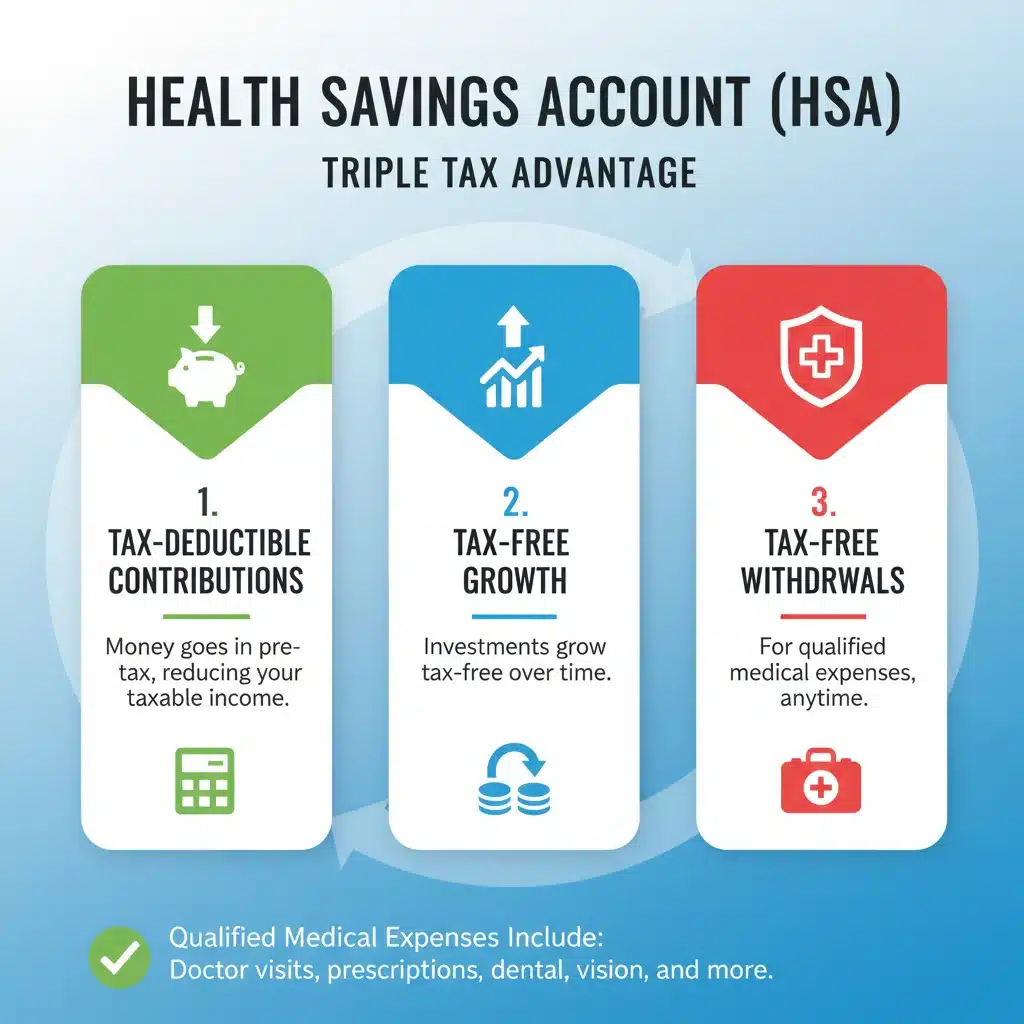
The appeal of an HSA lies in its unparalleled tax advantages:
- Tax-Deductible Contributions: Money you contribute to an HSA is tax-deductible, reducing your taxable income in the year you contribute. If contributions are made through payroll deductions, they are also exempt from FICA taxes (Social Security and Medicare), leading to even greater savings.
- Tax-Free Growth: Any earnings from investments within your HSA grow tax-free. This means dividends, interest, and capital gains are not taxed as long as they remain in the account.
- Tax-Free Withdrawals: Qualified medical expenses can be paid for with tax-free withdrawals at any time. This includes a wide range of expenses, from doctor visits and prescriptions to dental and vision care.
This ‘triple tax advantage’ makes the HSA an incredibly powerful tool, not just for healthcare savings, but also for retirement planning, as we’ll explore later.
Eligibility for a 2026 HSA
To be eligible to contribute to an HSA in 2026, you must meet specific criteria:
- You must be covered by a High-Deductible Health Plan (HDHP). For 2026, the IRS will set the minimum deductible and maximum out-of-pocket limits for HDHPs. While the exact 2026 figures are not yet released, based on current trends, we can anticipate them to be adjusted upwards from the 2025 limits. For reference, in 2025, an HDHP was defined as a plan with a deductible of at least $1,650 for self-only coverage or $3,300 for family coverage, and annual out-of-pocket expenses (including deductibles, co-payments, and other amounts, but not premiums) did not exceed $8,300 for self-only coverage or $16,600 for family coverage. Expect these numbers to be slightly higher for 2026.
- You cannot be covered by any other non-HDHP health insurance plan (with some exceptions, such as specific injury insurance, accident, disability, dental care, vision care, or long-term care).
- You cannot be enrolled in Medicare.
- You cannot be claimed as a dependent on someone else’s tax return.
It’s crucial to verify these eligibility requirements annually, as they can be subject to minor adjustments by the IRS. Consulting with your HR department or a tax professional can help ensure you meet the criteria for maximizing your 2026 HSA benefits.
2026 HSA Contribution Limits and How to Maximize Them
The IRS sets annual contribution limits for HSAs. While the precise figures for 2026 are yet to be announced, they are typically adjusted for inflation each year. Based on historical trends, we can project the 2026 limits to be slightly higher than 2025’s. For context, in 2025, the limits were $4,150 for self-only coverage and $8,300 for family coverage. Individuals aged 55 and older could contribute an additional catch-up contribution of $1,000.
Anticipating these limits will allow you to plan your contributions effectively to maximize your 2026 HSA benefits. Here’s how you can approach maximizing your contributions:
1. Contribute the Maximum Amount
The most straightforward way to maximize your 2026 HSA benefits is to contribute the full amount allowed by the IRS. This ensures you take full advantage of the tax-deductible contributions and the potential for tax-free growth.
- For Individuals: Aim to contribute the projected maximum for self-only coverage.
- For Families: Strive to contribute the projected maximum for family coverage.
- Catch-Up Contributions: If you are 55 or older by the end of the tax year, remember to add the extra $1,000 catch-up contribution. If both spouses are 55 or older and covered under a family HDHP, each spouse can contribute an additional $1,000 to their respective HSAs.
2. Make Regular Contributions
Setting up automatic, regular contributions throughout the year is an excellent strategy. This allows you to dollar-cost average your investments within the HSA (if you choose to invest) and ensures you reach the maximum contribution limit without a last-minute scramble.
3. Consider Employer Contributions
Many employers contribute to their employees’ HSAs as part of their benefits package. These employer contributions count towards the annual IRS limit. Be sure to factor in any employer contributions when planning your own contributions to avoid over-contributing.
4. Don’t Forget the ‘Last-Month Rule’
If you become eligible for an HSA in the middle of the year, the ‘last-month rule’ allows you to contribute the full annual amount for that year, provided you remain HSA-eligible for the entire following year. This can be a significant advantage for those who gain HDHP coverage later in the year.
The $3,850 Tax Savings Potential Explained
Now, let’s break down how maximizing your 2026 HSA benefits could lead to $3,850 or more in tax savings. This figure is an illustrative example, and your actual savings will depend on your individual tax bracket, state taxes, and specific contribution amounts.
Let’s assume the 2026 family contribution limit is slightly higher than 2025, perhaps around $8,500, and a catch-up contribution of $1,000 for those 55 and older. If you are 55 or older and contribute the maximum family amount plus the catch-up, your total contribution could be $9,500.
Here’s how the savings can accumulate:
1. Federal Income Tax Deduction
Your contributions are tax-deductible. If you are in the 22% federal tax bracket, a $9,500 contribution could save you $9,500 * 0.22 = $2,090 in federal income taxes.
2. FICA Tax Savings
If you contribute through payroll deductions, your contributions are also exempt from FICA taxes (Social Security and Medicare), which typically total 7.65% (6.2% for Social Security up to a certain limit and 1.45% for Medicare). For a $9,500 contribution, this could save you $9,500 * 0.0765 = $726.75.
3. State Income Tax Savings
Most states follow federal guidelines for HSA tax treatment, offering state income tax deductions. Assuming a modest 5% state income tax rate, a $9,500 contribution could save you $9,500 * 0.05 = $475 in state taxes. (Note: A few states, like California and New Jersey, do not offer state income tax deductions for HSA contributions, so check your state’s specific rules).
Total Potential First-Year Tax Savings:
$2,090 (Federal) + 726.75 (FICA) + $475 (State) = $3,291.75
This example already demonstrates substantial savings. The $3,850 figure is easily achievable when considering higher tax brackets, multiple catch-up contributions (e.g., both spouses are 55+), or state tax rates that are higher. Furthermore, this calculation doesn’t even include the tax-free growth of your investments, which compounds over time.
Strategic Use of Your HSA: Beyond Medical Expenses
While the primary purpose of an HSA is to cover healthcare costs, its unique structure allows it to serve as a powerful retirement savings vehicle. This is a key aspect of maximizing your 2026 HSA benefits.
1. The HSA as a Retirement Account
Many financial advisors refer to the HSA as the ‘triple-tax-advantaged’ account, even surpassing 401(k)s and IRAs in some aspects, because of its tax-free withdrawals for qualified medical expenses. If you manage to pay for current medical expenses out-of-pocket and allow your HSA funds to grow, you can accumulate a substantial tax-free nest egg for future healthcare costs in retirement.
After age 65, your HSA functions much like a traditional IRA. You can withdraw funds for any purpose without penalty, though withdrawals for non-medical expenses will be subject to ordinary income tax. However, withdrawals for qualified medical expenses remain tax-free at any age. Given that healthcare costs often increase significantly in retirement, having a dedicated, tax-free fund for these expenses is invaluable.
2. Investing Your HSA Funds
One of the most underutilized features of HSAs is their investment capability. Once your account reaches a certain threshold (often $1,000 or $2,000, depending on the provider), you can typically invest your HSA funds in a variety of options, including mutual funds, ETFs, and stocks, similar to a 401(k) or IRA.
To maximize your 2026 HSA benefits, especially for long-term growth, consider investing your contributions. The earlier you start, the more time your investments have to grow tax-free. Choose investments that align with your risk tolerance and time horizon, just as you would with any other retirement account.
3. The ‘Receipt Shoebox’ Strategy
This advanced strategy allows you to pay for current medical expenses out-of-pocket and save all your receipts. You then let your HSA funds grow and invest tax-free for years or even decades. Later, you can reimburse yourself for those past qualified medical expenses with tax-free withdrawals from your HSA. There’s no time limit on when you can reimburse yourself, as long as the expense was incurred after your HSA was established.
This strategy effectively turns your HSA into an even more flexible investment vehicle, providing a tax-free income stream in retirement for previously paid medical bills. It’s a powerful way to maximize your 2026 HSA benefits for future financial security.
Choosing the Right HSA Provider
The provider you choose for your HSA can significantly impact your ability to maximize your 2026 HSA benefits. Not all HSA providers are created equal, especially when it comes to investment options, fees, and user experience.
When evaluating HSA providers, consider the following:
- Investment Options: Does the provider offer a wide range of investment choices, including low-cost index funds or ETFs? Are there any restrictions on what you can invest in?
- Fees: Be aware of monthly maintenance fees, investment fees, and transaction fees. High fees can eat into your returns over time. Look for providers with transparent and low-fee structures.
- Minimum Balance Requirements: Some providers require a minimum cash balance before you can invest. Understand these requirements.
- User Interface and Customer Service: A user-friendly platform and responsive customer service can make managing your HSA much easier.
- Integration with your HDHP: While not strictly necessary, some providers offer seamless integration with your health plan, which can simplify claims and payments.
Popular HSA providers known for their investment options and lower fees often include Fidelity, Lively, and HealthEquity (though fees can vary with HealthEquity depending on your employer plan). Researching and comparing these options will help you select the best fit for your financial goals in 2026 and beyond.
Common Mistakes to Avoid with Your HSA
Even with the best intentions, it’s easy to make mistakes that can diminish your 2026 HSA benefits. Being aware of these pitfalls can help you navigate your HSA journey more effectively.
1. Not Contributing Enough (or at all)
The biggest mistake is failing to contribute or not contributing the maximum amount. Each dollar not contributed is a missed opportunity for tax deductions, tax-free growth, and future tax-free withdrawals.
2. Not Investing Your Funds
Leaving your HSA funds solely in a cash account means you’re missing out on the significant growth potential offered by tax-free investments. While a portion should remain liquid for immediate medical needs, consider investing the majority if you have a long-term horizon.
3. Withdrawing for Non-Qualified Expenses Before Age 65
While tempting, withdrawing funds for non-qualified expenses before age 65 will result in ordinary income tax and a 20% penalty. Always ensure your withdrawals are for qualified medical expenses to maintain the tax-free status.
4. Not Keeping Records of Medical Expenses
If you plan to use the ‘receipt shoebox’ strategy, meticulous record-keeping is essential. Without proper documentation, you won’t be able to reimburse yourself tax-free for past medical expenses.
5. Not Understanding Eligibility Rules
Contributing to an HSA when you’re not eligible can lead to tax penalties. Always confirm your eligibility status, especially if your health coverage or employment situation changes.
6. Over-Contributing
Contributing more than the IRS-mandated limit can result in a 6% excise tax on the excess contributions each year they remain in the account. Be mindful of your contributions, especially if your employer also contributes.

Integrating Your HSA into Your Overall Financial Plan
Maximizing your 2026 HSA benefits isn’t just about healthcare; it’s about integrating this powerful tool into your broader financial strategy. When viewed holistically, an HSA can complement your other savings vehicles and enhance your financial security.
1. Prioritizing Contributions
For many, the question is where to prioritize savings. A common strategy, especially if your employer offers a match, is:
- Contribute enough to your 401(k) or 403(b) to get the full employer match (free money!).
- Max out your HSA contributions.
- Max out your IRA (Traditional or Roth, depending on your income and goals).
- Contribute additional funds to your 401(k) or 403(b) up to the annual limit.
- Consider taxable brokerage accounts or other investment vehicles.
The HSA often comes second due to its unique triple tax advantage and the ability to grow funds tax-free for both healthcare and retirement.
2. Emergency Fund Considerations
While an HSA can act as a pseudo-emergency fund for medical expenses, it’s generally recommended to have a separate, readily accessible emergency fund for other unexpected costs. However, in a pinch, an HSA can provide a valuable fallback for health-related emergencies.
3. Long-Term Care Planning
As healthcare costs rise, especially for long-term care, an HSA can be an invaluable asset in retirement. The ability to withdraw funds tax-free for qualified medical expenses means you have a dedicated source of funds to cover potential long-term care needs without dipping into your other retirement savings.
4. Estate Planning
In the unfortunate event of your passing, the disposition of your HSA depends on the beneficiary. If your spouse is the beneficiary, the HSA can be treated as their own HSA, maintaining its tax-advantaged status. If a non-spouse is the beneficiary, the account ceases to be an HSA and becomes taxable income to the beneficiary, though it can still be used for qualified medical expenses incurred prior to your death. Incorporating your HSA into your estate plan ensures your wishes are honored and avoids unnecessary tax burdens for your heirs.
Future Outlook for HSAs and 2026 Adjustments
The future of HSAs remains bright, with continued bipartisan support for these tax-advantaged accounts. While specific legislative changes can always occur, the core benefits of HSAs are expected to persist, making it a reliable tool for future financial planning.
As mentioned, the IRS typically announces the new HDHP thresholds and HSA contribution limits in late spring or early summer of the preceding year. So, for 2026, we can expect the official numbers to be released around May-June 2025. Staying informed about these announcements will be crucial for fine-tuning your contribution strategy to maximize your 2026 HSA benefits.
Beyond the annual adjustments, there have been discussions in Congress about potentially expanding HSA eligibility or increasing contribution limits even further. While these are not guaranteed, they underscore the strong position of HSAs in the financial planning landscape. Regardless of future legislative changes, the fundamental advantages of HSAs – tax-deductible contributions, tax-free growth, and tax-free withdrawals for medical expenses – are likely to remain cornerstones of personal finance.
This stability makes HSAs a predictable and powerful component of a well-rounded financial plan, offering peace of mind regarding both current and future healthcare expenses, while simultaneously serving as a robust retirement savings vehicle.
Conclusion: Your Path to Maximizing 2026 HSA Benefits
The Health Savings Account is far more than just a savings vehicle for medical bills; it’s a dynamic financial tool capable of delivering substantial tax savings and significant long-term growth. By understanding the eligibility requirements, optimizing your contributions to meet the 2026 limits, and strategically investing your funds, you can unlock the full potential of your HSA.
Embracing the triple tax advantage – tax-deductible contributions, tax-free growth, and tax-free withdrawals for qualified medical expenses – positions you to save potentially $3,850 or more in taxes. This amount is not just a theoretical figure; it’s a tangible benefit that can significantly impact your financial health, both in the short term by reducing your taxable income and in the long term by building a robust, tax-free nest egg for retirement healthcare costs.
Remember to choose an HSA provider that aligns with your investment goals and offers competitive fees. Avoid common pitfalls such as under-contributing or failing to invest. Instead, integrate your HSA into your comprehensive financial plan, prioritizing it alongside other key retirement accounts.
As you plan for 2026, make it a priority to review your health plan options and commit to maximizing your 2026 HSA benefits. The proactive steps you take today will pay dividends for years to come, securing your health and financial future. Don’t leave money on the table – leverage your HSA to its fullest potential and enjoy the peace of mind that comes with smart financial planning.