
2026 Retirement Planning: Navigating 401(k) vs. IRA for Healthcare Professionals
As a dedicated healthcare professional, your days are often consumed by caring for others, leaving little time to meticulously plan for your own financial future. Yet, securing your post-career years is as crucial as any medical procedure you perform. With 2026 on the horizon, understanding the nuances of various retirement vehicles, particularly the 401(k) and Individual Retirement Account (IRA), is paramount. This comprehensive guide is specifically tailored for you, the hardworking healthcare professional, to help demystify these options and empower you to make informed decisions for your financial well-being. We will delve into the specifics of Healthcare Retirement Plans, exploring their benefits, limitations, and how they align with your unique career path and financial goals.
Anúncios
The landscape of retirement planning is ever-evolving, with annual adjustments to contribution limits, tax codes, and investment opportunities. For 2026, staying updated on these changes is vital to maximize your savings potential. Whether you’re a seasoned physician, a dedicated nurse, a vital therapist, or any other professional contributing to the healthcare sector, your retirement strategy needs to be robust, adaptable, and optimized for your circumstances. This article aims to provide clarity, enabling you to confidently choose the best path forward for your Healthcare Retirement Plans.
Understanding the Basics: 401(k) for Healthcare Professionals
The 401(k) is a cornerstone of many employer-sponsored retirement plans, and it’s a particularly common offering within large healthcare systems, hospitals, and medical groups. For healthcare professionals, participating in a 401(k) can be one of the most effective ways to save for retirement, especially if your employer offers a matching contribution. This ‘free money’ is an immediate, guaranteed return on your investment and should be a top priority.
Anúncios
A 401(k) allows you to contribute a portion of your pre-tax salary, which reduces your current taxable income. Your contributions and any earnings grow tax-deferred until retirement, at which point withdrawals are taxed as ordinary income. Many healthcare employers also offer a Roth 401(k) option, where contributions are made with after-tax dollars, but qualified withdrawals in retirement are entirely tax-free. The choice between a traditional and Roth 401(k) depends heavily on your current income level, anticipated future tax bracket, and overall tax strategy. For high-earning healthcare professionals, the upfront tax deduction of a traditional 401(k) can be very appealing, while those who anticipate being in a higher tax bracket in retirement might favor the Roth option.
In 2026, the contribution limits for 401(k) plans are expected to be substantial. While the exact figures are subject to change based on inflation and IRS adjustments, they typically allow for significant annual contributions, often exceeding $20,000 for employees under 50, with additional catch-up contributions for those aged 50 and over. These high limits make the 401(k) a powerful tool for accelerating your retirement savings, especially for healthcare professionals who often reach peak earning potential later in their careers.
Beyond the contribution limits, 401(k) plans also come with specific rules regarding rollovers, withdrawals, and loans. Understanding these rules is crucial to avoid penalties and ensure your money works for you. For instance, if you change employers within the healthcare sector, you’ll typically have options to leave your 401(k) with your previous employer, roll it over into your new employer’s plan, or transfer it into an IRA. Each option has its own implications for investment choices, fees, and administrative burden.
The Individual Retirement Account (IRA): A Complementary or Primary Tool
While a 401(k) is tied to your employment, an Individual Retirement Account (IRA) offers a personal savings vehicle that you control directly. IRAs come in two main flavors: Traditional and Roth, each with distinct tax advantages that can be highly beneficial for healthcare professionals.
Traditional IRA: Tax-Deductible Contributions and Tax-Deferred Growth
A Traditional IRA allows you to contribute pre-tax dollars, and these contributions may be tax-deductible, reducing your current taxable income. The earnings grow tax-deferred until retirement, when withdrawals are taxed as ordinary income. This mirrors the tax treatment of a traditional 401(k). The deductibility of your Traditional IRA contributions depends on whether you or your spouse are covered by a workplace retirement plan (like a 401(k)) and your Modified Adjusted Gross Income (MAGI). For many high-earning healthcare professionals, their income may exceed the thresholds for full deductibility if they also participate in a 401(k). However, a Traditional IRA can still be a valuable tool for non-deductible contributions, which can later be converted to a Roth IRA via the ‘backdoor Roth’ strategy, a common tactic for high-income earners.
Roth IRA: Tax-Free Withdrawals in Retirement
The Roth IRA is a favorite for many, particularly younger healthcare professionals or those who anticipate being in a higher tax bracket in retirement. Contributions to a Roth IRA are made with after-tax dollars, meaning there’s no upfront tax deduction. However, qualified withdrawals in retirement are completely tax-free. This can be a significant advantage, especially for healthcare professionals whose incomes are likely to increase substantially over their careers, potentially placing them in higher tax brackets later on. The ability to withdraw funds tax-free in retirement provides immense financial flexibility and predictability.
Similar to the Traditional IRA, there are income limitations for directly contributing to a Roth IRA. For 2026, these limits are expected to be substantial but could still exclude some very high-earning healthcare professionals from direct contributions. This is where the ‘backdoor Roth’ strategy comes into play, allowing those above the income thresholds to still benefit from a Roth IRA by contributing to a non-deductible Traditional IRA and then converting it to a Roth IRA. This strategy requires careful planning to avoid the pro-rata rule if you have existing pre-tax IRA balances.
The contribution limits for IRAs are generally lower than for 401(k)s, typically around $6,500-$7,000 per year for those under 50, with an additional catch-up contribution for those 50 and older. While these limits are lower, an IRA offers greater control over investment choices and generally lower fees compared to some employer-sponsored 401(k)s. This flexibility can be a significant advantage for healthcare professionals who prefer to manage their own investments or seek broader investment options than their 401(k) might offer.
Comparing 401(k) and IRA for Healthcare Professionals in 2026
Deciding between a 401(k) and an IRA, or more commonly, how to utilize both, requires a careful assessment of your personal financial situation, career stage, and future goals. Let’s break down key comparison points for Healthcare Retirement Plans in 2026.
Contribution Limits and Catch-Up Contributions
- 401(k): Generally higher contribution limits, allowing for more aggressive savings. Ideal for maximizing pre-tax (or Roth) savings directly from your paycheck. The expected 2026 limits will likely be over $20,000 for regular contributions and several thousands more for catch-up contributions for those 50+.
- IRA: Lower contribution limits, typically under $10,000 for regular and catch-up contributions combined. While lower, it’s an excellent supplementary tool.
Tax Advantages and Tax Brackets
- Traditional 401(k) / Traditional IRA: Contributions are often tax-deductible (IRA deductibility depends on income and other retirement plan participation), reducing current taxable income. Growth is tax-deferred, and withdrawals are taxed in retirement. Beneficial if you expect to be in a lower tax bracket in retirement than you are now.
- Roth 401(k) / Roth IRA: Contributions are made with after-tax dollars, but qualified withdrawals in retirement are tax-free. Ideal if you expect to be in a higher tax bracket in retirement or want tax-free income in your later years. High-income healthcare professionals might need to use the ‘backdoor Roth’ strategy for IRAs.
Employer Matching Contributions
This is where the 401(k) often shines for healthcare professionals. Many healthcare employers offer a matching contribution to your 401(k) – essentially, free money. Always contribute at least enough to get the full employer match. Neglecting this is leaving money on the table, a mistake no savvy financial planner would endorse. IRAs, being individual accounts, do not have employer matching contributions.
Investment Options and Control
- 401(k): Investment options are typically limited to a curated list of funds chosen by your employer (e.g., target-date funds, index funds, mutual funds). While this can simplify choices, it might lack the breadth of options some investors prefer.
- IRA: Offers much greater flexibility and control over investment choices. You can invest in a wider array of assets, including individual stocks, bonds, ETFs, and a broader selection of mutual funds. This can be advantageous for healthcare professionals who have a strong understanding of investing or prefer to work with a financial advisor to build a highly customized portfolio.

Optimal Strategies for Healthcare Professionals in 2026
Given the distinct features of both 401(k)s and IRAs, the optimal strategy for most healthcare professionals in 2026 involves utilizing a combination of both. Here’s a common hierarchy for maximizing your Healthcare Retirement Plans:
Step 1: Maximize Your Employer’s 401(k) Match
This is non-negotiable. If your healthcare employer offers a 401(k) match, contribute at least enough to receive the full match. It’s an immediate, risk-free return on your investment that significantly boosts your retirement savings.
Step 2: Fund a Roth IRA (or Backdoor Roth)
After securing your employer match, consider contributing to a Roth IRA. If your income exceeds the direct contribution limits, explore the ‘backdoor Roth’ strategy. The benefit of tax-free withdrawals in retirement is incredibly powerful, especially for healthcare professionals who tend to have high earning potential throughout their careers. This step is particularly valuable for diversification of tax-advantaged accounts.
Step 3: Max Out Your 401(k)
Once you’ve maximized your Roth IRA (or utilized the backdoor strategy), return to your 401(k) and aim to contribute the maximum allowable amount. The high contribution limits of the 401(k) allow for substantial tax-deferred or tax-free growth, accelerating your path to a comfortable retirement. This is where you can truly supercharge your Healthcare Retirement Plans.
Step 4: Explore Other Investment Vehicles
If you’ve maxed out both your 401(k) and IRA, congratulations! You’re in an excellent financial position. At this point, you might consider other investment vehicles such as a Health Savings Account (HSA) if you have a high-deductible health plan (HDHP), a taxable brokerage account, or even real estate investments. HSAs offer a triple tax advantage (tax-deductible contributions, tax-free growth, tax-free withdrawals for qualified medical expenses) and can be an incredibly powerful tool for retirement savings, especially for healthcare professionals who understand the nuances of medical costs.
Special Considerations for Healthcare Professionals
Your profession comes with unique financial considerations that impact your retirement planning:
- Student Loan Debt: Many healthcare professionals carry significant student loan debt. Balancing loan repayment with retirement savings is critical. Often, it’s advisable to contribute enough to your 401(k) to get the employer match, then focus aggressively on high-interest student loans, before ramping up other retirement contributions.
- Late Career Start: Some healthcare specializations require extensive education and training, leading to a later start in high-earning careers. This means you might have fewer years to save. Maximizing contribution limits in 401(k)s and IRAs, and utilizing catch-up contributions, becomes even more important.
- High Earning Potential: While demanding, your profession often comes with high earning potential. This can quickly push you into higher tax brackets, making tax-efficient savings strategies like Roth accounts and tax-deferred options particularly valuable.
- Disability Insurance: Your ability to earn a high income is your greatest asset. Adequate disability insurance is paramount to protect your future income stream, which in turn protects your ability to fund your retirement.
- Practice Ownership: If you own or plan to own a private practice, you might have access to more advanced retirement plans like Solo 401(k)s, SEP IRAs, or SIMPLE IRAs, which often allow for even higher contribution limits than traditional employee plans. These can be game-changers for boosting your Healthcare Retirement Plans.
Navigating Investment Choices Within Your Plans
Once you’ve decided on the types of accounts, the next crucial step is selecting the right investments within them. This is where many healthcare professionals, often busy with their demanding careers, might feel overwhelmed. Here are some general principles:
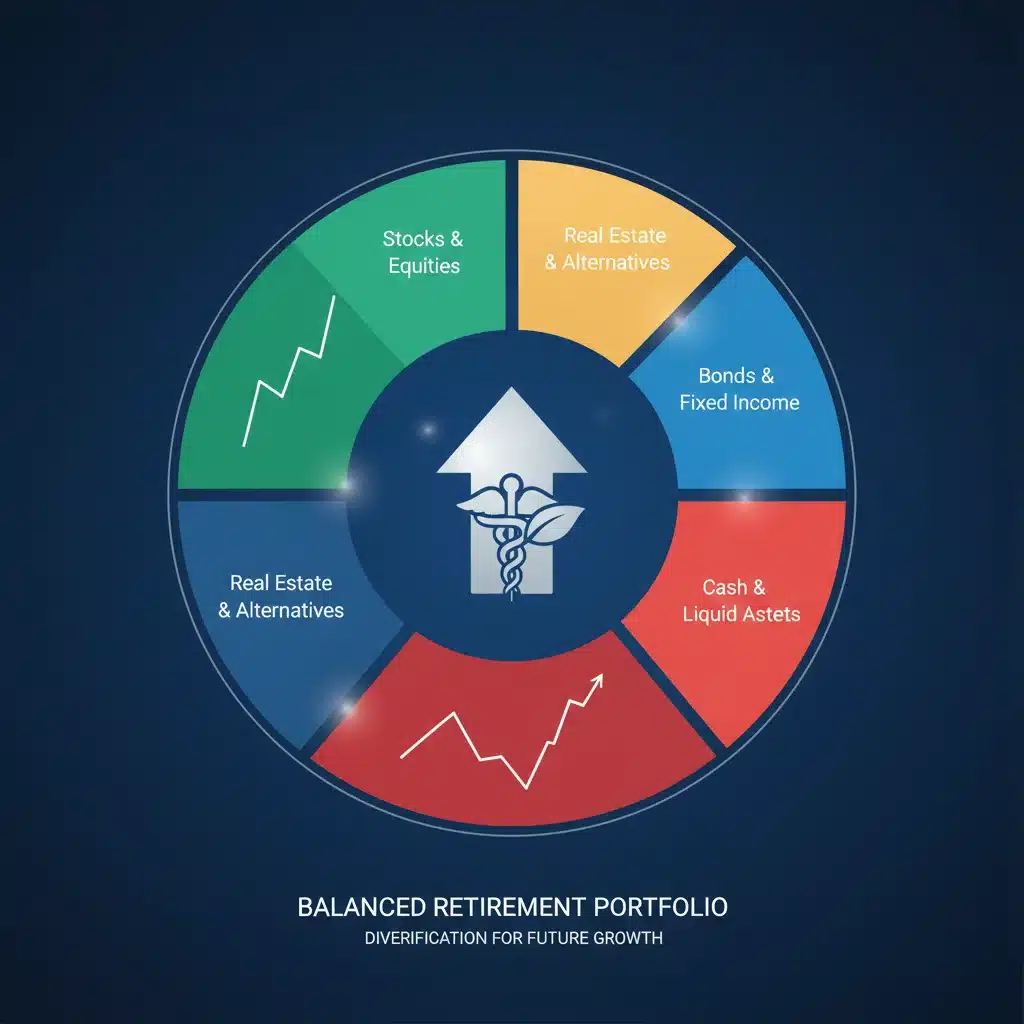
- Diversification: Don’t put all your eggs in one basket. Diversify your investments across different asset classes (stocks, bonds, real estate, etc.) to mitigate risk.
- Risk Tolerance: Understand your personal risk tolerance. Younger professionals with a longer time horizon can typically afford to take on more risk, while those closer to retirement might opt for more conservative investments.
- Low-Cost Index Funds/ETFs: For many, especially those who prefer a hands-off approach, low-cost index funds or Exchange Traded Funds (ETFs) that track broad market indices (like the S&P 500) are excellent choices. They offer broad diversification at minimal expense.
- Target-Date Funds: If your 401(k) offers them, target-date funds can be a good option. These funds automatically adjust their asset allocation to become more conservative as you approach your target retirement year.
- Rebalancing: Periodically review and rebalance your portfolio to ensure it aligns with your desired asset allocation and risk profile.
For those with a 401(k) that offers limited investment choices, using your IRA to diversify and access a wider range of investment options can be a smart strategy. This allows you to combine the benefits of your employer’s plan (especially the match) with the flexibility and control of an individual account to optimize your overall Healthcare Retirement Plans.
The Importance of Professional Financial Guidance
While this guide provides a solid foundation, the complexities of retirement planning, especially for high-income professionals with unique circumstances, often warrant professional advice. A qualified financial advisor specializing in working with healthcare professionals can provide personalized strategies, help navigate tax complexities, optimize investment portfolios, and ensure your plan is aligned with your specific goals. They can also assist with advanced strategies like the ‘backdoor Roth’ or managing a private practice’s retirement plans.
Finding an advisor who understands the specific financial challenges and opportunities within the healthcare sector can be invaluable. They can help you project your future income, estimate retirement expenses, and create a comprehensive financial plan that addresses not just retirement but also other crucial aspects like insurance, estate planning, and debt management. Investing in good financial advice can pay dividends many times over in the long run for your Healthcare Retirement Plans.
Conclusion: Building a Robust Healthcare Retirement Plan for 2026 and Beyond
As a healthcare professional, your dedication to others is unwavering. Now, it’s time to apply that same dedication to securing your own financial future. The 2026 landscape for retirement planning offers powerful tools in the form of 401(k)s and IRAs, each with distinct advantages. By strategically combining these options, maximizing employer matches, understanding tax implications, and making informed investment choices, you can build a robust retirement plan that ensures comfort and financial independence in your golden years.
Remember, retirement planning is not a one-time event but an ongoing process. Regularly review your accounts, adjust your contributions, and rebalance your portfolio as your career and life circumstances evolve. Staying informed about changes in contribution limits and tax laws will empower you to make the most of every opportunity. With careful planning and proactive management, your Healthcare Retirement Plans will be as strong and resilient as the care you provide to your patients every day. Start today, and secure the future you deserve.