Maximize Your 2026 Earned Income Tax Credit: Up to $7,430 Refund Guide

Anúncios
Maximize Your 2026 Earned Income Tax Credit: How to Secure Up to a $7,430 Refund
Are you looking to boost your financial well-being and claim every dollar you’re entitled to from the IRS? The 2026 Earned Income Tax Credit (EITC) could be your ticket to a significant refund, potentially putting up to $7,430 back into your pocket. For millions of working individuals and families, the EITC is a crucial financial lifeline, designed to support low-to-moderate income earners. However, navigating the complexities of tax law can be daunting, and many eligible taxpayers unknowingly leave money on the table. This comprehensive guide is meticulously crafted to help you understand, qualify for, and ultimately maximize your 2026 Earned Income Tax Credit, ensuring you receive the full refund you deserve. We’ll break down the eligibility requirements, walk you through the calculation process, and provide actionable strategies to secure your maximum benefit.
Anúncios
Understanding the EITC is not just about filling out a form; it’s about empowering yourself with knowledge to make informed financial decisions. The credit’s value fluctuates based on your income, filing status, and the number of qualifying children you have. With potential changes and adjustments for the 2026 tax year, staying informed is paramount. This article will serve as your definitive resource, covering everything from the foundational aspects of the EITC to advanced tips for maximizing your claim. Get ready to transform your understanding of this powerful tax credit and prepare to receive a substantial boost to your finances.
What is the 2026 Earned Income Tax Credit (EITC)?
The Earned Income Tax Credit (EITC) is one of the federal government’s largest and most effective anti-poverty programs. It is a refundable tax credit, meaning that if the credit is greater than the amount of tax you owe, you will receive the difference as a refund. Unlike some other tax credits, you don’t need to have paid taxes throughout the year to receive a refund from the EITC. Its primary purpose is to provide financial relief to working individuals and families with low to moderate incomes, encouraging work and offsetting the burden of social security taxes.
Anúncios
For the 2026 Earned Income Tax Credit, the specific income thresholds and maximum credit amounts will be adjusted for inflation. While the exact figures are typically released closer to the tax filing season, we can anticipate the general structure and requirements to remain consistent with previous years. The maximum credit for the 2025 tax year (filed in 2026) was $7,430 for those with three or more qualifying children. This figure is a powerful motivator for eligible taxpayers to meticulously review their financial situation and ensure they meet all criteria.
Historical Context and Impact
The EITC was first introduced in 1975 and has been expanded several times since then, reflecting its bipartisan support and proven effectiveness in lifting families out of poverty. It has a significant impact on local economies as recipients often spend their refunds on essential goods and services, stimulating economic activity. Studies consistently show that the EITC reduces poverty rates, improves children’s health and educational outcomes, and encourages workforce participation.
Understanding the historical context helps underscore the importance of this credit. It’s not just a handout; it’s an investment in working families and the broader economy. As we look towards the 2026 Earned Income Tax Credit, its role in supporting financial stability for millions remains as crucial as ever.
Who Qualifies for the 2026 Earned Income Tax Credit? Eligibility Requirements
Determining your eligibility for the 2026 Earned Income Tax Credit involves several key factors related to your income, filing status, and family situation. Missing even one requirement can disqualify you, so it’s essential to review each point carefully. The IRS sets specific criteria that must be met to claim this valuable credit.
1. Earned Income Requirement
You must have earned income. This includes wages, salaries, tips, and self-employment income. Investment income must be below a certain threshold (typically around $11,000 for 2025, likely adjusted for 2026). If your income is too high, or if you have no earned income, you won’t qualify for the 2026 Earned Income Tax Credit. It’s called the ‘Earned’ Income Tax Credit for a reason!
- Wages: Income reported on a W-2 form.
- Self-Employment Income: Income from operating your own business or profession, even if it’s a side gig, reported on Schedule C or F.
- Union Strike Benefits: Taxable benefits received.
- Disability Retirement Benefits: If you receive these benefits before minimum retirement age and they are taxable.
- Long-Term Disability Benefits: If you receive these benefits before minimum retirement age and they are taxable.
It’s crucial to distinguish earned income from unearned income, such as unemployment benefits, child support, alimony, social security benefits, and pensions, which generally do not count towards EITC eligibility.
2. Adjusted Gross Income (AGI) Limits
Your Adjusted Gross Income (AGI) must be below certain limits, which vary depending on your filing status and the number of qualifying children you have. These limits are updated annually for inflation. For the 2026 Earned Income Tax Credit, these thresholds will be slightly higher than the 2025 limits to account for inflation. For example, for the 2025 tax year, the maximum AGI for those with three or more qualifying children was around $63,398 (married filing jointly) or $56,838 (single/head of household). These figures are critical to check once the IRS releases the official 2026 tax year guidelines.
3. Filing Status
You cannot use the "Married Filing Separately" status to claim the EITC. Acceptable filing statuses include Single, Married Filing Jointly, Head of Household, or Qualifying Widow(er) with Dependent Child. If you are married but choose to file separately, you will forfeit your eligibility for the 2026 Earned Income Tax Credit.
4. Social Security Number (SSN) Requirement
Everyone listed on your tax return (you, your spouse, and any qualifying children) must have a valid Social Security Number issued by the Social Security Administration by the due date of your return (including extensions). An Individual Taxpayer Identification Number (ITIN) is not sufficient for EITC purposes.
5. U.S. Citizenship or Resident Alien Status
You must be a U.S. citizen or a resident alien all year. If you are a nonresident alien, you generally cannot claim the EITC unless you are married to a U.S. citizen or resident alien and elect to treat yourself as a resident alien for tax purposes.
6. Investment Income Limit
Your investment income must be $11,000 or less for the 2025 tax year (this limit will likely be adjusted slightly for the 2026 Earned Income Tax Credit). Investment income includes interest, dividends, capital gains, and rental or royalty income that isn’t from a business.
7. Qualifying Child Rules (If Applicable)
If you claim the EITC with a qualifying child, that child must meet specific criteria:
- Relationship Test: The child must be your son, daughter, stepchild, foster child, brother, sister, half-brother, half-sister, stepbrother, stepsister, or a descendant of any of them.
- Age Test: The child must be under age 19 at the end of the tax year, or under age 24 if a full-time student, or any age if permanently and totally disabled. They must also be younger than you (and your spouse, if filing jointly).
- Residency Test: The child must have lived with you in the U.S. for more than half the year.
- Joint Return Test: The child cannot file a joint return for the year, unless it’s filed only to claim a refund of withheld income tax or estimated tax paid.
It’s possible for a child to meet the qualifying child rules for more than one person. In such cases, the IRS has "tie-breaker" rules to determine who can claim the child for EITC purposes. Typically, the parent with whom the child lived for the longest period during the year claims the child.

Calculating Your 2026 Earned Income Tax Credit: A Step-by-Step Approach
Calculating your potential 2026 Earned Income Tax Credit can seem complex, but by breaking it down into manageable steps, you can estimate your refund with greater accuracy. The IRS provides tables and worksheets, but understanding the underlying factors is key.
Step 1: Determine Your Filing Status and Number of Qualifying Children
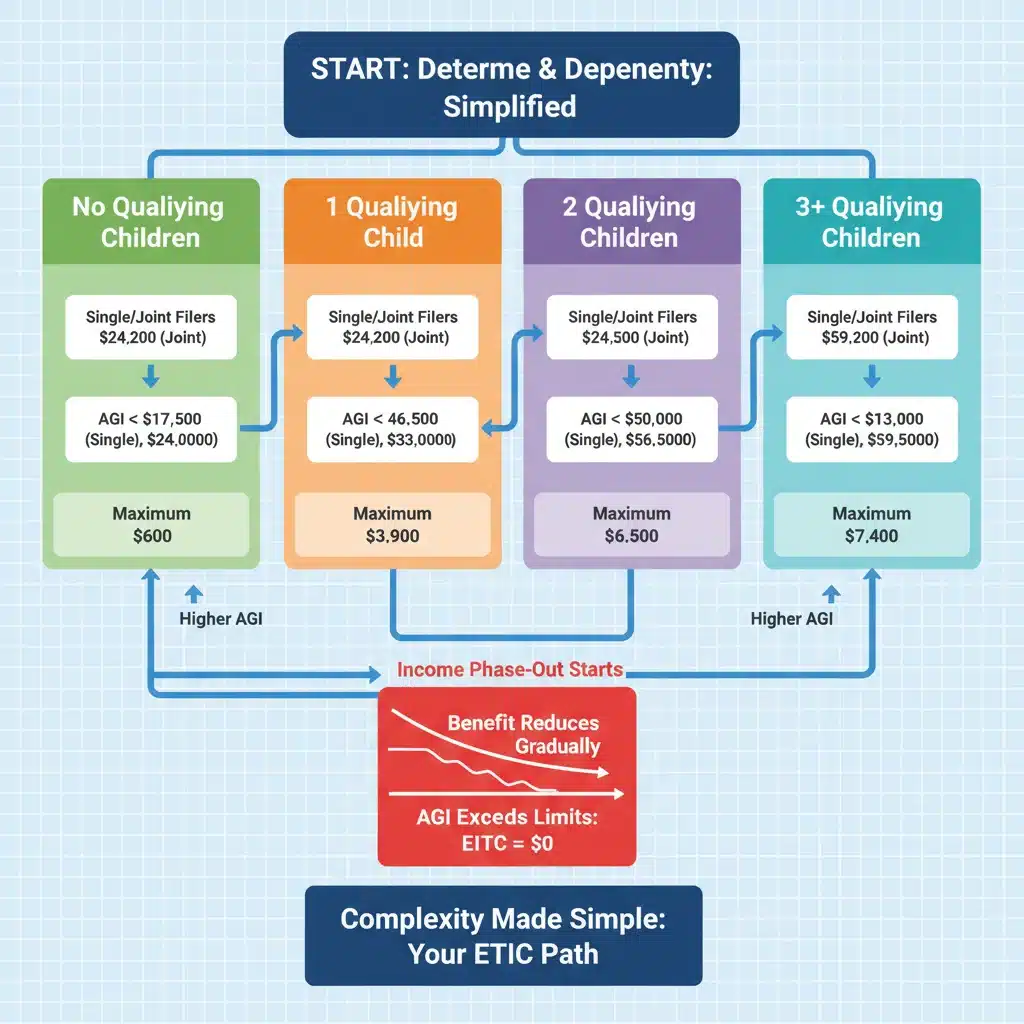
As discussed, your filing status (Single, Married Filing Jointly, Head of Household, Qualifying Widow(er)) and the number of qualifying children (0, 1, 2, or 3+) directly impact the maximum credit amount and the income thresholds. This is the foundational step for the 2026 Earned Income Tax Credit calculation.
Step 2: Calculate Your Earned Income and AGI
Accurately determine your total earned income for the tax year. This includes all taxable wages, salaries, tips, and net earnings from self-employment. Then, calculate your Adjusted Gross Income (AGI). Your AGI is your gross income minus certain deductions, such as traditional IRA contributions or student loan interest. Both figures are crucial for checking against the IRS limits for the 2026 Earned Income Tax Credit.
Step 3: Consult the EITC Tables (Once Released)
The IRS publishes official EITC tables each year, typically in Publication 596, "Earned Income Credit." These tables will list the maximum credit amounts and phase-out ranges for the 2026 Earned Income Tax Credit based on your filing status and number of qualifying children. You’ll find your earned income or AGI (whichever is greater) in the tables to determine your credit amount.
For example, if you are single with two qualifying children and your earned income is $35,000, you would locate the "Single, Head of Household, or Qualifying Widow(er) with two qualifying children" section of the table and find the row corresponding to your income to see the credit amount. The credit amount will gradually increase with earned income up to a certain point, then level off, and finally phase out as your income continues to rise.
Step 4: Consider Special Circumstances
Certain situations can affect your EITC calculation:
- "Look-back" Rule: For the 2026 Earned Income Tax Credit, the IRS might allow taxpayers to elect to use their 2024 or 2025 earned income to calculate their 2026 EITC if their 2026 earned income was lower than in those prior years. This rule, if extended, is designed to help those whose income significantly dropped due to unforeseen circumstances, ensuring they still receive a substantial credit. Always check for the latest IRS guidance on this rule.
- Disability: If you or your qualifying child is permanently and totally disabled, special rules may apply to the age test for a qualifying child.
- Members of the Military: Special rules may apply to military members regarding earned income and residency.
It’s important to use the most current IRS publications and tools, or consult with a tax professional, to ensure accuracy in your 2026 Earned Income Tax Credit calculation.
Maximizing Your 2026 Earned Income Tax Credit: Practical Strategies
Beyond simply meeting the eligibility requirements, there are several strategic steps you can take to ensure you maximize your 2026 Earned Income Tax Credit. These proactive measures can make a significant difference in the size of your refund.
1. Accurate Income Reporting
This might seem obvious, but accurately reporting all earned income is paramount. This includes all W-2 wages and any self-employment income, even from small side jobs. Underreporting can lead to a lower credit or even an audit, while overreporting could push you above the income limits. Keep meticulous records of all income sources throughout the year. For self-employed individuals, tracking all income and eligible business expenses accurately is vital for determining your net earnings, which directly impacts your 2026 Earned Income Tax Credit.
2. Correct Filing Status
Choosing the correct filing status is critical. For instance, if you qualify for "Head of Household" instead of "Single," your AGI limits and potential EITC could be higher. Review the IRS criteria for each filing status carefully, especially if your living situation changed during the year. If you are married but living apart, you might qualify for Head of Household if you meet specific conditions, which could potentially increase your 2026 Earned Income Tax Credit.
3. Identify All Qualifying Children
Ensure you identify every child who meets the qualifying child rules. The more qualifying children you have (up to three), the higher your potential EITC. If you have a complex family situation (e.g., shared custody, foster children, or relatives living with you), carefully review the dependency rules. Don’t assume a child doesn’t qualify without checking the specific IRS criteria. A common mistake is overlooking a child who lives with you but isn’t your biological offspring.
4. Utilize the "Look-Back" Rule (If Applicable for 2026)
As mentioned, if the "look-back" rule is extended for the 2026 Earned Income Tax Credit, it could be a game-changer. If your 2026 earned income is lower than your 2024 or 2025 earned income, you may have the option to use the higher prior-year income to calculate your EITC. This is particularly beneficial for those who experienced job loss, reduced hours, or a significant decrease in self-employment income. Stay informed about IRS announcements regarding this provision.
5. Avoid Common Errors
The EITC is one of the most frequently audited credits due to common errors. These include:
- Claiming a child who doesn’t meet the rules: Ensure residency, age, and relationship tests are met.
- Incorrectly reporting income: Double-check W-2s and self-employment income.
- Using the wrong filing status: Verify your status against IRS guidelines.
- Not having a valid SSN: Everyone on the return must have one.
Taking extra time to review your information and documentation can prevent delays and potential audits related to your 2026 Earned Income Tax Credit.
How to Claim Your 2026 Earned Income Tax Credit
Claiming the 2026 Earned Income Tax Credit requires you to file a federal income tax return, even if you don’t owe any tax. This is crucial because the EITC is a refundable credit, and you won’t receive it unless you file.
1. File a Federal Tax Return
You must file Form 1040, U.S. Individual Income Tax Return. Even if your income is below the filing threshold, you need to file to claim the EITC. If you have qualifying children, you must also attach Schedule EIC, Earned Income Credit, to your Form 1040.
2. Use Tax Software or a Tax Professional
Many tax software programs (e.g., TurboTax, H&R Block) are designed to guide you through the EITC eligibility questions and automatically calculate the credit. This can significantly reduce errors. Alternatively, you can seek assistance from a qualified tax professional or free tax preparation services. The IRS offers free tax help through programs like Volunteer Income Tax Assistance (VITA) and Tax Counseling for the Elderly (TCE) for eligible taxpayers. These services can be invaluable for ensuring you correctly claim your 2026 Earned Income Tax Credit.
3. Keep Good Records
Maintain accurate records of all income, W-2 forms, 1099 forms, self-employment records, and documents proving your children’s residency (e.g., school records, medical records). The IRS may request these documents if your return is selected for review. Good record-keeping is your best defense against potential issues and helps streamline the process of claiming your 2026 Earned Income Tax Credit.
4. What to Do if You Missed Claiming EITC in Prior Years
If you realize you were eligible for the EITC in a previous year (up to three years back) but didn’t claim it, you can still file an amended return (Form 1040-X) to claim the credit. For example, if you realize you were eligible for the 2023 EITC (filed in 2024), you can amend your 2023 return to claim it. This applies to the 2026 Earned Income Tax Credit in future years as well.
Common Misconceptions About the 2026 Earned Income Tax Credit
Despite its widespread availability, several myths and misunderstandings surround the EITC, preventing many eligible individuals from claiming it. Let’s debunk some common misconceptions regarding the 2026 Earned Income Tax Credit.
Myth 1: "I don’t have children, so I can’t get the EITC."
Reality: While the maximum credit is significantly higher for those with qualifying children, individuals without children can also qualify for the EITC. The credit for childless workers is smaller and has stricter age and income requirements, but it is available. For the 2025 tax year, the maximum credit for those without qualifying children was $632. This amount will be adjusted for the 2026 Earned Income Tax Credit.
Myth 2: "The EITC is only for people who don’t work."
Reality: This is entirely false. The "Earned" in Earned Income Tax Credit explicitly means you must have earned income to qualify. It is designed to support and incentivize work, not to replace it. In fact, if you have no earned income, you are ineligible for the EITC.
Myth 3: "I’m self-employed, so I can’t get the EITC."
Reality: Self-employment income absolutely counts as earned income for EITC purposes, as long as it’s net earnings from self-employment. Many small business owners and independent contractors are eligible. The key is to accurately report your self-employment income and expenses on Schedule C or F.
Myth 4: "It’s too complicated to claim, so it’s not worth it."
Reality: While tax forms can be intimidating, the potential refund from the 2026 Earned Income Tax Credit (up to $7,430) makes it well worth the effort. Tax software, free tax assistance programs, and tax professionals can simplify the process significantly. Don’t let perceived complexity deter you from a substantial financial benefit.
Myth 5: "If I receive government benefits, I won’t qualify."
Reality: Receiving certain government benefits (like SNAP, Medicaid, or housing assistance) generally does not disqualify you from the EITC. What matters is your earned income and AGI. Unearned benefits themselves typically do not count as earned income but also don’t preclude you from claiming the credit if you meet other criteria.
The Future of the Earned Income Tax Credit and What to Expect for 2026
The EITC is a dynamic credit, often subject to legislative discussions and adjustments. While the core structure is expected to remain consistent for the 2026 Earned Income Tax Credit, there are always potential changes to monitor.
Inflation Adjustments
The most predictable change for 2026 will be the annual inflation adjustments to the income thresholds and maximum credit amounts. These adjustments ensure that the credit’s value keeps pace with the cost of living, providing meaningful support to eligible taxpayers. The IRS typically releases these updated figures in late fall or early winter preceding the tax filing season.
Potential Legislative Changes
While less certain, there’s always the possibility of legislative changes to the EITC. Policymakers frequently debate expansions or modifications to the credit, such as increasing the credit for childless workers, adjusting age limits, or simplifying eligibility rules. Staying informed through reputable tax news sources and the official IRS website is the best way to be aware of any significant legislative impacts on the 2026 Earned Income Tax Credit.
Continued Focus on Outreach
The IRS and various advocacy groups continue their efforts to reach eligible taxpayers who may not be claiming the EITC. Millions of dollars go unclaimed each year because people are unaware they qualify or find the process too complex. Expect continued outreach campaigns and resources to help taxpayers claim their due for the 2026 Earned Income Tax Credit.
Conclusion: Unlock Your Full 2026 Earned Income Tax Credit Potential
The 2026 Earned Income Tax Credit represents a powerful opportunity for working individuals and families to significantly boost their financial resources, with potential refunds reaching up to $7,430. This credit is not just a tax break; it’s a vital support system designed to reward work and alleviate financial pressure for those who need it most.
By carefully reviewing the eligibility requirements, understanding how the credit is calculated, and implementing the practical strategies outlined in this guide, you can confidently navigate the tax landscape and ensure you claim every dollar you are entitled to. Remember to keep meticulous records, choose the correct filing status, and utilize available resources like free tax assistance programs or professional tax preparers.
Don’t let the complexity of tax law intimidate you. The potential financial impact of the 2026 Earned Income Tax Credit is too significant to overlook. Take the proactive steps today to educate yourself, prepare your documents, and secure your maximum refund. Your financial future will thank you.
Stay tuned to official IRS announcements for the precise income thresholds and credit amounts for the 2026 tax year. With this knowledge in hand, you are well-equipped to maximize your 2026 Earned Income Tax Credit and achieve greater financial stability.