
The rapid advancement of medical technology (MedTech) has ushered in an era of unprecedented innovation, promising better diagnostics, more effective treatments, and personalized healthcare. However, this progress is inextricably linked to the collection, processing, and sharing of vast amounts of sensitive patient data. As we look towards 2026, the landscape of MedTech Data Privacy is becoming increasingly complex, demanding a robust educational framework to ensure compliance, foster trust, and uphold ethical standards.
This article delves into the critical aspects of mastering MedTech Data Privacy, outlining a comprehensive educational framework designed to equip professionals with the knowledge and tools necessary to navigate this intricate domain. We will explore the evolving regulatory environment, the technical challenges, the ethical imperatives, and the strategic approaches required to build and maintain patient trust in an increasingly data-driven healthcare ecosystem.
The Evolving Landscape of MedTech Data Privacy
The convergence of healthcare and technology has given rise to a myriad of medical devices, software, and digital health solutions that collect diverse forms of health data. From wearable sensors monitoring vital signs to AI-powered diagnostic tools and telehealth platforms, the scope of data collection is expanding exponentially. This expansion, while beneficial for patient care, introduces significant privacy challenges. The sheer volume and sensitivity of the data necessitate stringent measures to protect against breaches, misuse, and unauthorized access.
Key Drivers of Complexity in MedTech Data Privacy
- Interconnected Devices: The Internet of Medical Things (IoMT) means devices are constantly communicating, creating complex data pathways.
- Cloud Computing: Storing and processing health data in the cloud introduces new security considerations and compliance requirements.
- Artificial Intelligence and Machine Learning: AI algorithms often require large datasets for training, raising questions about data anonymization, re-identification risks, and algorithmic bias.
- Global Reach: MedTech products are often developed and deployed across multiple jurisdictions, each with its own data privacy laws.
- Patient Expectations: Patients are increasingly aware of their data rights and expect transparency and control over their health information.
Understanding these drivers is the first step in developing an effective strategy for MedTech Data Privacy. The educational framework must address these complexities holistically, preparing professionals for the multifaceted challenges they will encounter.
Pillars of the 2026 MedTech Data Privacy Educational Framework
To effectively master MedTech Data Privacy by 2026, an educational framework must be built upon several foundational pillars. These pillars ensure a comprehensive understanding of both the theoretical underpinnings and the practical applications of data privacy in the MedTech sector.
Pillar 1: Deep Dive into Global Regulatory Compliance
Regulatory compliance forms the bedrock of data privacy. Professionals in MedTech must possess an in-depth understanding of the various laws and regulations governing health data across different regions. This pillar focuses on:
- General Data Protection Regulation (GDPR): Its extraterritorial reach and stringent requirements for data processing, consent, and data subject rights are crucial for any MedTech company operating in or serving the EU.
- Health Insurance Portability and Accountability Act (HIPAA): A cornerstone of health data privacy in the United States, covering Protected Health Information (PHI) and requiring robust administrative, physical, and technical safeguards.
- California Consumer Privacy Act (CCPA) / California Privacy Rights Act (CPRA): While not health-specific, these laws impact how MedTech companies handle personal information of California residents, including data collected through devices and apps.
- Emerging Regional and National Laws: Staying abreast of new regulations such as Brazil’s LGPD, Canada’s PIPEDA, and evolving national data protection acts worldwide is essential.
- Industry-Specific Guidelines: Understanding guidelines from bodies like the FDA, EMA, and ISO standards (e.g., ISO 27001, ISO 27701) relevant to medical device security and data privacy.
The educational framework must provide practical guidance on how to interpret these regulations, conduct privacy impact assessments (PIAs), and implement compliant data handling practices throughout the product lifecycle.
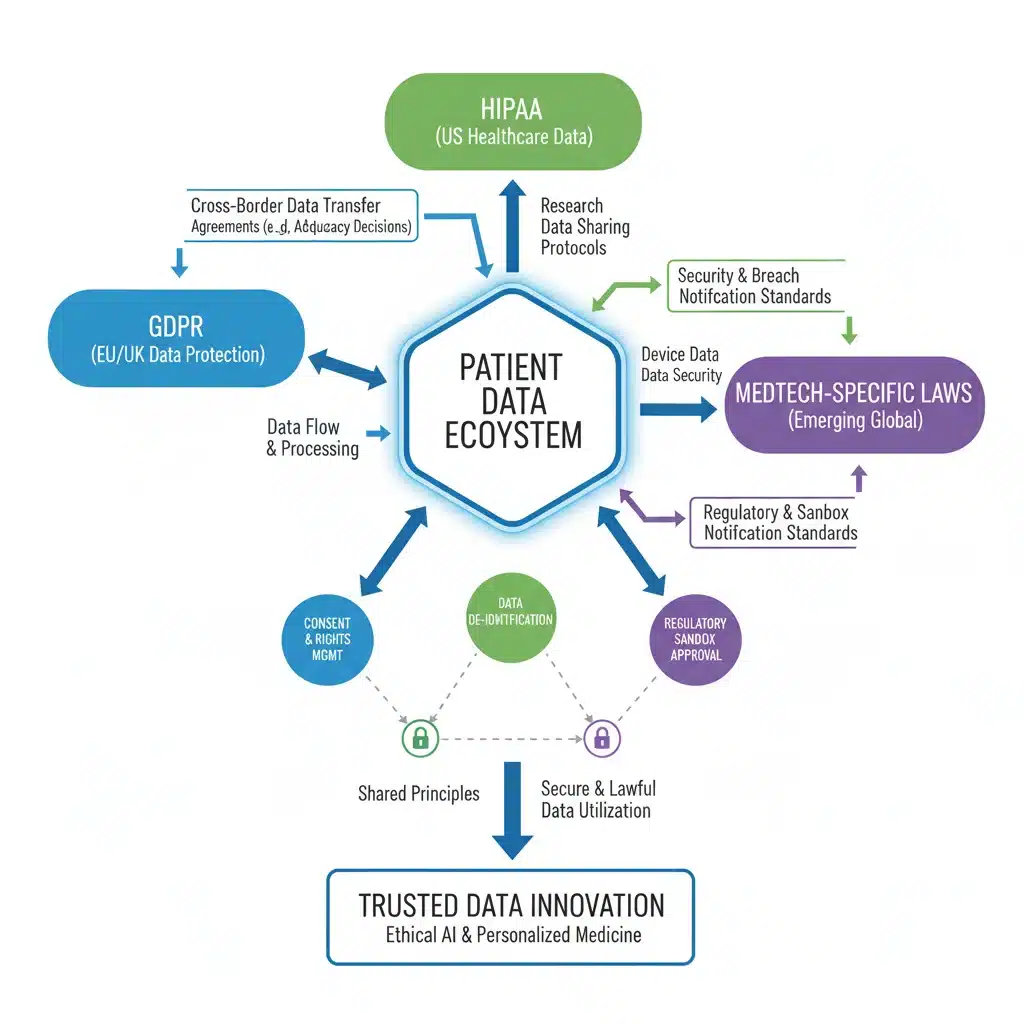
Pillar 2: Technical Safeguards and Cybersecurity Best Practices
Technical expertise is paramount in protecting sensitive health data. This pillar focuses on the practical implementation of security measures and cybersecurity best practices:
- Data Encryption: Understanding various encryption techniques (at rest and in transit) and their application to MedTech data.
- Access Control Mechanisms: Implementing robust authentication and authorization protocols to ensure only authorized personnel can access sensitive data.
- Secure Software Development Lifecycle (SSDLC): Integrating security considerations from the design phase of MedTech products, including threat modeling and secure coding practices.
- Network Security: Protecting MedTech devices and systems from cyber threats through firewalls, intrusion detection systems, and secure network architectures.
- Vulnerability Management: Regularly identifying, assessing, and mitigating security vulnerabilities in MedTech devices and software.
- Incident Response Planning: Developing and practicing comprehensive plans for detecting, responding to, and recovering from data breaches and cybersecurity incidents.
- De-identification and Anonymization Techniques: Understanding the methods and limitations of rendering data anonymous to protect patient identity while enabling research and development.
Training should include hands-on exercises and case studies to solidify understanding and practical application of these technical safeguards.
Pillar 3: Ethical Considerations and Patient Trust
Beyond legal compliance, ethical considerations and patient trust are vital for the long-term success and adoption of MedTech innovations. This pillar addresses:
- Informed Consent: Ensuring patients fully understand how their data will be collected, used, and shared, and providing clear, granular consent options.
- Transparency: Openly communicating data practices to patients, stakeholders, and the public.
- Data Minimization: Adhering to the principle of collecting only the data necessary for a specific purpose.
- Purpose Limitation: Using collected data only for the purposes for which it was originally gathered and consented to.
- Patient Rights: Educating professionals on patients’ rights to access, rectify, erase, and port their data.
- Bias in Algorithms: Addressing potential biases in AI/ML algorithms used in MedTech that could lead to discriminatory outcomes or privacy infringements.
- Building Trust: Strategies for fostering a culture of privacy within organizations and communicating privacy commitments effectively to patients.
This ethical dimension ensures that technological advancements are pursued responsibly and align with societal values, ultimately strengthening MedTech Data Privacy.
Pillar 4: Data Governance and Lifecycle Management
Effective MedTech Data Privacy requires robust data governance throughout the entire data lifecycle. This pillar covers:
- Data Inventory and Mapping: Identifying where sensitive data resides, how it flows through systems, and who has access to it.
- Data Retention Policies: Establishing clear guidelines for how long data should be stored and when it should be securely disposed of.
- Third-Party Vendor Management: Assessing and managing privacy risks associated with third-party vendors, cloud providers, and partners who process MedTech data.
- Privacy by Design and Default: Integrating privacy considerations into the design and architecture of MedTech products and services from the outset.
- Data Protection Officer (DPO) Role: Understanding the responsibilities and importance of a DPO in overseeing data protection strategies.
- Internal Policies and Procedures: Developing and implementing clear internal policies, training programs, and awareness initiatives for all employees.
A well-defined data governance framework ensures accountability and continuous improvement in MedTech Data Privacy practices.
Implementing the 2026 Educational Framework
The successful implementation of this educational framework for MedTech Data Privacy requires a multi-faceted approach, targeting various stakeholders within the MedTech ecosystem.
Target Audiences for Education
- Developers and Engineers: Training on secure coding, privacy-enhancing technologies, and privacy-by-design principles.
- Product Managers: Education on regulatory requirements, ethical considerations, and integrating privacy into product roadmaps.
- Legal and Compliance Teams: Deep dives into specific regulations, risk assessments, and incident response planning.
- Healthcare Providers and Clinicians: Awareness of data handling protocols, patient consent, and secure use of MedTech devices.
- Sales and Marketing Teams: Understanding data privacy implications in communication and customer engagement.
- Executive Leadership: Strategic overview of privacy risks, compliance costs, and the importance of a privacy-first culture.
Educational Modalities
- Online Courses and Certifications: Structured learning paths leading to recognized qualifications in MedTech data privacy.
- Workshops and Bootcamps: Intensive, hands-on training sessions focusing on practical skills and case studies.
- Conferences and Webinars: Keeping professionals updated on emerging trends, regulatory changes, and best practices.
- Internal Training Programs: Customized training developed by organizations to address their specific needs and products.
- Simulation Exercises: Practicing incident response and data breach scenarios to build preparedness.
Continuous learning and regular updates to the curriculum are essential, given the dynamic nature of both technology and regulation in MedTech Data Privacy.
Challenges and Opportunities in 2026 and Beyond
While the educational framework aims to address current and near-future challenges, the MedTech landscape will continue to evolve, presenting both new hurdles and opportunities for MedTech Data Privacy.
Anticipated Challenges
- Quantum Computing: The emergence of quantum computing could potentially break current encryption standards, necessitating new cryptographic approaches.
- Increased Data Volume and Velocity: More sophisticated devices and real-time data streams will amplify the scale of data to protect.
- Global Harmonization (or Lack Thereof): The absence of a single global data privacy standard will continue to complicate international operations.
- AI Ethics and Explainability: Ensuring transparency and accountability in complex AI systems that process health data.
- Supply Chain Risks: Managing privacy risks across an increasingly complex and global MedTech supply chain.
Opportunities for Enhanced MedTech Data Privacy
- Privacy-Enhancing Technologies (PETs): Advancements in technologies like differential privacy, federated learning, and homomorphic encryption can enable data utilization while preserving privacy.
- Blockchain for Data Security and Consent: Exploring decentralized ledger technologies for secure data sharing and immutable consent records.
- Standardization Efforts: Greater industry collaboration to develop common standards for data privacy and security in MedTech.
- User-Centric Privacy Controls: Developing intuitive interfaces that give patients more granular control over their health data.
The educational framework must be agile enough to incorporate these future trends, preparing professionals not just for compliance, but for innovation in privacy-preserving technologies.

Building and Maintaining Patient Trust in MedTech
Ultimately, the success of any MedTech Data Privacy initiative hinges on building and maintaining patient trust. Without trust, patients may be reluctant to adopt new technologies, share their data, or fully engage with innovative healthcare solutions.
Strategies for Fostering Trust
- Transparency and Clear Communication: Providing easy-to-understand privacy policies and clear explanations of data usage.
- Empowering Patients with Control: Offering mechanisms for patients to view, manage, and revoke consent for their data.
- Demonstrating Accountability: Being transparent about data breaches, taking responsibility, and showing clear remediation steps.
- Ethical Leadership: Companies demonstrating a strong commitment to ethical data practices from the top down.
- Security Certifications and Audits: Publicly demonstrating adherence to recognized security standards and undergoing independent audits.
- Education for Patients: Helping patients understand the benefits and risks of sharing their data, and how to protect their own privacy.
The educational framework must instill in MedTech professionals the understanding that privacy is not merely a compliance burden but a fundamental component of patient care and a competitive differentiator.
Conclusion
As we advance towards 2026, mastering MedTech Data Privacy is no longer optional; it is imperative for innovation, compliance, and the future of healthcare. The proposed educational framework, built on pillars of regulatory compliance, technical safeguards, ethical considerations, and data governance, provides a roadmap for cultivating a skilled workforce capable of navigating this complex environment.
By investing in comprehensive education and fostering a culture of privacy-first thinking, the MedTech industry can continue to push the boundaries of medical innovation while safeguarding the trust and privacy of patients worldwide. The journey to mastering MedTech Data Privacy is ongoing, requiring continuous learning, adaptation, and a steadfast commitment to responsible data stewardship. The future of healthcare depends on it.