Maximize Your 401(k) Match in 2026: Don’t Miss Out on Free Money

Maximize Your 401(k) Matching Benefits in 2026: Don’t Leave Up to $5,000 on the Table
In the world of personal finance, few opportunities offer a guaranteed return on investment quite like an employer 401(k) match. It’s essentially free money for your retirement, yet a significant number of employees consistently fail to take full advantage of it. As we look ahead to 2026, understanding and optimizing your 401k matching benefits is more crucial than ever. For many, this could mean leaving thousands of dollars – potentially up to $5,000 or more – on the table each year. This comprehensive guide will walk you through everything you need to know to ensure you’re maximizing this invaluable benefit.
The concept of a 401(k) match is straightforward: your employer contributes a certain amount to your retirement account based on your own contributions. However, the specifics can vary wildly from one company to another, making it essential to grasp the nuances of your particular plan. Ignoring these details is akin to voluntarily taking a pay cut, as you’re foregoing a direct boost to your long-term financial security. Let’s delve into the intricacies of 401k matching benefits and how you can strategically position yourself to capture every dollar available.
Understanding the Basics of 401(k) Matching
Before we dive into optimization strategies, it’s vital to have a firm grasp of what a 401(k) match entails. A 401(k) plan is a tax-advantaged retirement savings plan offered by many employers. When your employer offers a match, they contribute money to your 401(k) account based on a percentage of your contributions. This is often referred to as ‘free money’ because it doesn’t come out of your paycheck; it’s an additional benefit provided by your employer.
How Does a 401(k) Match Work?
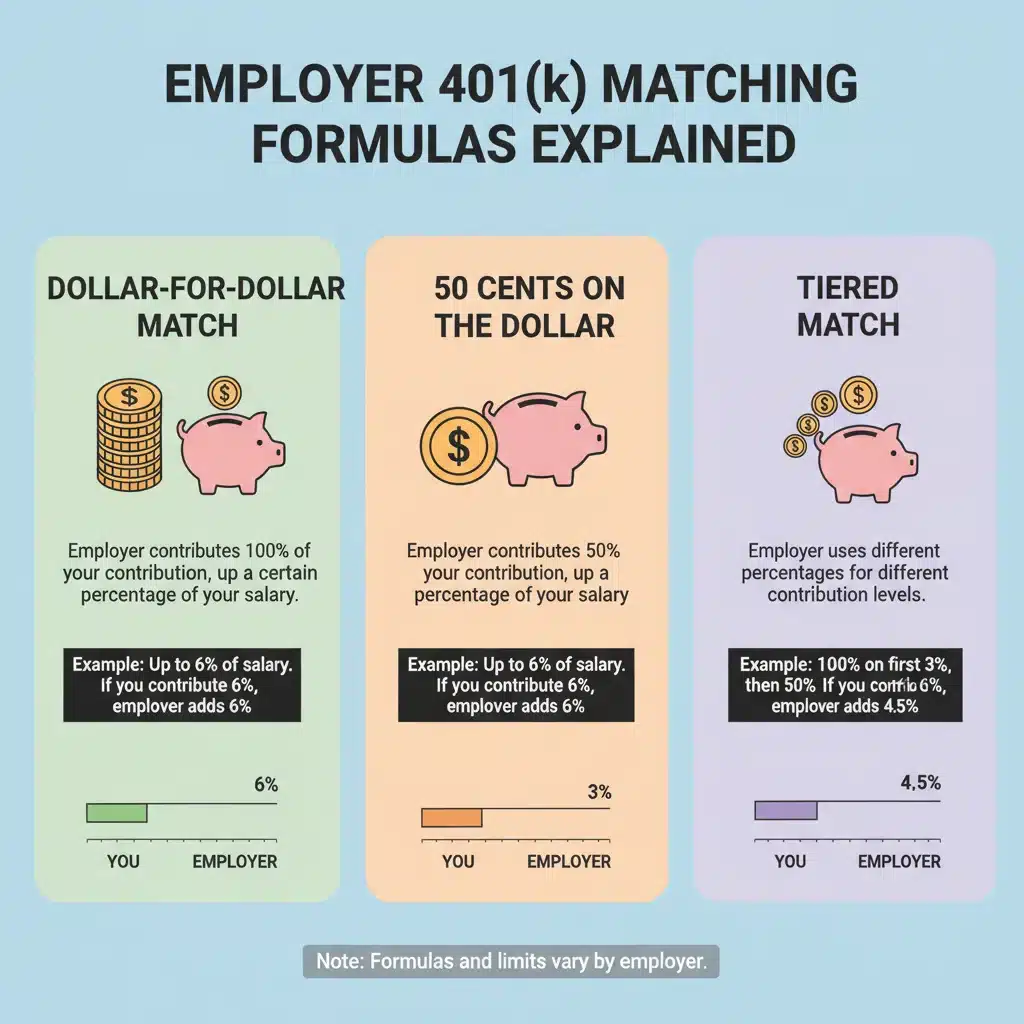
Most employer matches follow one of a few common formulas:
- Dollar-for-Dollar Match: Your employer matches 100% of your contributions up to a certain percentage of your salary. For example, if your employer matches 100% of your contributions up to 3% of your salary, and you earn $70,000, they will contribute up to $2,100 if you contribute at least that much.
- 50 Cents on the Dollar Match: Your employer matches 50% of your contributions up to a certain percentage of your salary. Using the same example, if your employer matches 50% of your contributions up to 6% of your salary, they will contribute up to $2,100 if you contribute $4,200 (50% of $4,200 = $2,100).
- Tiered Match: Some employers use a combination, for instance, matching 100% for the first X% and then 50% for the next Y%.
- Discretionary Match: Less common, but some employers offer a match that is not guaranteed and depends on company performance or other factors.
It’s crucial to find out your specific employer’s 401k matching benefits formula. This information is typically available in your benefits package, HR portal, or by speaking with your human resources department.
Why Maximizing Your 401(k) Match is Non-Negotiable
The primary reason to maximize your 401(k) match is simple: it’s an immediate, guaranteed return on your investment. If your employer offers a 100% match up to 3% of your salary, that’s an instant 100% return on the first 3% of your income that you contribute. You won’t find that kind of immediate return anywhere else in the investment world.
The Power of Compounding
Beyond the immediate return, the matched funds benefit from the power of compounding over decades. Even small employer contributions, when invested wisely and given enough time, can grow into substantial sums. Consider this: if you receive an annual match of $2,000 and it grows at an average annual rate of 7% for 30 years, those matched funds alone could be worth over $150,000 at retirement, without you contributing a single extra personal dollar beyond what was needed to get the match. This illustrates the profound impact of consistently capturing your full 401k matching benefits.
Lost Opportunity Cost
Every dollar of employer match you don’t receive is a dollar you’re effectively giving up. It’s a missed opportunity to accelerate your retirement savings and build wealth. Over a career, these missed opportunities can amount to tens, if not hundreds, of thousands of dollars. This is why understanding and acting on your 401k matching benefits is paramount.
Key Factors Influencing Your 401(k) Match in 2026
While the core principles of 401(k) matching remain consistent, there are several factors that can influence how much you receive and how you should approach your contributions, especially looking towards 2026.
Contribution Limits for 2026
The IRS sets annual contribution limits for 401(k) plans. These limits typically adjust each year for inflation. While the exact limits for 2026 are usually announced in late 2025, it’s safe to assume they will be similar to or slightly higher than current limits. For context, in 2024, the employee contribution limit was $23,000, with an additional $7,500 catch-up contribution for those aged 50 and over. Your employer match does not count towards your personal contribution limit, but there is a separate overall limit for total contributions (employee + employer) to a 401(k).
Staying informed about these limits is crucial. If you contribute up to the personal limit early in the year, you might inadvertently miss out on some of your employer’s 401k matching benefits if your company has a ‘per-pay-period’ matching schedule rather than an annual true-up.
Vesting Schedules: When is the Money Truly Yours?
One of the most critical aspects of employer contributions is the vesting schedule. Vesting refers to the point in time when you gain full ownership of the money your employer has contributed to your 401(k). Until you are fully vested, if you leave the company, you may forfeit some or all of the employer-matched funds.
Common vesting schedules include:
- Immediate Vesting: The money is yours as soon as it’s contributed. This is the most employee-friendly option.
- Cliff Vesting: You become 100% vested after a certain number of years of service (e.g., 3 years). If you leave before that time, you get none of the employer contributions.
- Graded Vesting: You become vested gradually over several years (e.g., 20% after 2 years, 40% after 3 years, 60% after 4 years, and 100% after 5 years).
Understanding your vesting schedule is vital for long-term career planning. If you’re considering changing jobs, calculate how it might impact your employer’s 401k matching benefits. Don’t leave money on the table by leaving just before a significant vesting milestone.
Contribution Pacing: The ‘True-Up’ Clause
This is a subtle but extremely important detail. Some employers match your contributions on a pay-period basis. If you max out your 401(k) contributions early in the year, you might stop contributing for the latter part of the year. If your employer doesn’t offer a ‘true-up’ at year-end, you could miss out on potential matches for the pay periods in which you didn’t contribute. A ‘true-up’ ensures that even if you max out early, your employer will still contribute the full match you would have received had you contributed consistently throughout the year.
Always check if your plan includes a true-up provision. If not, it’s generally advisable to spread your contributions evenly throughout the year to ensure you receive the maximum possible 401k matching benefits.
Strategies to Maximize Your 401(k) Matching Benefits
Now that we’ve covered the fundamentals, let’s explore actionable strategies to ensure you’re getting every penny of your employer’s match in 2026.
1. Always Contribute at Least Enough to Get the Full Match
This is the golden rule of 401(k) matching. If your employer matches 100% of your contributions up to 5% of your salary, make sure you’re contributing at least 5%. This is the absolute minimum you should aim for. Anything less means you’re intentionally declining free money. Seriously, it’s like turning down a bonus.
2. Understand Your Employer’s Specific Matching Formula
As discussed, formulas vary. Don’t guess. Read your plan documents, consult your HR department, or log into your benefits portal. Knowing the exact percentage and cap will allow you to fine-tune your contributions for optimal results. Is it 100% up to 3%? 50% up to 6%? The details matter significantly when calculating your potential 401k matching benefits.
3. Be Aware of Vesting Schedules
If you’re in a graded vesting schedule, consider the implications if you plan to leave your job. While you shouldn’t stay in an unhappy job just for the match, being aware of when you fully vest can help you make informed decisions. If you’re only a few months away from full vesting and a significant portion of your employer’s match becomes yours, it might be worth waiting.
4. Monitor Your Contributions Throughout the Year
Especially if your plan lacks a true-up provision, regularly check your contribution rate and year-to-date contributions. Ensure you’re on track to hit the maximum match without over-contributing too early. Many online 401(k) portals provide tools to help you project your contributions and match amounts.
5. Increase Your Contributions Over Time
Once you’re receiving the full match, don’t stop there if you can afford to contribute more. Financial advisors often recommend contributing at least 10-15% of your income to retirement, including the employer match. As your salary increases, try to increase your contribution percentage by at least 1% each year. This incremental approach can significantly boost your retirement savings without feeling like a major hit to your take-home pay.
6. Don’t Forget About Catch-Up Contributions (Age 50+)
If you’re 50 or older, you’re eligible for additional catch-up contributions to your 401(k). For 2024, this was an extra $7,500. This is another excellent way to boost your retirement savings and potentially receive more 401k matching benefits, though the employer match usually only applies to your regular contributions up to a certain percentage of your salary, not the catch-up amount itself. Still, it’s a powerful tool for those nearing retirement.
7. Consider Your Overall Financial Picture
While maximizing your 401(k) match is a top priority, it’s part of a broader financial strategy. Ensure you also have an emergency fund, are managing high-interest debt, and are considering other investment vehicles like IRAs or HSAs if appropriate. Your 401(k) is a cornerstone, but not the only pillar of your financial house.
Common Pitfalls to Avoid with 401(k) Matching Benefits
Even with the best intentions, it’s easy to make mistakes that can cost you valuable employer contributions. Here are some common pitfalls to steer clear of:
Not Contributing Enough
The most egregious error is simply not contributing enough to get the full match. This is literally leaving free money on the table. If you’re struggling to meet the minimum, re-evaluate your budget. Even a small adjustment can make a big difference over time.
Cashing Out a 401(k) When Changing Jobs
When you leave a job, you might be tempted to cash out your 401(k). This is almost always a bad idea. You’ll likely pay income taxes on the distribution, plus a 10% early withdrawal penalty if you’re under 59½. Furthermore, you lose all the future growth potential of those funds, including the employer’s 401k matching benefits that you worked hard to earn. Instead, roll it over into your new employer’s 401(k) or an IRA.
Ignoring Your Investment Options
While the focus here is on the match, don’t forget that the money needs to grow. Many 401(k) plans offer a range of investment options, from target-date funds to individual stock and bond funds. Make sure your investments align with your risk tolerance and time horizon. A poorly performing portfolio can diminish the impact of even the most generous 401k matching benefits.
Not Reviewing Your Plan Annually
Benefits plans can change. Your employer might adjust their matching formula, vesting schedule, or even the plan administrator. Make it a habit to review your 401(k) plan documents and your contributions at least once a year, preferably during open enrollment or at the beginning of the new year. This ensures you’re always optimized for the current rules and maximizing your 401k matching benefits.
Falling Victim to Lifestyle Creep
As your income grows, it’s natural to want to enjoy a higher standard of living. However, if increased spending prevents you from increasing your 401(k) contributions, you’re missing out on significant long-term gains. Try to save a portion of every raise you receive. If you get a 5% raise, commit to increasing your 401(k) contribution by at least 1-2% of your salary.

The 2026 Landscape: What to Anticipate
While specific legislative changes or economic shifts for 2026 are speculative, we can anticipate a few general trends that will continue to emphasize the importance of maximizing your 401k matching benefits:
- Inflationary Pressures: Ongoing inflation means that every dollar saved today will need to work harder to maintain its purchasing power in retirement. Employer matches provide a vital boost to combat this.
- Potential for Contribution Limit Increases: Historically, 401(k) contribution limits tend to increase incrementally with inflation. Be prepared to adjust your contributions if these limits rise, allowing you to save even more.
- Economic Uncertainty: Global economic factors can introduce volatility into investment markets. The guaranteed return of an employer match provides a stable, foundational element to your retirement savings amidst any market fluctuations.
- Focus on Employee Retention: In a competitive job market, strong benefits packages, including generous 401k matching benefits, remain a key tool for employers to attract and retain talent. Companies are likely to continue offering competitive matches.
Staying informed about economic forecasts and potential policy changes will allow you to make nimble adjustments to your financial planning, ensuring that your 401k matching benefits strategy remains robust.
Calculating Your Potential 401(k) Match
Let’s put some numbers to this. Imagine you earn $80,000 annually, and your employer offers a 100% match on the first 4% of your salary. To get the full match, you need to contribute 4% of $80,000, which is $3,200 per year. Your employer will then contribute an additional $3,200. That’s $3,200 of ‘free money’ every year!
Now, let’s consider the ‘up to $5,000’ figure mentioned in the title. If you earn $100,000 and your employer matches 50% on the first 10% of your salary, you’d need to contribute $10,000 (10% of $100,000). Your employer would then contribute $5,000 (50% of $10,000). This demonstrates how quickly these matching benefits can add up, especially for higher earners or those with very generous employer plans. Even if your match is less, it’s still a significant amount that you absolutely should not forgo.
Steps to Calculate Your Match:
- Find your annual salary.
- Identify your employer’s matching formula: What percentage do they match, and up to what percentage of your salary?
- Calculate the maximum personal contribution needed: Multiply your salary by the percentage cap for the match.
- Calculate the maximum employer match: Apply the employer’s matching percentage to the amount from step 3.
This simple calculation will give you a clear target for your contributions to maximize your 401k matching benefits.
Beyond the Match: Other 401(k) Considerations
While the employer match is a powerful incentive, a holistic approach to your 401(k) involves more than just capturing that ‘free money’.
Roth 401(k) vs. Traditional 401(k)
Many plans now offer both Traditional and Roth 401(k) options. Contributions to a Traditional 401(k) are tax-deductible in the year they are made, and withdrawals are taxed in retirement. Roth 401(k) contributions are made with after-tax dollars, but qualified withdrawals in retirement are tax-free. Your employer match will always go into a Traditional 401(k) account, even if your personal contributions are to a Roth. The decision between Roth and Traditional depends on your current and projected future tax brackets.
Diversification and Asset Allocation
Ensure your 401(k) investments are well-diversified across different asset classes (stocks, bonds, real estate, etc.) and aligned with your risk tolerance and time horizon. A target-date fund can be a good ‘set it and forget it’ option for many, automatically adjusting its asset allocation as you approach retirement. Regularly review your asset allocation to ensure it still meets your needs.
Fees and Expenses
Be aware of the fees associated with your 401(k) plan and its investment options. High fees can erode your returns over time. While you may not have control over the plan administration fees, you can often choose lower-cost investment funds within the plan, such as index funds or ETFs, over actively managed funds with higher expense ratios. Even small differences in fees can have a substantial impact on your retirement nest egg.
Conclusion: Take Control of Your Retirement Future
Optimizing your 401k matching benefits in 2026 is one of the most impactful financial decisions you can make. It’s a direct pathway to increasing your retirement savings, leveraging the power of employer contributions and compounding interest. By understanding your plan’s specifics, contributing strategically, and avoiding common pitfalls, you can ensure you’re not leaving thousands of dollars of ‘free money’ on the table.
Take the time today to review your 401(k) statement, understand your employer’s match, and adjust your contributions if necessary. Your future self will thank you for taking proactive steps to maximize your 401k matching benefits and build a more secure financial future. Don’t let this invaluable opportunity pass you by!