Telehealth’s Impact on MedTech Training: New Models for 2026
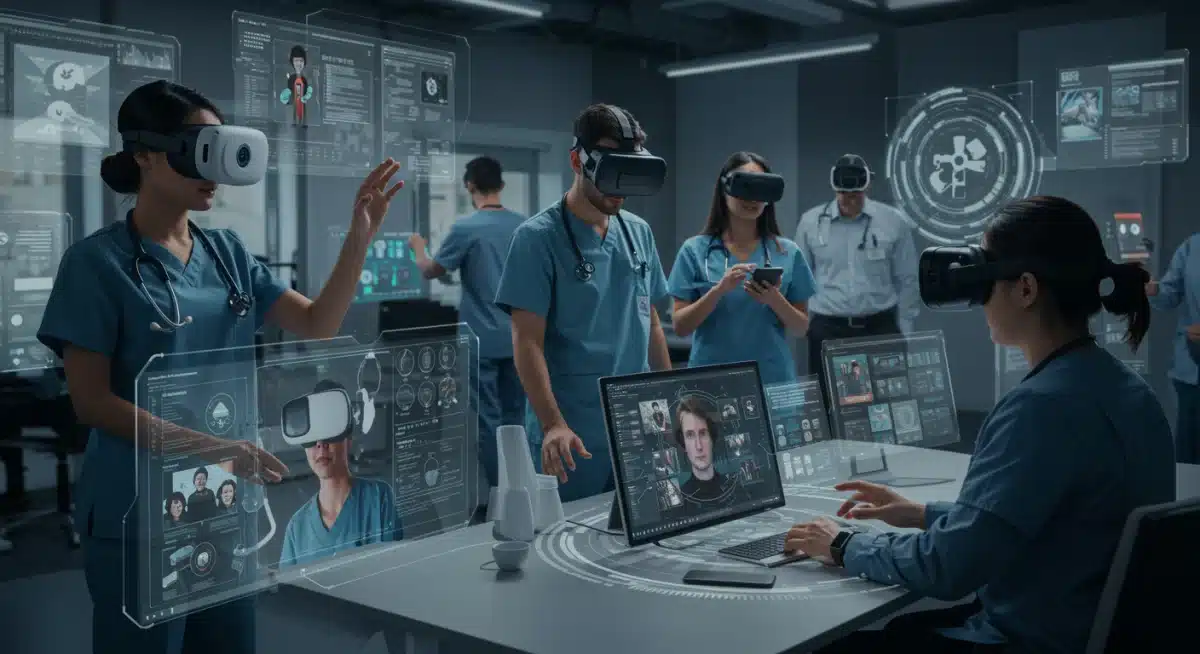
Telehealth is profoundly reshaping MedTech training, driving the adoption of innovative educational models for 2026 that prioritize virtual learning, remote collaboration, and adaptive skill development to meet the evolving demands of modern healthcare.
The landscape of healthcare is in constant flux, and at its forefront is the rapid integration of telehealth. This digital transformation carries significant implications, particularly for how medical technology (MedTech) professionals are educated and trained. Understanding the impact of telehealth on MedTech training: new educational models for 2026 is not merely an academic exercise; it’s a critical imperative for ensuring the future competency of the healthcare workforce.
The rise of telehealth and its implications for MedTech
Telehealth has rapidly transitioned from a niche service to a cornerstone of modern healthcare delivery, accelerated significantly by global events. This shift has not only altered how patients receive care but also fundamentally changed the operational dynamics for medical device companies and their personnel. The traditional model of in-person training and device demonstrations is being reevaluated, paving the way for more flexible and digitally-driven approaches.
The widespread adoption of telehealth means that MedTech professionals must now be proficient in supporting virtual consultations, troubleshooting devices remotely, and even guiding healthcare providers through procedures without being physically present. This demands a different skill set, emphasizing digital literacy, remote communication, and an understanding of virtual care workflows. The implications extend across the entire MedTech product lifecycle, from development and regulatory approval to sales, support, and ongoing education.
Adapting to virtual patient interactions
One of the most immediate impacts is the need for MedTech professionals to understand and adapt to virtual patient interactions. While they may not directly treat patients, their products are integral to these virtual encounters. This means training must cover how devices perform in a telehealth context, potential connectivity issues, and how to optimize device usage for remote monitoring and diagnostics.
- Understanding telehealth platforms and their integration with MedTech.
- Troubleshooting common technical issues during virtual care sessions.
- Optimizing device performance for remote data collection and transmission.
- Ensuring patient data security and privacy in a virtual environment.
The rise of telehealth is compelling the MedTech industry to innovate its training methodologies, ensuring that its workforce is not just familiar with new technologies, but truly adept at leveraging them within a virtual care paradigm. This foundational shift is setting the stage for entirely new educational models designed to meet the demands of a digitally integrated healthcare system.
Challenges in traditional MedTech training methods
Traditional MedTech training has long relied on hands-on experiences, in-person workshops, and direct interactions between trainers and trainees. While invaluable for certain aspects, this model presents several inherent challenges that have become more pronounced with the advent of telehealth and the increasing complexity of medical devices. These challenges often lead to inefficiencies, limited reach, and difficulties in maintaining up-to-date knowledge across a geographically dispersed workforce.
One significant hurdle is the logistical complexity and high cost associated with live training events. Coordinating schedules, securing facilities, and covering travel expenses for both trainers and trainees can be prohibitive. Furthermore, the availability of specialized equipment for hands-on practice is often limited, meaning not all trainees get adequate exposure. These factors restrict the frequency and accessibility of training, particularly for new product launches or software updates.
Geographic barriers and accessibility
The physical presence required in traditional training creates substantial geographic barriers. MedTech professionals are spread across vast regions, and bringing them together for training sessions is often impractical. This limits access to specialized training for those in remote areas or those who cannot easily travel, leading to disparities in skill levels and knowledge dissemination.
- High travel costs and time commitment for participants.
- Limited access to expert trainers and specialized equipment.
- Difficulty in scaling training for a large, dispersed workforce.
- Inconsistent training quality due to varying instructor availability.
Moreover, the pace of innovation in MedTech means that product lifecycles are shortening. Traditional training models struggle to keep pace, as developing and deploying new in-person curricula takes time. This can result in a knowledge gap where professionals are using devices that have already undergone significant updates, impacting patient care and operational efficiency. The limitations of these conventional methods underscore the urgent need for more agile and accessible training solutions.
Emergence of virtual training platforms and tools
In response to the challenges of traditional methods and the growing influence of telehealth, the MedTech industry is witnessing a rapid emergence of virtual training platforms and tools. These innovative solutions are designed to deliver high-quality, scalable education to professionals regardless of their location, transforming how MedTech knowledge and skills are acquired and maintained. The shift towards virtual environments is not just a temporary measure but a strategic evolution in educational delivery.
Virtual training encompasses a wide array of technologies, from sophisticated simulation software and augmented reality (AR) applications to interactive e-learning modules and live virtual classrooms. These platforms enable trainees to engage with medical devices, practice complex procedures, and interact with instructors and peers in a dynamic, digital setting. The goal is to replicate the effectiveness of hands-on training while overcoming its logistical and financial constraints.
Key technologies driving virtual MedTech education
Several technologies are at the forefront of this educational revolution. Virtual reality (VR) allows for immersive simulations of surgical procedures or device operation, offering a safe space for repeated practice without risk. Augmented reality overlays digital information onto real-world views, assisting with device assembly, maintenance, or complex diagnostic processes. These tools provide interactive and engaging learning experiences that can be tailored to individual learning paces.
- Virtual reality (VR) for immersive procedural simulations.
- Augmented reality (AR) for interactive device guidance and maintenance.
- High-fidelity e-learning modules with interactive quizzes and case studies.
- Live virtual classrooms and webinars for real-time instruction and Q&A sessions.
These platforms also offer robust analytics capabilities, allowing trainers to track trainee progress, identify areas for improvement, and personalize learning paths. This data-driven approach ensures that training is not only delivered efficiently but also effectively, leading to better knowledge retention and skill development. The continued refinement and integration of these virtual tools are pivotal for shaping the future of MedTech training.
Designing effective virtual curricula for MedTech professionals
The transition to virtual training requires more than simply porting existing materials online; it demands a fundamental rethinking of curriculum design. To be truly effective, virtual MedTech curricula must be engaging, interactive, and specifically tailored to leverage the unique advantages of digital platforms. The focus shifts from passive information consumption to active participation and experiential learning, ensuring that professionals gain practical skills relevant to a telehealth-driven environment.
Effective virtual curricula often incorporate a blended learning approach, combining self-paced modules with live virtual sessions. This allows trainees to absorb foundational knowledge at their own convenience while also participating in real-time discussions, problem-solving exercises, and direct interaction with instructors. The design must also consider varying levels of digital literacy among trainees, providing intuitive interfaces and clear instructions to ensure accessibility for all.
Incorporating simulation and gamification
A cornerstone of effective virtual MedTech training is the integration of high-fidelity simulations and gamification elements. Simulations, whether VR-based or screen-based, offer realistic practice scenarios for device operation, troubleshooting, and even complex patient interactions. Gamification, through points, badges, and leaderboards, can boost engagement and motivate trainees to master challenging concepts.
- Developing interactive scenarios for device troubleshooting and remote support.
- Creating virtual labs for practicing device calibration and maintenance.
- Integrating case studies that reflect real-world telehealth challenges.
- Utilizing adaptive learning pathways based on individual performance data.
Furthermore, effective virtual curricula must prioritize continuous assessment and feedback. This includes automated quizzes, peer reviews in collaborative virtual environments, and instructor-led evaluations during live sessions. The goal is to create a dynamic learning ecosystem that not only imparts knowledge but also builds confidence and competence in MedTech professionals, preparing them for the evolving demands of healthcare delivery.
Measuring success and ensuring competency in virtual training
As MedTech training increasingly shifts to virtual models, the critical question becomes how to effectively measure success and ensure that trainees achieve genuine competency. It’s not enough to simply complete modules; professionals must demonstrate the practical skills and knowledge necessary to safely and effectively utilize medical technologies in a telehealth context. Robust assessment strategies and continuous evaluation are paramount to validating the efficacy of these new educational approaches.
Measuring success in virtual training involves a multi-faceted approach, moving beyond traditional written exams. It includes performance-based assessments within simulations, analysis of participation in virtual collaborative exercises, and tracking progress through adaptive learning pathways. Feedback loops, both automated and instructor-led, are essential for identifying knowledge gaps and areas requiring further development, ensuring a personalized and effective learning journey.
Utilizing data analytics for performance insights
One of the significant advantages of virtual platforms is their ability to collect vast amounts of data on trainee performance. This data can be analyzed to provide deep insights into learning patterns, common errors, and areas where the curriculum might need adjustment. Learning analytics can help identify individuals who are struggling and allow for targeted interventions, ultimately improving overall training outcomes.
- Tracking completion rates and time spent on modules.
- Analyzing performance in simulated environments (e.g., error rates, efficiency).
- Evaluating engagement in virtual discussions and collaborative projects.
- Correlating training performance with real-world job effectiveness.
Ensuring competency also requires ongoing assessment and re-certification mechanisms. Given the rapid pace of technological advancement, a one-time training session is often insufficient. Virtual platforms facilitate continuous learning and micro-credentialing, allowing professionals to regularly update their skills and prove proficiency in new device functionalities or telehealth protocols. This continuous cycle of learning and assessment is vital for maintaining a highly skilled MedTech workforce.
The future outlook: MedTech training in 2026 and beyond
Looking ahead to 2026 and beyond, the future of MedTech training will be inextricably linked to the continued evolution of telehealth and digital technologies. The educational models emerging today are merely the foundation for a more integrated, personalized, and adaptive learning ecosystem. The industry will continue to push the boundaries of what’s possible, leveraging advanced AI, haptics, and predictive analytics to create even more sophisticated and effective training experiences.
One key trend will be the hyper-personalization of learning paths. AI-driven platforms will analyze individual trainee performance, learning styles, and career goals to curate highly customized curricula. This will ensure that every MedTech professional receives the most relevant and efficient training, optimizing their time and maximizing their skill development. The concept of a one-size-fits-all training program will become increasingly obsolete.
Integration of AI and haptic feedback
The integration of artificial intelligence (AI) will move beyond basic analytics to intelligent tutoring systems that can provide real-time, adaptive feedback and guidance during simulations. Haptic feedback technology will become more commonplace, allowing trainees to experience the tactile sensations of interacting with medical devices, further blurring the line between virtual and physical practice. This will be particularly beneficial for complex surgical or interventional procedures.
- AI-powered intelligent tutoring systems for personalized guidance.
- Advanced haptic feedback devices for realistic tactile training.
- Predictive analytics to anticipate future skill requirements.
- Global collaboration platforms for cross-cultural knowledge exchange.
Furthermore, cloud-based training solutions will become the standard, offering unparalleled accessibility and scalability. This will allow MedTech companies to deploy and update training materials globally with ease, ensuring that their entire workforce remains at the cutting edge of technological advancements. The future of MedTech training will be characterized by continuous innovation, driven by the imperative to support an increasingly virtual and technologically advanced healthcare landscape.
| Key Aspect | Description |
|---|---|
| Virtual Platforms | Evolving from traditional methods to immersive digital environments for MedTech education. |
| Curriculum Design | Focus on interactive, blended learning, and hands-on simulation within virtual spaces. |
| Competency Measurement | Utilizing data analytics and performance-based assessments for skill validation. |
| Future Trends | Hyper-personalization, AI integration, and haptic feedback for advanced training. |
Frequently asked questions about MedTech training and telehealth
Telehealth demands enhanced digital literacy, remote communication proficiency, and an understanding of virtual care workflows. MedTech professionals must now be adept at supporting virtual consultations, troubleshooting devices remotely, and optimizing device usage for remote monitoring and diagnostics.
Virtual platforms offer scalability, accessibility, and cost-effectiveness compared to traditional methods. They enable immersive simulations, interactive e-learning, and real-time instruction, overcoming geographic barriers and allowing for personalized learning paths and continuous skill updates.
Competency is ensured through performance-based assessments within simulations, analysis of virtual collaboration, and tracking progress via data analytics. Continuous feedback, automated quizzes, and ongoing certification mechanisms are also crucial for validating skill acquisition and retention.
AI will drive hyper-personalization of learning paths, intelligent tutoring systems providing real-time adaptive feedback, and predictive analytics to anticipate future skill requirements. This will make training more efficient, targeted, and responsive to individual needs and industry shifts.
While virtual methods are gaining prominence, traditional hands-on training remains valuable for certain complex procedures and initial device familiarization. The trend is towards a blended learning approach, combining the best of both worlds to create comprehensive and effective educational programs.
Conclusion
The profound impact of telehealth on MedTech training is undeniable, ushering in an era of innovative educational models that prioritize adaptability, accessibility, and advanced digital integration. As we move towards 2026, the MedTech industry is embracing virtual platforms, sophisticated simulations, and data-driven learning to equip its professionals with the essential skills for a rapidly evolving healthcare landscape. This transformative shift ensures that the workforce remains competent and agile, ready to support the future of patient care delivered both virtually and in-person.