U.S. Hospitals Embrace Predictive Analytics: A Quarter by Mid-2026

The landscape of healthcare in the United States is on the precipice of a profound transformation, driven by the relentless march of technological innovation. A groundbreaking new report has cast a revealing light on this impending shift, projecting that an impressive 25% of U.S. hospitals will have fully embraced and integrated advanced predictive analytics into their core operations by the middle of 2026. This isn’t just a marginal increase; it signifies a monumental leap forward in how healthcare institutions approach everything from patient care and operational efficiency to financial management and strategic planning. The widespread adoption of hospital predictive analytics is set to redefine the very essence of modern medicine, ushering in an era of proactive, data-driven healthcare delivery.
For decades, healthcare has largely operated on a reactive model, responding to illnesses and crises as they arise. While this approach has undoubtedly saved countless lives, it often falls short in preventing adverse events, optimizing resource allocation, and providing truly personalized care. Enter predictive analytics – a sophisticated branch of artificial intelligence that leverages historical data, statistical algorithms, and machine learning techniques to identify the likelihood of future outcomes based on present and past data. In the context of healthcare, this means anticipating patient deterioration, predicting disease outbreaks, optimizing staffing levels, and even forecasting equipment needs before they become critical issues. The implications of this technology are vast and revolutionary, promising to enhance patient safety, improve clinical outcomes, and streamline hospital operations in unprecedented ways.
The report’s findings underscore a growing recognition within the healthcare industry that traditional methods are no longer sufficient to meet the escalating demands of a complex and evolving patient population. With rising healthcare costs, an aging demographic, and the increasing prevalence of chronic diseases, hospitals are under immense pressure to deliver more efficient, effective, and equitable care. Hospital predictive analytics offers a powerful suite of tools to address these challenges head-on, providing actionable insights that enable healthcare providers to make more informed decisions, often in real-time. This article delves deep into the implications of this report, exploring the drivers behind this rapid adoption, the myriad benefits it promises, the challenges that lie ahead, and the exciting future that awaits U.S. hospitals as they step into this new era of data-driven healthcare.
The Impetus Behind the Predictive Analytics Surge
Several key factors are converging to accelerate the adoption of hospital predictive analytics across the United States. Understanding these drivers is crucial to appreciating the magnitude of this technological shift.
Improving Patient Outcomes and Safety
At the heart of any healthcare innovation is the ultimate goal of enhancing patient well-being. Predictive analytics offers a powerful avenue to achieve this by enabling earlier interventions and more personalized care. For instance, predictive models can identify patients at high risk of readmission, allowing hospitals to implement targeted post-discharge care plans and reduce costly and often preventable hospital stays. Similarly, algorithms can flag patients at risk of developing sepsis or other life-threatening conditions, providing clinicians with crucial time to intervene before a crisis unfolds. This proactive approach significantly improves patient safety and ultimately leads to better health outcomes.
Optimizing Operational Efficiency
Hospitals are complex organizations with intricate operational challenges. From managing bed capacity and surgical schedules to optimizing staff deployment and supply chain logistics, efficiency is paramount. Hospital predictive analytics provides the intelligence needed to streamline these processes. By forecasting patient volumes, for example, hospitals can adjust staffing levels more effectively, reducing both understaffing (which can lead to burnout and compromised care) and overstaffing (which incurs unnecessary costs). Predictive models can also optimize operating room utilization, reduce wait times, and improve the flow of patients throughout the facility, leading to a more efficient and less stressful environment for both patients and staff.
Controlling Soaring Healthcare Costs
The financial burden of the U.S. is immense, and hospitals are constantly seeking ways to control costs without compromising care quality. Predictive analytics offers significant potential for cost savings. By reducing readmissions, preventing adverse events, and optimizing resource allocation, hospitals can avoid unnecessary expenses. Furthermore, predictive models can help identify wasteful spending patterns, optimize inventory management, and even predict equipment malfunctions, allowing for proactive maintenance rather than costly emergency repairs. This financial prudence is not just about the bottom line; it frees up resources that can be reinvested into patient care and technological advancements.
Leveraging the Deluge of Data
Modern healthcare generates an astonishing amount of data, from electronic health records (EHRs) and imaging results to genomic data and wearable device information. This vast ocean of data, however, remains largely untapped without the right tools. Predictive analytics serves as the essential compass, navigating this data deluge to extract meaningful insights. Machine learning algorithms can sift through massive datasets, identify hidden patterns, and uncover correlations that would be impossible for humans to discern. This ability to transform raw data into actionable intelligence is a primary driver behind the growing interest in hospital predictive analytics.
Meeting Regulatory and Quality Standards
Healthcare institutions operate within a stringent regulatory environment, with increasing pressure to meet quality metrics and demonstrate accountability. Predictive analytics can play a crucial role in helping hospitals achieve these standards. By identifying areas of potential non-compliance or suboptimal performance, these tools enable hospitals to proactively address issues, improve quality scores, and avoid penalties. This data-driven approach to quality improvement is becoming increasingly indispensable in the current healthcare landscape.
Key Applications of Hospital Predictive Analytics
The versatility of hospital predictive analytics is truly remarkable, with applications spanning almost every facet of hospital operations and patient care. Here are some of the most impactful uses:
1. Patient Readmission Reduction
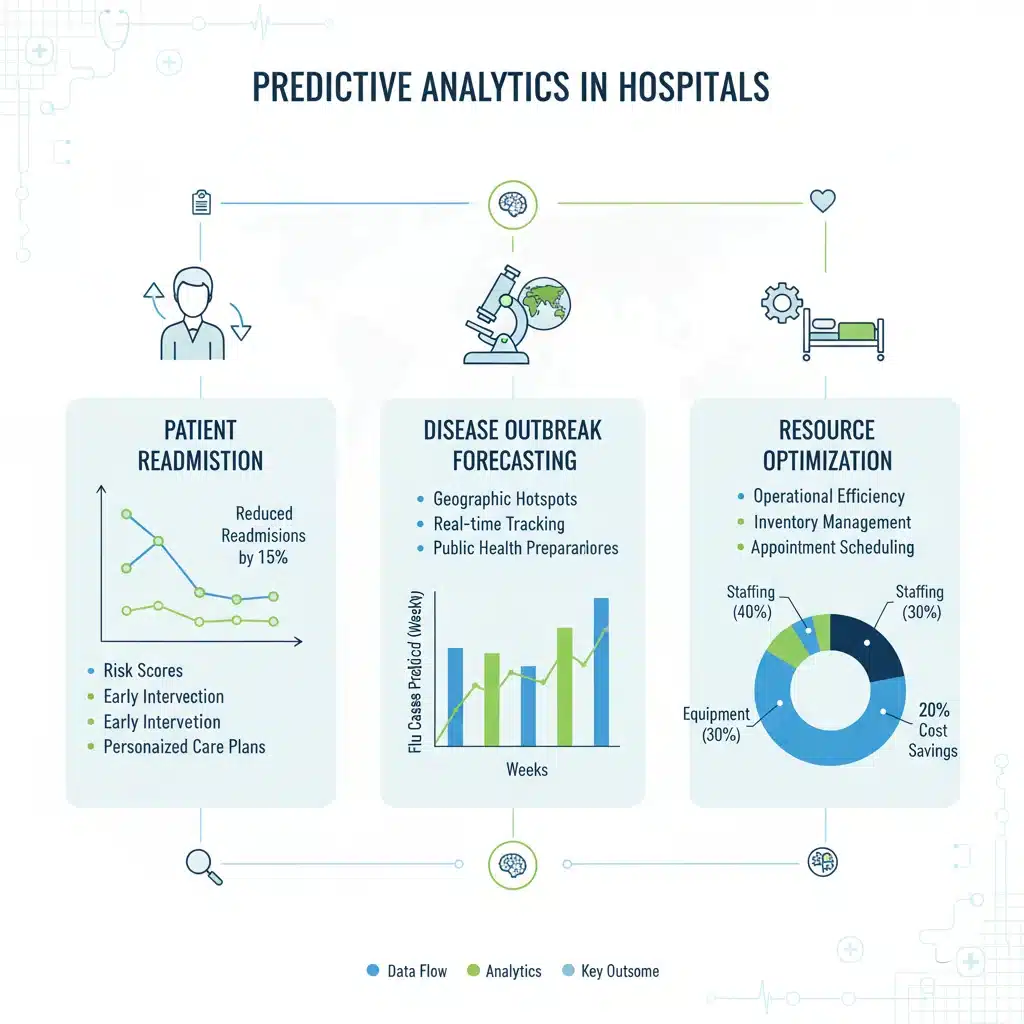
One of the most significant and well-documented applications is predicting patient readmissions. Models analyze factors like demographics, medical history, social determinants of health, and discharge instructions to identify patients at high risk of returning to the hospital within a short period (e.g., 30 days). This allows healthcare providers to implement targeted interventions, such as intensified post-discharge follow-up, home health services, or patient education programs, thereby improving care continuity and reducing avoidable readmissions.
2. Early Sepsis Detection and Intervention
Sepsis is a leading cause of death in hospitals, and early detection is critical for survival. Predictive analytics systems continuously monitor patient vital signs, lab results, and other clinical data. Algorithms can detect subtle changes that indicate the onset of sepsis hours before traditional methods, alerting clinicians and enabling rapid intervention, which dramatically improves patient outcomes.
3. Disease Outbreak Forecasting
Beyond individual patient care, predictive analytics can operate at a population level. By analyzing epidemiological data, geographic information, and even social media trends, models can forecast the spread of infectious diseases, allowing public health officials and hospitals to prepare resources, allocate staff, and implement preventive measures more effectively.
4. Staffing Optimization and Workforce Management
Hospitals face constant challenges in staffing, balancing patient needs with staff availability and budget constraints. Predictive analytics can forecast patient census and acuity levels, enabling hospitals to optimize nursing and physician schedules, reduce overtime costs, and ensure adequate staffing ratios, which directly impacts the quality of care and staff satisfaction.
5. Supply Chain and Inventory Management
Managing medical supplies is a complex task. Predictive models can analyze historical consumption data, seasonal trends, and upcoming surgical schedules to forecast demand for various supplies. This helps hospitals optimize inventory levels, reduce waste, prevent stockouts, and negotiate better deals with suppliers, leading to significant cost savings.
6. Financial Forecasting and Revenue Cycle Management
Predictive analytics extends to the financial health of hospitals. Models can forecast patient volumes, payer mix, and reimbursement rates, helping hospitals to better manage their budgets and financial planning. They can also identify potential issues in the revenue cycle, such as claim denials or underpayments, allowing for proactive resolution and improved financial performance.
7. Personalized Treatment Plans
By analyzing a patient’s unique genetic profile, medical history, and response to previous treatments, predictive analytics can help clinicians tailor treatment plans that are more likely to be effective. This moves healthcare towards a truly personalized medicine approach, minimizing trial-and-error and improving therapeutic outcomes.
8. Equipment Maintenance Prediction
Downtime for critical medical equipment can be costly and impact patient care. Predictive analytics can monitor equipment performance data and identify patterns that indicate potential failures, allowing for proactive maintenance and repair, thus extending equipment life and preventing unexpected service interruptions.
Challenges and Considerations for Adoption
While the benefits of hospital predictive analytics are undeniable, the path to widespread adoption is not without its hurdles. Hospitals embarking on this journey must carefully consider several key challenges:
Data Quality and Integration
The effectiveness of any predictive model hinges on the quality and accessibility of the data it consumes. In healthcare, data often resides in disparate systems, is inconsistent, or may contain inaccuracies. Integrating data from various sources (EHRs, lab systems, imaging, financial records) and ensuring its cleanliness and standardization is a monumental task. Hospitals need robust data governance strategies and interoperability solutions to overcome this challenge.
Privacy and Security Concerns
Dealing with sensitive patient health information (PHI) brings significant privacy and security responsibilities. Hospitals must adhere to strict regulations like HIPAA and ensure that predictive analytics systems are designed with robust security measures to protect patient data from breaches and unauthorized access. Building and maintaining patient trust in these technologies is paramount.
Algorithm Bias and Explainability
Predictive models are only as unbiased as the data they are trained on. If historical data reflects existing healthcare disparities or biases, the algorithms can inadvertently perpetuate or even amplify these inequities. Ensuring algorithmic fairness and developing explainable AI models (where the reasoning behind a prediction can be understood) are critical ethical considerations. Clinicians need to trust the recommendations, and that trust is built on transparency.
Talent Gap and Training
Implementing and managing sophisticated predictive analytics systems requires specialized skills in data science, machine learning, and clinical informatics. There is a significant talent gap in these areas within the healthcare sector. Hospitals will need to invest in training existing staff, hiring new talent, or partnering with external experts to build the necessary capabilities.
Cost of Implementation
The initial investment in predictive analytics software, infrastructure, and personnel can be substantial. Hospitals, especially smaller ones, may face budget constraints. Demonstrating a clear return on investment (ROI) through improved outcomes and cost savings is crucial for securing funding and ensuring sustainable adoption.
Change Management and Clinical Adoption
Introducing new technologies fundamentally alters workflows and requires clinicians to adapt to new ways of working. Resistance to change can be a significant barrier. Effective change management strategies, including comprehensive training, clear communication of benefits, and involving clinicians in the design and implementation process, are essential for successful adoption and integration into daily practice.
The Future of Hospital Predictive Analytics
Looking beyond mid-2026, the trajectory for hospital predictive analytics is one of continuous growth and increasing sophistication. The initial wave of adoption will pave the way for even more advanced applications and deeper integration into the fabric of healthcare delivery.
Increased Personalization and Precision Medicine
As predictive models become more refined and incorporate richer datasets, including genomic and proteomic information, they will enable an unprecedented level of personalized medicine. Treatments will be tailored not just to a patient’s condition, but to their unique biological makeup and predicted response to specific therapies, leading to significantly improved efficacy and reduced side effects.
Proactive Health Management and Prevention
The focus will increasingly shift from treating illness to preventing it. Predictive analytics will empower individuals and healthcare providers to identify health risks long before symptoms appear, allowing for proactive lifestyle interventions, preventive screenings, and early disease management strategies. This will transform healthcare from a reactive system to a truly preventive one.
Integration with Emerging Technologies
Predictive analytics will not operate in isolation. It will increasingly integrate with other cutting-edge technologies such as the Internet of Medical Things (IoMT), virtual reality (VR), augmented reality (AR), and robotics. Imagine predictive models feeding real-time data to surgical robots, or AR interfaces providing clinicians with immediate, data-driven insights during patient examinations. This convergence will create a symbiotic ecosystem of advanced healthcare technology.
Enhanced Public Health Surveillance
The lessons learned from recent global health crises underscore the need for robust public health surveillance. Predictive analytics will play a pivotal role in creating more sophisticated early warning systems for epidemics and pandemics, allowing for faster, more coordinated, and more effective responses at local, national, and global levels.
Ethical AI and Trust Frameworks
As predictive analytics becomes more pervasive, the ethical considerations will intensify. Future developments will focus heavily on building robust ethical AI frameworks, ensuring transparency, fairness, and accountability in algorithmic decision-making. Developing trust in these systems among patients, clinicians, and the public will be paramount for sustained success.
Conclusion: A New Era for U.S. Healthcare
The report indicating that 25% of U.S. hospitals will adopt advanced predictive analytics by mid-2026 is more than just a statistic; it’s a harbinger of a new era in healthcare. This rapid embrace of hospital predictive analytics signifies a fundamental shift towards a more intelligent, proactive, and patient-centric model of care. While challenges related to data, privacy, talent, and change management certainly exist, the overwhelming benefits in terms of improved patient outcomes, enhanced operational efficiency, and cost control are compelling enough to drive this transformation forward.
Hospitals that successfully integrate predictive analytics will not only gain a significant competitive advantage but will also be better equipped to navigate the complexities of modern medicine, deliver higher quality care, and ultimately improve the health and well-being of the communities they serve. The journey ahead will require strategic planning, significant investment, and a commitment to innovation, but the destination—a healthcare system that is more intelligent, efficient, and equitable—is well worth the effort. The future of U.S. healthcare is undoubtedly data-driven, and predictive analytics is leading the charge.