FDA Device Approval Process 2026: MedTech Startup Guide
The landscape of medical device regulation is constantly evolving, and for MedTech startups, staying ahead of these changes is not just beneficial—it’s imperative for survival and success. As we look towards 2026, the U.S. Food and Drug Administration (FDA) continues to refine its processes, aiming to ensure the safety and efficacy of medical devices while fostering innovation. Understanding the nuances of the FDA device approval process is paramount for any startup aspiring to bring groundbreaking technology to market.
This comprehensive guide is designed to equip MedTech startups with the knowledge and foresight needed to navigate the FDA’s regulatory maze in 2026. We will delve into the critical aspects of device classification, explore the various regulatory pathways, highlight recent and anticipated changes, and offer actionable strategies to streamline your approval journey. The goal is to demystify the FDA device approval process, transforming it from a formidable hurdle into a navigable path for your innovative solutions.
The Evolving Landscape of FDA Device Approval in 2026
The FDA’s approach to medical device regulation is dynamic, influenced by technological advancements, public health needs, and legislative mandates. For 2026, several themes are expected to continue shaping the FDA device approval environment. These include an increased focus on real-world evidence, enhanced cybersecurity requirements for connected devices, and a continued push for greater transparency and patient involvement in the review process.
MedTech startups must recognize that the FDA is not a static entity; it is an agency that adapts. This adaptability means that what was considered best practice a few years ago might be outdated today. Proactive engagement with FDA guidance documents, participation in industry forums, and continuous monitoring of regulatory updates are crucial. Ignoring these shifts can lead to costly delays, redesigns, or even rejection of your device.
One significant area of evolution is the FDA’s embrace of digital health technologies. Devices that incorporate artificial intelligence (AI), machine learning (ML), and software as a medical device (SaMD) are subject to specific considerations. The FDA is actively developing frameworks to assess these rapidly evolving technologies, balancing the need for rigorous oversight with the desire to facilitate innovation that can dramatically improve patient care. Startups in this space must pay particular attention to these specialized guidelines within the broader FDA device approval framework.
Understanding Device Classification: The First Critical Step
Before embarking on any regulatory pathway, a MedTech startup must accurately classify its medical device. This initial step is foundational, as device classification directly dictates the regulatory controls and the specific approval pathway your device will follow. The FDA assigns medical devices to one of three classes based on the level of control necessary to assure safety and effectiveness:
- Class I Devices: These present the lowest risk to patients. Examples include bandages, tongue depressors, and some basic surgical instruments. Most Class I devices are exempt from premarket notification (510(k)) requirements, though some may still require general controls.
- Class II Devices: These pose a moderate risk and require general controls plus special controls to assure safety and effectiveness. Special controls can include performance standards, postmarket surveillance, patient registries, and specific labeling requirements. Most Class II devices require premarket notification (510(k)) clearance. Examples include powered wheelchairs, infusion pumps, and surgical drapes.
- Class III Devices: These are high-risk devices that sustain or support life, are implanted, or present a potential unreasonable risk of illness or injury. They require premarket approval (PMA), which is the most stringent regulatory review. Examples include pacemakers, HIV diagnostic tests, and implanted prosthetic devices.
Misclassifying your device can lead to significant setbacks. If you under-classify, you may face compliance issues later. If you over-classify, you might pursue a more arduous and expensive approval pathway than necessary. The FDA provides various tools and databases, such as the Product Classification Database, to assist manufacturers in determining the correct classification. Consulting with regulatory experts early in the development process can also prevent costly errors in this critical initial phase of FDA device approval.
Navigating the Main Regulatory Pathways for FDA Device Approval
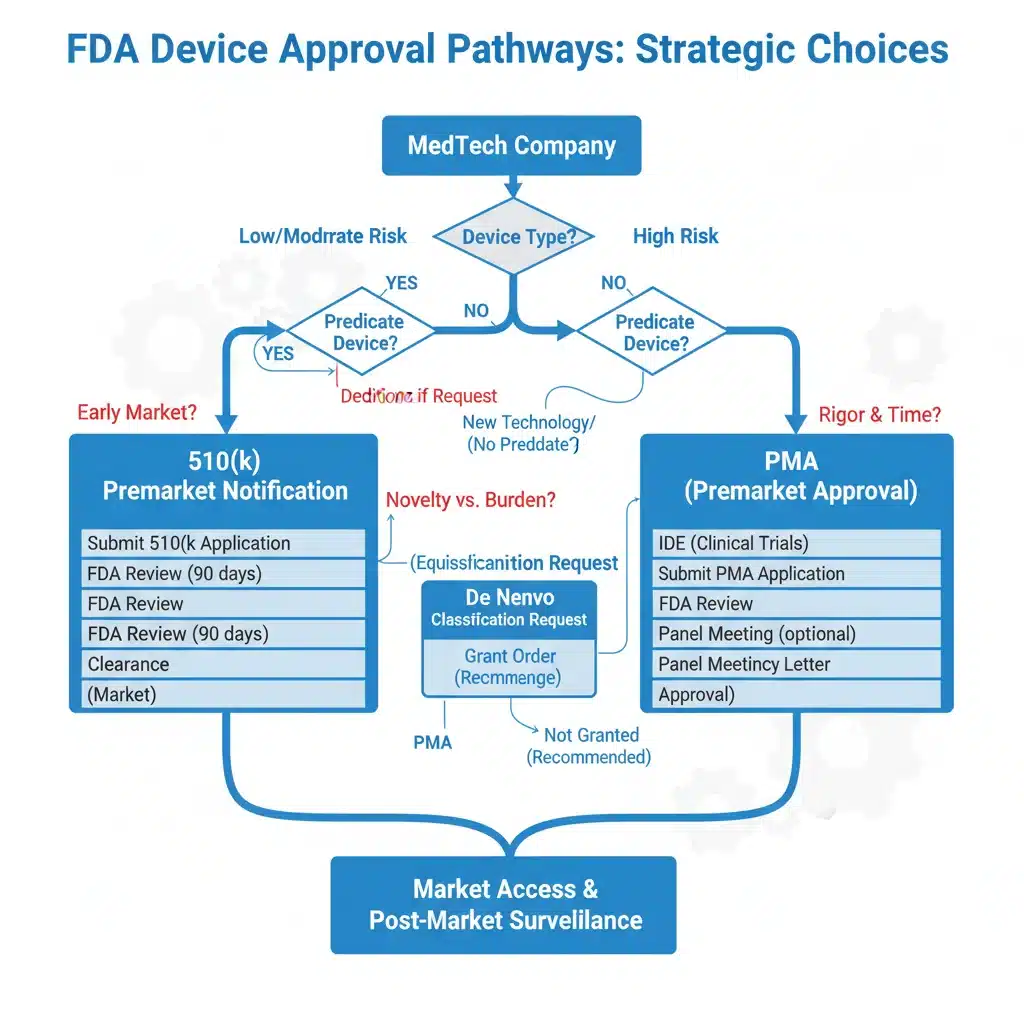
Once your device is classified, you can determine the appropriate regulatory pathway. The FDA primarily utilizes three main premarket pathways for medical devices:
1. Premarket Notification (510(k))
The 510(k) pathway is for Class II devices and some Class I devices that are not exempt. The core principle of a 510(k) submission is to demonstrate that your device is "substantially equivalent" to a legally marketed predicate device. This means showing that your device has the same intended use as a predicate device and is as safe and effective as the predicate device.
Key elements of a 510(k) submission typically include:
- Device Description: Detailed information about your device’s design, materials, and operational principles.
- Intended Use and Indications for Use: A precise statement of what the device is for and the conditions under which it should be used.
- Comparison to a Predicate Device: A thorough analysis comparing your device to one or more legally marketed predicate devices, highlighting similarities and differences.
- Performance Data: This often includes bench testing, biocompatibility testing, electrical safety, electromagnetic compatibility (EMC), and sometimes clinical data, depending on the differences from the predicate.
- Labeling: Drafts of all proposed labels, including instructions for use, patient information, and any promotional materials.
The FDA aims to review 510(k) submissions within 90 days, but this timeline can be extended if the FDA requires additional information. A successful 510(k) submission results in "clearance," not "approval."
2. Premarket Approval (PMA)
The PMA pathway is the most rigorous and complex route for FDA device approval, reserved for Class III devices. A PMA requires scientific evidence demonstrating the device’s safety and effectiveness. Unlike the 510(k), there is no predicate device to rely on; instead, the manufacturer must independently prove the device’s benefits outweigh its risks.
PMA submissions are extensive and typically include:
- Non-clinical Laboratory Studies: Detailed results from bench testing, animal studies, and biocompatibility assessments.
- Clinical Investigations: Comprehensive data from human clinical trials demonstrating the device’s safety and effectiveness for its intended use. This is often the most time-consuming and expensive part of the PMA process.
- Manufacturing Information: Detailed descriptions of the manufacturing process, quality control procedures, and facility information, adhering to Good Manufacturing Practices (GMP).
- Labeling: Proposed labeling, including instructions for use, warnings, and any patient information.
The PMA review process is significantly longer than 510(k), often taking several months to over a year, and involves an in-depth evaluation by FDA experts. A successful PMA results in "approval."
3. De Novo Classification Request
The De Novo pathway is for novel low-to-moderate risk devices (typically Class I or Class II) that do not have a legally marketed predicate device and thus cannot be cleared through the 510(k) process. Instead of being automatically classified as Class III due to the absence of a predicate, the De Novo pathway allows manufacturers to request reclassification into Class I or Class II if they can demonstrate that general controls, or general and special controls, are sufficient to provide reasonable assurance of safety and effectiveness.
A De Novo submission requires:
- Risk-Benefit Analysis: A detailed assessment of the device’s risks and benefits.
- Proposed Special Controls: If seeking Class II classification, the manufacturer must propose specific special controls to mitigate identified risks.
- Performance Data: Similar to 510(k) or PMA, depending on the device’s complexity, to support the safety and effectiveness claims.
The De Novo pathway is an increasingly important route for truly innovative devices that don’t fit neatly into existing categories. It allows for the introduction of novel technologies without the burden of a full PMA, provided the risk profile is appropriate.
Key Regulatory Updates and Trends for MedTech Startups in 2026
The FDA is continually updating its regulatory framework to keep pace with innovation and address emerging challenges. For MedTech startups planning for 2026, several key trends and anticipated updates deserve close attention:
Increased Emphasis on Cybersecurity
With the proliferation of connected medical devices and digital health solutions, cybersecurity is no longer an optional add-on but a fundamental aspect of device safety and effectiveness. The FDA has been strengthening its guidance on premarket and postmarket cybersecurity requirements. Startups developing internet-connected or network-enabled devices must integrate robust cybersecurity measures from the design phase, conduct thorough risk assessments, and provide comprehensive documentation in their FDA device approval submissions. Expect more stringent requirements for software bill of materials (SBOMs) and plans for addressing post-market vulnerabilities.
Real-World Evidence (RWE) Integration
The FDA is increasingly exploring the use of Real-World Evidence (RWE) to support regulatory decisions. RWE, derived from sources like electronic health records, claims data, and patient registries, can complement traditional clinical trial data, especially for postmarket surveillance and expanding indications for use. While not yet a primary pathway for initial approval for most devices, understanding how RWE can strengthen your regulatory submissions or post-market commitments will be a significant advantage.
Digital Health and AI/ML-based Medical Devices
The FDA’s approach to regulating AI/ML-based medical devices is evolving rapidly. The agency is moving towards a "Total Product Lifecycle" (TPL) approach, which acknowledges the adaptive nature of these algorithms. This involves pre-specifying update protocols and performance monitoring plans. Startups in this space should familiarize themselves with the FDA’s proposed regulatory framework for AI/ML-based SaMD, focusing on concepts like "predetermined change control plans" and "good machine learning practice (GMLP)." Transparency in algorithm development and validation will be crucial.
Patient-Centricity and User Experience (UX)
The FDA continues to emphasize the importance of patient input and human factors engineering. Devices that are intuitively designed, easy to use, and minimize the risk of user error are more likely to gain favor. Incorporating human factors testing and usability studies into your development process and documenting these efforts in your FDA device approval submission will be increasingly important. Patient perspectives are also gaining more weight in benefit-risk assessments.
Supply Chain Resiliency and Quality Management
Global supply chain disruptions have highlighted the need for robust and resilient manufacturing and supply chain processes. The FDA is expected to continue scrutinizing manufacturers’ quality management systems (QMS) and supply chain controls. Startups must demonstrate strong QMS adherence from day one, ensuring traceability of components, managing supplier risks, and having contingency plans in place.
Strategies for MedTech Startups to Achieve FDA Device Approval
Navigating the FDA device approval process requires meticulous planning, robust execution, and a deep understanding of regulatory requirements. Here are key strategies for MedTech startups:
1. Early Regulatory Strategy and Planning
Do not wait until your device is fully developed to think about regulation. Engage with regulatory experts and consultants from the earliest stages of product conceptualization. This allows for "designing for regulation," ensuring that your device’s features, intended use, and testing protocols align with FDA expectations. Consider pre-submission meetings with the FDA to get early feedback on your regulatory strategy.
2. Robust Quality Management System (QMS) Implementation
A strong QMS, compliant with ISO 13485 and FDA’s 21 CFR Part 820 (Quality System Regulation), is non-negotiable. Your QMS should govern every aspect of your device’s lifecycle, from design and development to manufacturing, distribution, and post-market activities. The FDA will assess your QMS during inspections, and deficiencies can lead to significant delays or enforcement actions. Implement your QMS early and ensure all personnel are trained and compliant.
3. Comprehensive Documentation and Data Integrity
The FDA operates on the principle that "if it isn’t documented, it didn’t happen." Maintain meticulous records of all design controls, testing protocols, results, risk assessments, and manufacturing processes. Data integrity is paramount; ensure your data is attributable, legible, contemporaneously recorded, original, and accurate (ALCOA principles). This includes raw data, analysis, and conclusions.
4. Strategic Clinical Trial Design (If Applicable)
For devices requiring clinical data (especially PMA and some 510(k)s), a well-designed clinical trial is critical. This involves defining clear endpoints, appropriate patient populations, robust statistical analysis plans, and adherence to Good Clinical Practice (GCP). Consider engaging with clinical research organizations (CROs) that specialize in medical devices to manage your trials efficiently and compliantly.

5. Invest in Human Factors Engineering (HFE)
HFE studies are increasingly important to demonstrate that your device can be used safely and effectively by its intended users in its intended use environment. This involves identifying potential use errors and designing controls to mitigate them. Document your HFE process and results thoroughly in your submission.
6. Proactive Cybersecurity Measures
As mentioned, cybersecurity is critical. Integrate security by design principles, conduct threat modeling, and perform penetration testing. Prepare a comprehensive cybersecurity plan detailing how your device will manage risks throughout its lifecycle, including post-market updates and vulnerability management. This is a non-negotiable aspect of modern FDA device approval.
7. Post-Market Surveillance Planning
Your responsibility doesn’t end with approval or clearance. The FDA expects a robust post-market surveillance plan to monitor device performance, collect adverse event data, and identify potential issues once the device is on the market. This includes complaint handling, medical device reporting (MDR), and potentially post-market studies. A well-defined post-market plan demonstrates your commitment to patient safety.
8. Continuous Learning and Adaptation
The regulatory landscape is constantly shifting. Stay informed about new FDA guidance documents, industry best practices, and technological advancements. Attend workshops, read regulatory publications, and network with other MedTech professionals. This continuous learning will enable your startup to adapt quickly and maintain compliance.
Common Pitfalls to Avoid in the FDA Device Approval Process
While the path to FDA device approval can be challenging, many common pitfalls can be avoided with careful planning and awareness:
- Insufficient Predicate Device Justification (for 510(k)): Failing to adequately demonstrate substantial equivalence or choosing an inappropriate predicate device can lead to rejection.
- Incomplete or Poorly Organized Submissions: The FDA reviewers have limited time. A disorganized submission lacking critical data will invariably lead to questions and delays.
- Lack of "Design Controls" Documentation: Not documenting your design and development process, including requirements, risks, verification, and validation activities, is a major red flag for the FDA.
- Underestimating Testing Requirements: Skimping on bench testing, biocompatibility, electrical safety, or cybersecurity testing will result in requests for additional data, significantly delaying approval.
- Ignoring Human Factors: Failing to consider how users will interact with your device can lead to safety issues and regulatory scrutiny.
- Inadequate Quality System: A QMS that exists only on paper and is not truly implemented or followed will be exposed during an inspection.
- Mismanaging Clinical Data: Poorly designed clinical trials, data integrity issues, or non-compliance with GCP can invalidate your clinical evidence.
- Delayed Engagement with the FDA: Waiting until the last minute to interact with the FDA (e.g., pre-submission meetings) can mean missing opportunities for early feedback and course correction.
- Lack of Regulatory Expertise: Attempting to navigate the complex FDA landscape without experienced regulatory professionals is a common and costly mistake for startups.
Conclusion: Your Path to FDA Device Approval in 2026
The FDA device approval process for MedTech startups in 2026, while complex, is a surmountable challenge with the right strategy and execution. By understanding device classification, selecting the appropriate regulatory pathway, staying abreast of evolving requirements (especially in cybersecurity and digital health), and implementing robust quality and documentation practices, your startup can significantly increase its chances of success.
Remember, the FDA’s mission is to protect public health while fostering innovation. By demonstrating a clear commitment to patient safety, device effectiveness, and regulatory compliance, your MedTech startup can successfully bring its transformative technologies to market. Invest in expert guidance, build a strong internal regulatory culture, and approach the process with diligence and foresight. The future of healthcare depends on your innovation, and navigating the FDA effectively is your gateway to making that impact.