MedTech M&A Surge: Q2 2026 Sees $25 Billion in Industry Consolidation
MedTech M&A Surge: Q2 2026 Sees $25 Billion in Industry Consolidation
The second quarter of 2026 has irrevocably altered the landscape of the medical technology (MedTech) sector, witnessing an unprecedented surge in mergers and acquisitions (M&A). A staggering $25 billion in value exchanged hands across just seven major deals, signaling a profound period of MedTech M&A Q2 consolidation. This intense activity underscores a strategic pivot within the industry, driven by a confluence of technological advancements, evolving patient needs, regulatory shifts, and the relentless pursuit of market dominance and efficiency. Understanding these pivotal transactions is crucial for anyone navigating the future of healthcare innovation and investment.
The Driving Forces Behind MedTech M&A Q2 2026
Several underlying currents fueled the robust MedTech M&A Q2 activity. Firstly, the imperative for innovation continues to be a primary driver. Companies are actively seeking to acquire specialized technologies, intellectual property, and R&D capabilities that can accelerate their product pipelines and competitive edge. This often means integrating cutting-edge digital health solutions, artificial intelligence (AI) in diagnostics, robotics in surgery, and advanced materials for medical devices.
Secondly, market access and geographical expansion play a significant role. Acquiring a company with an established presence in a new or emerging market can provide immediate access to distribution channels, regulatory expertise, and a pre-existing customer base, sidestepping the often-arduous process of organic market entry. This is particularly relevant as healthcare markets globalize and companies seek to diversify their revenue streams and reduce reliance on single regional economies.
Thirdly, cost efficiencies and economies of scale are perennial motivators for M&A. By combining operations, companies can eliminate redundancies, optimize supply chains, and leverage greater purchasing power. In an industry facing increasing pressure on pricing and reimbursement, achieving operational synergies can significantly boost profitability and financial resilience. The drive for efficiency is especially pronounced in the MedTech sector, where development costs are high and regulatory hurdles are complex.
Finally, the pursuit of a broader product portfolio and integrated solutions is becoming increasingly vital. Healthcare is moving towards more holistic and patient-centric models, where devices, diagnostics, and digital health platforms are expected to work seamlessly together. Acquisitions allow companies to build comprehensive ecosystems that offer end-to-end solutions, enhancing patient outcomes and creating stronger value propositions for healthcare providers. This trend towards integrated care solutions is a powerful catalyst for strategic acquisitions.
The Seven Landmark Deals: A Closer Look at MedTech M&A Q2
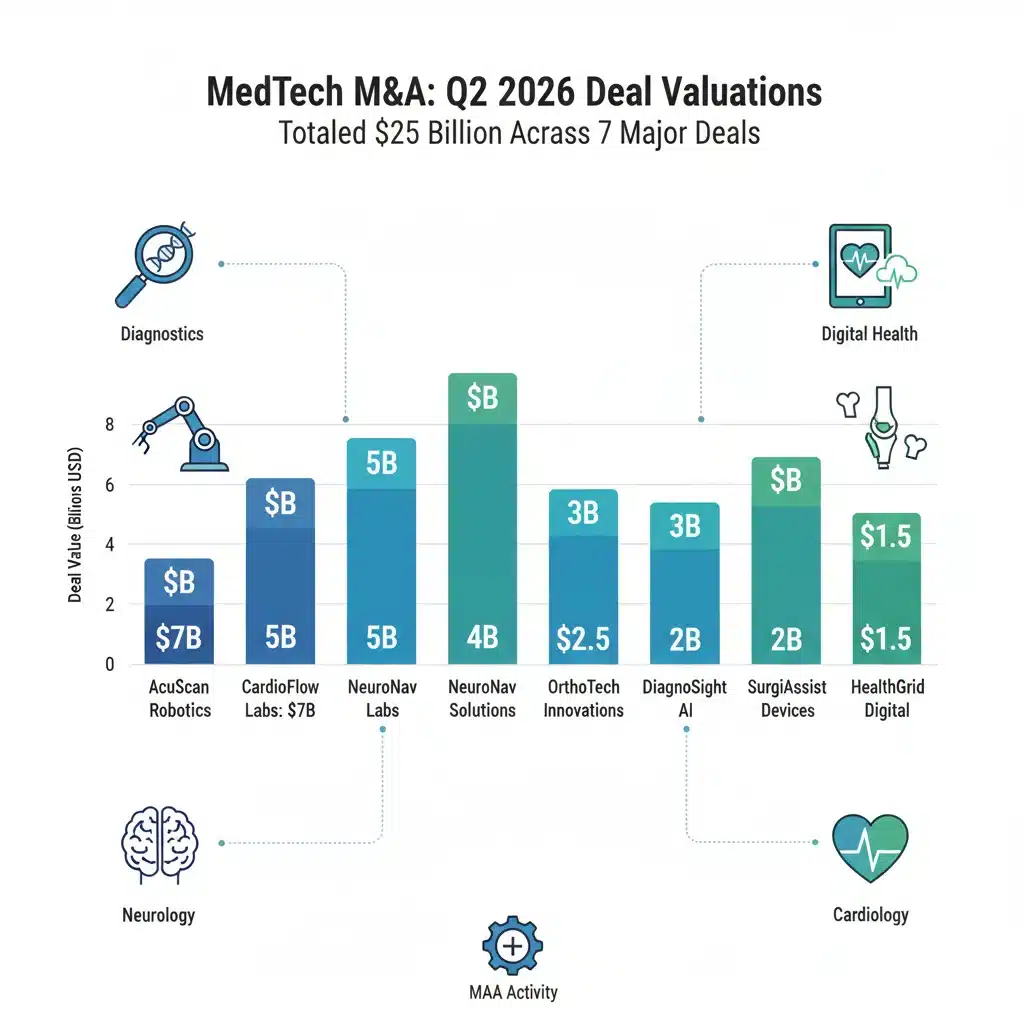
The $25 billion valuation spread across seven key transactions highlights the strategic significance of each deal. While the full details of every acquisition are complex, we can analyze the overarching themes and implications of these movements within the MedTech M&A Q2 landscape.
- Acquisition of Innova Diagnostics by Global Health Solutions ($6.2 Billion): This deal saw a major player in general medical devices acquire a leader in advanced diagnostic imaging and AI-powered pathology. The synergy here is clear: Global Health Solutions aims to integrate Innova’s diagnostic capabilities with its existing device portfolio, offering a more complete solution for early disease detection and personalized treatment planning. This acquisition positions Global Health Solutions as a formidable force in integrated diagnostics, a rapidly growing segment of MedTech.
- Merger of Bio-Robotics Corp. and Surgi-Tech Innovations ($4.8 Billion): This merger created a powerhouse in surgical robotics and minimally invasive surgery. Bio-Robotics brought its expertise in robotic-assisted surgical systems, while Surgi-Tech contributed its advanced surgical instruments and imaging technologies. The combined entity is poised to dominate the high-growth surgical robotics market, promising enhanced precision, reduced recovery times, and improved patient outcomes. This strategic move highlights the increasing importance of automation and robotics in modern surgery.
- Pharma-Link’s Purchase of Digital Therapeutics Inc. ($3.5 Billion): This acquisition signals a strong push by pharmaceutical giants into the digital health space. Digital Therapeutics Inc. is renowned for its clinically validated software programs that deliver therapeutic interventions. Pharma-Link’s move indicates a recognition that digital solutions can complement traditional drug therapies, offering new avenues for patient engagement, adherence, and disease management. This convergence of pharma and digital health is a significant trend in MedTech M&A Q2.
- Cardiac Systems Group Acquires Cardio-AI Solutions ($2.9 Billion): Focused squarely on cardiovascular health, Cardiac Systems Group bolstered its portfolio by acquiring Cardio-AI Solutions, a company specializing in AI-driven cardiac monitoring and predictive analytics. This integration allows for more proactive management of heart conditions, earlier detection of critical events, and personalized patient care plans. The deal exemplifies the growing role of AI in transforming chronic disease management.
- Ortho-Materials Corp. Buys Advanced Implants Ltd. ($2.6 Billion): This acquisition strengthened Ortho-Materials Corp.’s position in the orthopedic implant market. Advanced Implants Ltd. brought innovative biomaterials and 3D printing capabilities for custom implants. The combined entity can now offer a wider range of high-performance, personalized orthopedic solutions, addressing the increasing demand for customized patient care in orthopedics.
- VisionCare Global’s Takeover of Ocular Analytics ($2.5 Billion): In the ophthalmology sector, VisionCare Global expanded its reach into advanced diagnostics and data analytics for eye care. Ocular Analytics provides AI-powered platforms for early detection of eye diseases and personalized treatment recommendations. This acquisition allows VisionCare Global to move beyond traditional optical devices into comprehensive eye health management, leveraging data for improved patient outcomes.
- Health Data Solutions Acquires Secure Medical Cloud ($2.5 Billion): This deal emphasizes the critical importance of secure data management in healthcare. Health Data Solutions, a leader in healthcare IT, acquired Secure Medical Cloud, a specialist in compliant cloud storage and data analytics for sensitive patient information. This move addresses the escalating need for robust cybersecurity and efficient data handling in the digital healthcare ecosystem, a foundational element for all other MedTech advancements.
Strategic Implications for the MedTech Landscape
The sheer volume and value of MedTech M&A Q2 transactions carry significant implications for the industry’s future trajectory. Firstly, we are likely to see increased concentration of market power among a few dominant players. These larger entities will possess greater resources for R&D, marketing, and global expansion, potentially making it harder for smaller, independent companies to compete.
Secondly, the focus on integrated solutions will intensify. The acquisitions demonstrate a clear trend towards companies offering comprehensive platforms rather than standalone products. This means that future innovations will increasingly be developed with interoperability and holistic patient care in mind, pushing the boundaries of what MedTech can achieve.
Thirdly, innovation will likely accelerate in specific, highly targeted areas. The deals highlight a strong interest in AI, robotics, digital therapeutics, and advanced biomaterials. Companies are clearly investing in technologies that promise to revolutionize diagnosis, treatment, and patient monitoring. This intense focus could lead to breakthroughs in these specialized fields at an accelerated pace.
Moreover, regulatory bodies will be watching closely. As the industry consolidates, concerns about competition, pricing, and access to innovation may arise. Regulators will need to balance the benefits of efficiency and innovation from M&A with the need to ensure a competitive market that serves the best interests of patients and healthcare providers. The increased scale of these consolidated entities will also mean greater scrutiny on ethical practices and data privacy.
Challenges and Opportunities Arising from Consolidation
While consolidation brings numerous benefits, it also presents challenges. Integration of disparate company cultures, technologies, and operational systems can be complex and time-consuming. Merging R&D pipelines and ensuring seamless product development requires meticulous planning and execution. There is also the risk of losing key talent during the transition, as employees may feel uncertain about their future roles or cultural fit within the new, larger organization.
However, the opportunities far outweigh these challenges for well-executed deals. For the acquiring companies, these transactions offer accelerated growth, enhanced competitive positioning, and the ability to address broader market needs. For the acquired entities, it can provide access to greater capital, wider distribution networks, and advanced manufacturing capabilities, allowing their innovative technologies to reach a larger patient population.
For investors, the MedTech M&A Q2 surge indicates a dynamic and evolving market. Identifying companies with strong intellectual property, innovative pipelines, and strategic alignment with larger players could yield significant returns. The healthcare sector, particularly MedTech, remains a resilient and attractive investment area due to consistent demand and ongoing technological advancements.
Furthermore, the increased scale and resources of consolidated entities can lead to more substantial investments in research and development, potentially tackling more complex and previously intractable medical challenges. This could result in a new generation of medical devices and therapies that significantly improve the quality of life for millions worldwide. The ability to pool resources and expertise allows for bolder, more ambitious projects that single companies might struggle to undertake.
The Future Outlook: Beyond MedTech M&A Q2
The MedTech M&A Q2 activity is not an isolated phenomenon but rather a strong indicator of future trends. We can anticipate continued consolidation as companies strive to build comprehensive portfolios and gain a competitive edge in a rapidly evolving healthcare ecosystem. The focus will likely remain on digital health, AI, personalized medicine, and minimally invasive technologies.
The integration of data analytics and connectivity into medical devices will become even more pervasive. The ability to collect, analyze, and act upon real-time patient data will be a key differentiator. This will drive further acquisitions of companies specializing in data science, cybersecurity, and cloud infrastructure, ensuring that the foundational elements for advanced MedTech solutions are robust and secure.
Moreover, strategic partnerships and alliances, even outside of full acquisitions, will continue to be important. Companies may opt for joint ventures or licensing agreements to access specific technologies or markets without the full commitment of an M&A deal. This flexibility allows for rapid adaptation to market changes and technological shifts.
The role of venture capital and private equity in fueling innovation and preparing smaller companies for acquisition will also remain critical. These investment firms identify and nurture promising startups, providing the necessary capital and strategic guidance to develop breakthrough technologies that eventually become attractive targets for larger MedTech players. The ecosystem of innovation relies heavily on this early-stage investment.

Impact on Healthcare Providers and Patients
Ultimately, the impact of these large-scale MedTech M&A Q2 deals will reverberate through healthcare systems and directly affect patients. For healthcare providers, consolidation could mean access to a more integrated suite of products and services from fewer vendors, potentially simplifying procurement and enhancing interoperability within their facilities. However, it also raises concerns about reduced choice and potential price increases if competition diminishes.
For patients, the promise of advanced, integrated care solutions is significant. Innovations in diagnostics, surgical robotics, and digital therapeutics have the potential to lead to earlier diagnoses, more effective treatments, and improved quality of life. Personalized medicine, driven by AI and advanced data analytics, could become more widely accessible, tailoring treatments to individual patient needs and genetic profiles.
However, patients and advocacy groups will also need to monitor the ethical implications of increased data collection and the potential for reduced access to certain specialized or niche products if smaller companies are absorbed and their unique offerings are streamlined or discontinued. Ensuring equitable access to cutting-edge technologies, regardless of socioeconomic status, will be a critical challenge for the industry and policymakers.
The emphasis on value-based care models is also a significant factor influencing these M&A decisions. As healthcare systems increasingly move towards models that reward outcomes rather than volume, MedTech companies are pressured to provide solutions that demonstrate clear clinical and economic benefits. Acquisitions that enhance a company’s ability to deliver such value-based solutions are particularly attractive, as they align with the evolving reimbursement landscape.
Conclusion: A New Era for MedTech
The MedTech M&A Q2 of 2026 marks a pivotal moment, with $25 billion in strategic acquisitions reshaping the industry. These seven major deals reflect a dynamic environment where innovation, market access, efficiency, and integrated solutions are paramount. As the sector continues to evolve, we can expect further consolidation, driven by technological advancements and the pursuit of comprehensive healthcare ecosystems.
Stakeholders across the board – from investors and industry executives to healthcare providers and patients – must remain vigilant and adaptable. The decisions made during this period of intense M&A activity will define the competitive landscape, innovation trajectory, and ultimately, the future of healthcare technology for years to come. The emphasis on digital transformation, artificial intelligence, and personalized medicine will only intensify, making the MedTech sector one of the most exciting and impactful areas of global economic activity.
The strategic maneuvers witnessed in Q2 2026 are not merely financial transactions; they are foundational shifts that will influence how diseases are diagnosed, treated, and managed, ushering in a new era of medical innovation and patient care. The MedTech industry is in a state of continuous transformation, and these mergers and acquisitions are powerful catalysts propelling it forward into an increasingly interconnected and technologically advanced future.