Top 5 MedTech Certifications 2026: Boost Your Career

The Top 5 MedTech Certifications for Career Advancement in 2026: An Educational Deep Dive (INSIDER KNOWLEDGE)
The medical technology (MedTech) industry is a dynamic and rapidly evolving sector, characterized by groundbreaking innovations, stringent regulatory landscapes, and an ever-increasing demand for specialized expertise. As we look towards 2026, the need for highly skilled professionals capable of navigating these complexities is more critical than ever. For those aspiring to leadership roles, seeking to validate their expertise, or simply aiming to stay competitive, acquiring the right MedTech certifications is not just an advantage—it’s a necessity. This comprehensive guide will delve into the top 5 MedTech certifications poised to significantly boost your career in 2026 and beyond, offering insider knowledge on why these qualifications are paramount.
The MedTech landscape is continually reshaped by technological advancements such as AI, machine learning, robotics, and personalized medicine. Simultaneously, global regulatory bodies like the FDA, EMA, and ISO are refining their frameworks to ensure patient safety and product efficacy. This dual pressure creates a unique environment where theoretical knowledge must be coupled with practical, certified skills. Our focus here is to illuminate the certifications that address these evolving demands, providing you with a clear roadmap for professional development.
Understanding the value proposition of each certification is key. It’s not merely about adding letters after your name; it’s about acquiring a recognized stamp of approval that signifies a profound understanding of specific areas within MedTech. This can range from regulatory compliance and quality management to clinical research and cybersecurity. Employers in 2026 will prioritize candidates who demonstrate proactive engagement with industry standards and future trends, and these certifications are the clearest indicators of such dedication.
Let’s embark on this educational deep dive into the most impactful MedTech certifications for career advancement in 2026.
1. Regulatory Affairs Certification (RAC) – Global/US/EU
Why RAC is Crucial for MedTech Professionals in 2026
In the MedTech industry, regulatory compliance isn’t just a department; it’s the bedrock upon which all innovation and product development stand. The Regulatory Affairs Certification (RAC), offered by the Regulatory Affairs Professionals Society (RAPS), remains an undisputed gold standard for professionals navigating the complex web of medical device regulations. As global markets expand and regulatory frameworks like the EU’s Medical Device Regulation (MDR) and In Vitro Diagnostic Regulation (IVDR) mature, the demand for RAC-certified experts will only intensify by 2026.
The RAC credential signifies a comprehensive understanding of regulatory requirements for medical products in major global markets (RAC Global), or specifically for the United States (RAC US) or European Union (RAC EU). This certification is critical for anyone involved in bringing medical devices to market, ensuring their ongoing compliance, or interacting with regulatory bodies. The ever-changing nature of these regulations means that up-to-date knowledge is not just beneficial, but absolutely essential for preventing costly delays, recalls, and legal complications.
Key Benefits of RAC Certification:
- Global Recognition: The RAC credential is internationally recognized, opening doors to opportunities in multinational MedTech companies.
- Enhanced Expertise: It validates a deep understanding of regulatory strategies, submissions, post-market surveillance, and quality system requirements.
- Career Advancement: RAC holders are often sought after for senior regulatory affairs roles, compliance management, and even executive positions.
- Risk Mitigation: Certified professionals help companies avoid regulatory pitfalls, ensuring products meet safety and efficacy standards.
- Staying Current: The certification process and ongoing professional development ensure practitioners are abreast of the latest regulatory changes and interpretations.
Who Should Consider RAC?
Regulatory affairs specialists, quality assurance professionals, clinical research associates, R&D managers, product development teams, and even legal counsel working within the MedTech sector will find the RAC invaluable. As the industry continues to globalize, a strong grasp of international regulatory nuances, as provided by the RAC Global, becomes increasingly important. For those focused on specific markets, the RAC US or RAC EU offers targeted expertise that is highly prized.
The foresight to invest in RAC certification now positions you as a critical asset in any MedTech organization in 2026, ensuring the safe and effective delivery of medical innovations to patients worldwide. This is a foundational certification for anyone serious about a long-term career in MedTech.
2. Certified Quality Auditor (CQA) / Certified Quality Engineer (CQE) – ASQ
The Indispensable Role of Quality in MedTech by 2026
Quality is non-negotiable in the MedTech industry. Patient safety, product reliability, and regulatory compliance all hinge on robust quality management systems. The American Society for Quality (ASQ) offers two highly respected certifications that are paramount for quality professionals: the Certified Quality Auditor (CQA) and the Certified Quality Engineer (CQE). Both will continue to be critical MedTech certifications for 2026, ensuring that products meet the highest standards from design to post-market surveillance.
The CQA demonstrates proficiency in auditing quality systems. This is vital for internal audits, supplier audits, and preparing for regulatory inspections (e.g., FDA, notified bodies). A CQA-certified professional can objectively assess a company’s quality management system (QMS) against standards like ISO 13485, identifying areas for improvement and ensuring compliance. Their expertise helps maintain the integrity of a company’s QMS, which is directly linked to patient safety and regulatory approval.
The CQE, on the other hand, focuses on the engineering principles of quality control and assurance. This includes product and process design, statistical methods, measurement systems analysis, and reliability engineering. CQE-certified individuals are instrumental in designing quality into medical devices from the outset, optimizing manufacturing processes, and resolving quality issues using data-driven approaches. Their role is pivotal in preventing defects and ensuring consistent product performance.
Why CQA/CQE are Essential MedTech Certifications for 2026:
- ISO 13485 Alignment: Both certifications are deeply aligned with ISO 13485, the international standard for medical device quality management systems.
- Enhanced Product Safety: CQEs design for quality, while CQAs verify its implementation, collectively safeguarding patient welfare.
- Operational Efficiency: By minimizing defects and optimizing processes, these professionals contribute to significant cost savings and operational efficiency.
- Regulatory Confidence: A strong quality team with CQA/CQE certifications instills confidence in regulatory bodies during audits and inspections.
- Career Versatility: These certifications are applicable across various MedTech functions, from R&D and manufacturing to post-market surveillance and supplier management.
Who Benefits from CQA/CQE?
Quality engineers, quality managers, auditors, supplier quality professionals, manufacturing engineers, and product development specialists will find these ASQ certifications highly beneficial. As the complexity of medical devices increases, so too does the importance of rigorous quality control and auditing processes. Holding a CQA or CQE credential signals to employers that you possess the advanced knowledge and skills necessary to uphold the highest quality standards in the MedTech sector.
Investing in ASQ’s CQA or CQE is a strategic move for any MedTech professional looking to specialize in quality assurance and control, ensuring they remain invaluable assets in 2026’s competitive market.

3. Certified Clinical Research Professional (CCRP) – SOCRA/ACRP
Navigating Clinical Trials with Expertise in 2026
Clinical research is the bridge between innovative medical devices and patient access. Ensuring the ethical conduct, scientific integrity, and regulatory compliance of clinical trials is paramount. The Certified Clinical Research Professional (CCRP), offered by organizations like the Society of Clinical Research Associates (SOCRA) and the Association of Clinical Research Professionals (ACRP), is a vital MedTech certification for those involved in the clinical development of medical devices. By 2026, with an accelerating pace of device innovation, the demand for CCRP-certified individuals will be higher than ever.
The CCRP credential validates a professional’s knowledge of Good Clinical Practice (GCP), regulatory requirements (e.g., FDA, ICH), ethical considerations, and the operational aspects of managing clinical trials. This includes everything from protocol development and patient recruitment to data management, monitoring, and adverse event reporting. For MedTech companies, having CCRP-certified staff ensures that their clinical studies are conducted to the highest standards, leading to credible data that supports regulatory submissions and market approval.
Key Advantages of CCRP Certification:
- GCP Mastery: Demonstrates a thorough understanding and adherence to international ethical and scientific quality standards for clinical trials.
- Regulatory Compliance: Ensures trials are conducted in accordance with relevant national and international regulations, minimizing risks of non-compliance.
- Enhanced Data Integrity: Contributes to the generation of high-quality, reliable clinical data essential for regulatory submissions and product validation.
- Career Specialization: Positions professionals for advanced roles in clinical operations, clinical project management, and clinical quality assurance within MedTech.
- Global Applicability: The principles covered by CCRP are globally accepted, making the certification valuable across different markets.
Who Should Pursue CCRP?
Clinical research associates (CRAs), clinical research coordinators (CRCs), clinical project managers, data managers, regulatory specialists involved in clinical submissions, and ethics committee members will find the CCRP highly beneficial. As MedTech companies increasingly rely on rigorous clinical evidence to differentiate their products and gain market access, professionals with certified expertise in clinical research become indispensable. The CCRP is a clear indicator of a professional’s commitment to excellence and ethical conduct in clinical trials, making it one of the top MedTech certifications for 2026.
For those passionate about bringing life-changing medical devices to patients through robust clinical evidence, the CCRP offers a clear pathway to establishing expert credibility and advancing their careers.
4. Certified Information Systems Security Professional (CISSP) – (ISC)²
Securing MedTech Innovation in the Digital Age of 2026
The convergence of medical devices with digital health, IoT, and cloud computing has introduced unprecedented cybersecurity challenges. Protecting patient data, ensuring device functionality, and preventing cyber-attacks are now critical concerns for MedTech manufacturers and healthcare providers alike. The Certified Information Systems Security Professional (CISSP) from (ISC)² is a globally recognized certification that addresses these concerns head-on, making it an increasingly vital MedTech certification for 2026.
While not exclusively a MedTech certification, the CISSP’s comprehensive coverage of information security principles, including security and risk management, asset security, security architecture and engineering, communication and network security, identity and access management, security assessment and testing, security operations, and software development security, makes it highly relevant. MedTech companies require professionals who can design secure devices, protect sensitive patient information (PHI), and comply with regulations like HIPAA and GDPR, all of which fall under the CISSP’s domain of expertise.
Why CISSP is Becoming a Top MedTech Certification for 2026:
- Data Protection: Essential for safeguarding patient data and intellectual property in an increasingly digital MedTech ecosystem.
- Device Security: Provides the knowledge to build security into medical devices from the design phase, preventing vulnerabilities.
- Regulatory Compliance: Helps organizations meet stringent cybersecurity requirements mandated by health authorities and data protection laws.
- Risk Management: Equips professionals to assess, mitigate, and respond to cyber threats, minimizing potential breaches and operational disruptions.
- High Demand: Cybersecurity expertise is in high demand across all industries, and MedTech is no exception, making CISSP holders highly marketable.
Who Should Obtain CISSP?
IT security professionals, cybersecurity architects, risk managers, compliance officers, and even product development engineers working on connected medical devices will find immense value in the CISSP. As medical devices become more interconnected and generate vast amounts of data, the expertise to secure these systems is no longer a niche skill but a fundamental requirement. The CISSP is a testament to a professional’s ability to design, implement, and manage a best-in-class cybersecurity program, making it a critical asset in the MedTech industry of 2026.
For those aiming to be at the forefront of securing the future of healthcare technology, the CISSP provides the foundational knowledge and recognized credential to excel in this rapidly expanding field.
5. Certified Medical Device Auditor (CMDA) – Exemplar Global
Specialized Auditing for MedTech Excellence in 2026
While the ASQ CQA provides a broad foundation in quality auditing, the Certified Medical Device Auditor (CMDA) from Exemplar Global offers a specialized credential tailored specifically to the intricacies of medical device quality management systems (QMS). As the MedTech industry becomes even more regulated and scrutinized by 2026, the need for auditors with deep, industry-specific knowledge will be particularly acute. This makes CMDA one of the most targeted and valuable MedTech certifications.
The CMDA certification focuses on auditing against ISO 13485:2016, the international standard for medical device QMS. It covers the principles and practices of auditing, the regulatory framework specific to medical devices (including aspects of FDA QSR, EU MDR/IVDR), and the unique considerations for auditing medical device design, manufacturing, post-market activities, and risk management. This specialization ensures that CMDA-certified auditors are not just general quality auditors, but experts who understand the nuances and critical aspects of the medical device lifecycle.
Key Advantages of CMDA Certification:
- Medical Device Focus: Provides specialized auditing skills directly applicable to the medical device industry, unlike broader quality auditing certifications.
- ISO 13485 Expertise: Deep understanding of the specific requirements of ISO 13485, crucial for regulatory compliance and market access.
- Enhanced Compliance: Enables more effective internal and external audits, leading to stronger QMS and fewer non-conformities during regulatory inspections.
- Valued by Regulators: Demonstrates a commitment to medical device-specific quality standards, which is highly regarded by regulatory bodies and notified bodies.
- Career Specialization: Opens doors to specialized roles in medical device auditing, supplier auditing, and lead auditor positions within MedTech companies.
Who Benefits from CMDA?
Quality assurance managers, internal auditors, supplier auditors, regulatory affairs professionals involved in QMS, and consultants specializing in medical device compliance will find the CMDA exceptionally valuable. For companies that need to demonstrate robust QMS compliance, having CMDA-certified personnel on staff or as external consultants provides a significant advantage. This certification ensures that audits are conducted by individuals who truly understand the unique challenges and requirements of medical device manufacturing and distribution.
For professionals seeking to become recognized experts in medical device quality auditing, the CMDA is an unparalleled credential that will be highly sought after in the MedTech landscape of 2026, solidifying its place among the top MedTech certifications.
Honorable Mentions and Emerging Trends for MedTech Certifications
While the top five MedTech certifications listed above represent established and highly impactful credentials, the industry’s rapid evolution means that other areas are also gaining significant traction. Staying ahead requires an awareness of these emerging trends and specialized certifications.
Project Management Professional (PMP) – PMI
Although not MedTech-specific, the Project Management Professional (PMP) certification from the Project Management Institute (PMI) remains incredibly valuable. MedTech projects, from R&D to product launch, are complex and require exceptional leadership and organizational skills. A PMP certification demonstrates proficiency in managing projects efficiently, on time, and within budget, which is a universal need in the fast-paced MedTech environment. Many MedTech companies value PMP holders for their ability to drive complex device development and regulatory submission projects.
Six Sigma Certifications (Green Belt, Black Belt)
Lean Six Sigma methodologies are increasingly being adopted in MedTech to optimize processes, reduce waste, and improve efficiency in manufacturing, R&D, and even administrative functions. Certifications like Six Sigma Green Belt or Black Belt, often offered through various accredited bodies, equip professionals with statistical analysis and problem-solving skills to drive continuous improvement. This is particularly relevant for streamlining quality processes and enhancing manufacturing output in 2026.
Cybersecurity Certifications (e.g., CompTIA Security+, CEH)
Beyond CISSP, other cybersecurity certifications are gaining ground as medical device security becomes a paramount concern. CompTIA Security+ offers a foundational understanding, while certifications like Certified Ethical Hacker (CEH) provide skills in identifying vulnerabilities before malicious actors do. As the IoT in healthcare expands, these certifications become more relevant for MedTech professionals involved in product development, IT, and risk management.
Artificial Intelligence and Machine Learning Certifications
With AI and machine learning rapidly integrating into medical devices and diagnostics, certifications in these areas (e.g., Google’s TensorFlow Developer Certificate, various university-affiliated AI programs) are becoming highly valuable. While not yet standardized for MedTech regulatory aspects, a foundational understanding of AI/ML principles is crucial for professionals involved in developing and regulating next-generation smart medical devices. Expect more specialized MedTech AI certifications to emerge by and beyond 2026.
Digital Health and Health Informatics Certifications
The rise of digital health platforms, telemedicine, and health informatics means that certifications in these areas (e.g., Certified Professional in Health Information and Management Systems – CPHIMS, various digital health specializations) are becoming important. These credentials equip professionals to understand the interoperability, data management, and user experience aspects of digital MedTech solutions, a key growth area for 2026.
The Strategic Importance of MedTech Certifications in 2026
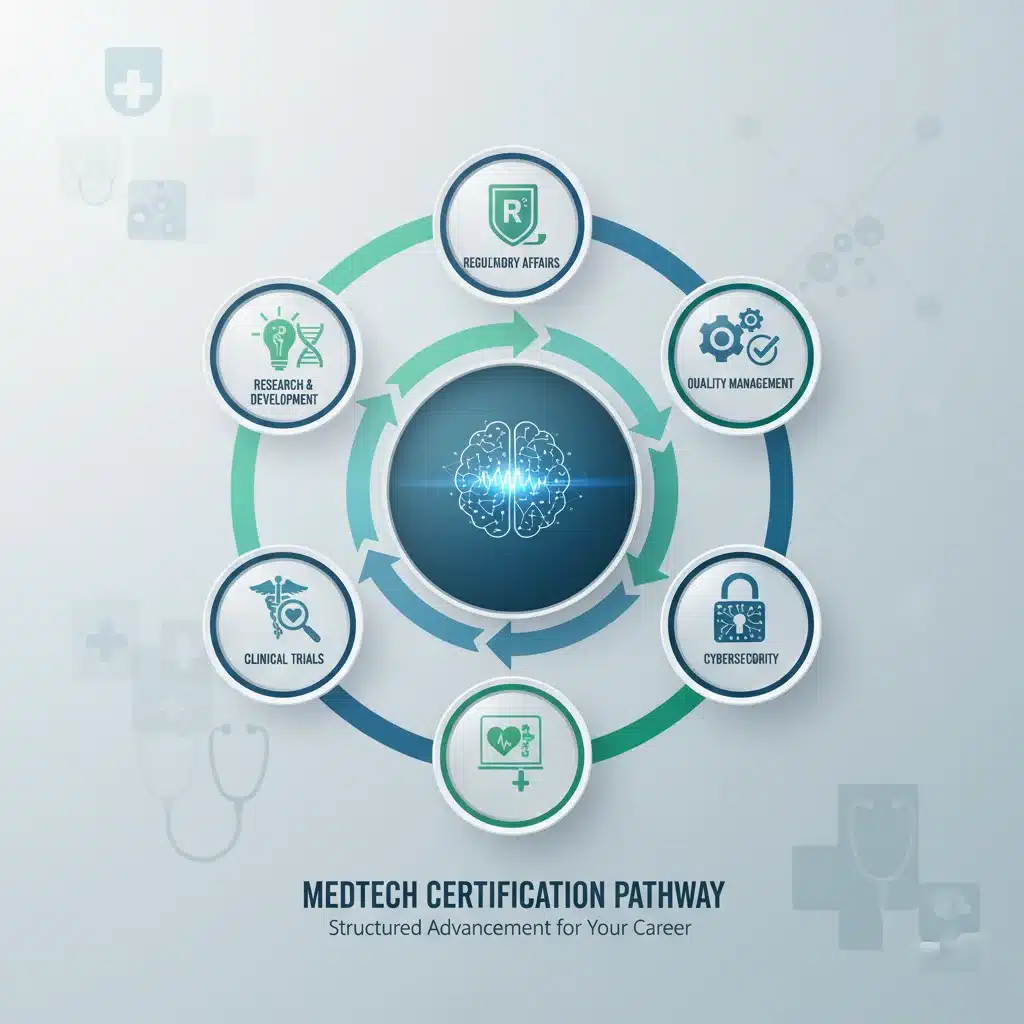
The MedTech industry is not just about innovation; it’s about responsible innovation. This responsibility is underscored by the complex interplay of regulatory demands, quality imperatives, ethical considerations in clinical research, and the absolute necessity of cybersecurity. The MedTech certifications highlighted in this article—RAC, CQA/CQE, CCRP, CISSP, and CMDA—collectively address these critical pillars, making them indispensable for career advancement in 2026.
For professionals, these certifications are more than just credentials; they are investments in their future, demonstrating a commitment to excellence and a proactive approach to professional development. For employers, certified professionals represent a lower risk profile, higher competence, and a greater ability to navigate the intricate MedTech landscape successfully. They signify a workforce that is not only skilled but also formally validated against industry-recognized benchmarks.
In a competitive job market, certifications act as a powerful differentiator. They signal to potential employers that you possess specialized knowledge and have undergone rigorous testing to prove your capabilities. This can lead to increased earning potential, faster career progression, and access to more challenging and rewarding roles. As the industry continues to grow and evolve, the value of these specialized MedTech certifications will only appreciate.
Choosing the Right MedTech Certifications for You
Deciding which MedTech certifications to pursue depends largely on your current role, career aspirations, and the specific niche within MedTech you wish to specialize in. Consider the following:
- Your current role: Are you in regulatory affairs, quality, clinical research, or IT security? Your current responsibilities often point to the most relevant certifications.
- Your career goals: Do you aspire to leadership in a specific domain, or are you looking to broaden your expertise?
- Industry demand: Research job postings and industry trends to see which certifications are most frequently requested by employers in your target area.
- Prerequisites and commitment: Evaluate the eligibility criteria, study time, and financial investment required for each certification.
Many professionals choose to pursue a combination of certifications to build a robust skill set. For example, a quality engineer might pursue both a CQE and a CMDA, or a regulatory professional might combine RAC with a PMP to manage complex submission projects more effectively. The key is to create a personalized professional development plan that aligns with your long-term vision.
Conclusion: Securing Your Future with Top MedTech Certifications in 2026
The MedTech industry is a beacon of innovation, offering immense opportunities for professionals who are equipped with the right skills and knowledge. As we approach 2026, the landscape will demand even greater specialization, regulatory acumen, and a steadfast commitment to quality and security. The top 5 MedTech certifications—RAC, CQA/CQE, CCRP, CISSP, and CMDA—are not just badges; they are powerful tools that will unlock new career pathways, enhance your professional credibility, and position you as a leader in this critical sector.
By investing in these MedTech certifications, you are not only advancing your individual career but also contributing to the overarching mission of the MedTech industry: to improve patient lives through safe, effective, and innovative medical technologies. Take the initiative, plan your educational journey, and secure your place at the forefront of medical technology in 2026 and beyond. Your future in MedTech is bright, and these certifications are your guideposts to success.